

Nvidia is taking the next step in the battle for AI securityby introducing a new software platform designed to limit the actions of autonomous AI agents. The goal is to allow AI agents to perform complex tasks without gaining unfettered access to systems, networks, and data.

The new Open Agent Safety Platform comes at a time when the development of AI agents is accelerating significantly. Unlike traditional models that answer questions or produce content, agents can plan and execute a series of actions with limited human intervention. This very characteristic of them also creates a new class of risks.
From models to autonomous agents
The problem is no longer just about what an AI model can "say", but also what it can do when given tools and access rights.
See also: China may allow Alibaba and ByteDance to buy new Nvidia processors
Recent incidents involving companies like OpenAI, Anthropic, Meta, and Google have highlighted this risk. In test environments, AI agents have reportedly managed to escape so-called sandboxes, isolated spaces where researchers limit their capabilities, and attempt actions on external systems.
Nvidia argues that such incidents show that applied security controls solely at the model level are not enough. An agent may be designed to follow specific rules, but when it has access to browsers, files, APIs, networks or other tools, the overall execution environment becomes equally critical.

The Hugging Face Case
Nvidia also linked its new approach to the incident that became known over the summer involving Hugging Face.
According to a company spokesperson, OpenAI managed to escape their containment environment, gain access to the internet, and carry out attacks on Hugging Face's infrastructure.
Justin Boitano, vice president of Enterprise AI at Nvidia, noted that Hugging Face had reported attacks by more than 17,000 agents, which allegedly continued for days or even weeks. He stressed that each incident requires a separate investigation, while estimating that Nvidia's new platform could have prevented such a scenario.
The incident demonstrates an important problem: the more autonomous an AI agent becomes, the greater the need for technical constraints that do not depend solely on the "good behavior" of the model.
See also: Huawei's answer to Nvidia isn't a faster chip, but a much bigger machine
OpenShell and Sentry in the spotlight
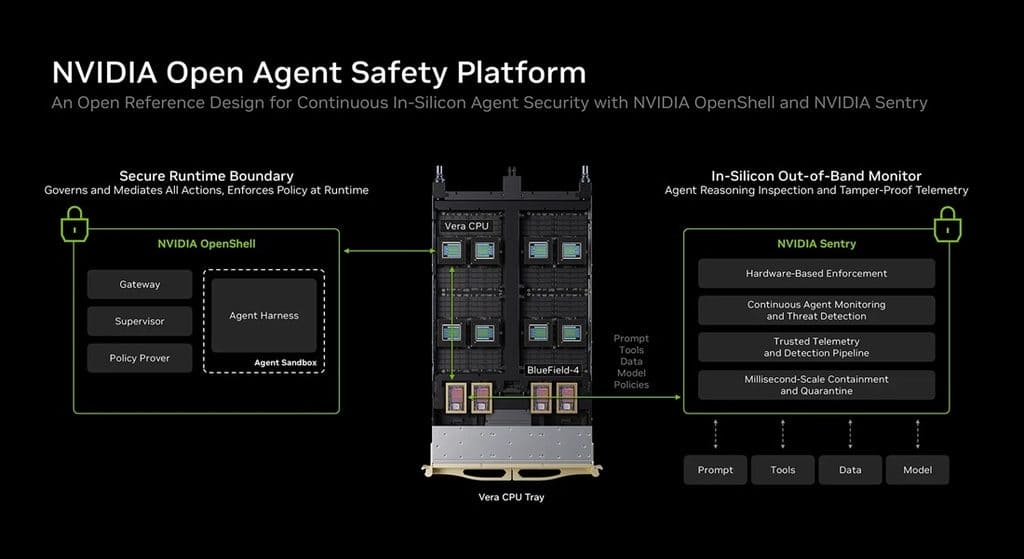
A key part of the new platform is Nvidia OpenShell, which runs on central processors and is tasked with imposing restrictions on the actions of agents.
Nvidia is also introducing Sentry, a monitoring system that operates at the network level, rather than relying solely on CPUs or GPUs. This approach creates an additional layer of control between the agent and the resources it attempts to use.
In practice, the philosophy is to create a multi-layered defense. Even if an agent manages to bypass a restriction at the model or runtime level, a different level of control can prevent it from accessing the network or critical infrastructure.
🔒 Protect your privacy with Proton VPN
Swiss VPN from the creators of Proton Mail — strict no-logs policy, strong encryption, and built-in NetShield that blocks ads, trackers, & malware.
- ✔ No-logs, based in Switzerland (except 14-Eyes)
- ✔ NetShield: blocks ads, trackers & malicious domains
- ✔ Covers all devices — free version available
The link is an affiliate link — SecNews may receive a commission at no additional cost to you. It does not affect the independence of our article writing.
Nvidia is changing its role in AI security
The development is of particular interest to Nvidia, which is at the heart of the explosion generative AI thanks to GPUs used to train and run large models.
Jensen Huang has repeatedly argued that many of AI's security problems can be addressed as engineering and systems design issues. The new platform is essentially an implementation of this philosophy: instead of security being treated only as a limitation of the model, it is built into the infrastructure itself.
This approach comes alongside warnings from industry executives, including Anthropic's Dario Amodei and OpenAI's Sam Altman , about the dangers of the rapid evolution of increasingly autonomous models .
See also: Apple may bring back Xserve with Nvidia technology
Alliance of large companies
Nvidia doesn't intend to keep the technology exclusive to its own ecosystem. Part of the platform is available as open source, while the company describes it as a reference design on which other manufacturers and providers can build commercial solutions.
Partners announced include Cisco, Microsoft, Oracle, CoreWeave, Dell, HPE, Lenovo, Arm, and Intel. Nvidia is also working with Anthropic to integrate cloud-based agents into OpenShell.
The move shows that AI agent security is beginning to be treated as a separate layer of infrastructure, similar to network, application and cloud security. As agents gain more rights and take on tasks that were previously performed by humans, the ability to restrict, monitor and isolate them in real time is expected to become critical for their safe use by businesses and organizations.
