

Apple is looking at new suppliers for OLED-on-Silicon panels, likely indicating the development of a more affordable headset to accompany the Vision Pro, according to The Elec.
The Korean website has uncovered an apparent change in Apple's supply chain management for OLED-on-Silicon (OLEDoS) panels, a key component in the Vision Pro headset.
Read also: Is Meta's VR headset vulnerable to ransomware attacks? – Research
Sony currently supplies these high-resolution micro-displays, however, its limited production capacity of up to 900,000 panels per year and lack of plans for expansion have led Apple to look for alternatives for the future. Apple has reportedly requested information (RFI) from Samsung Display and LG Display to evaluate their capabilities in producing larger OLEDOS panels, ranging in size from 2.0 to 2.1 inches and a display density of around 1,700 pixels per inch (PPI).
These displays will be larger than those currently used in the Vision Pro and will feature a lower resolution. The Vision Pro uses Sony's OLEDoS panels, which feature a 1.42-inch display with a pixel density of nearly 3,400 PPI, using OLED with color filter technology (wOLED+CF). This advanced display technology is one of the main reasons for the headset's high price.
See more: Apple Vision Pro launches in China, Hong Kong, Japan and Singapore
At Displayweek 2024, both Samsung and LG showed off developments in OLED microdisplay technology that could catch Apple’s eye. Samsung unveiled a 1.03-inch RGB (direct-emission) OLED microdisplay, developed in collaboration with eMagin, that promises higher brightness compared to the wOLED+CF method. At the same time, LG showed off a 1.3-inch 4K OLED microdisplay with 10,000 nits of brightness, using a micro lens array (MLA) to increase brightness by about 40 percent.
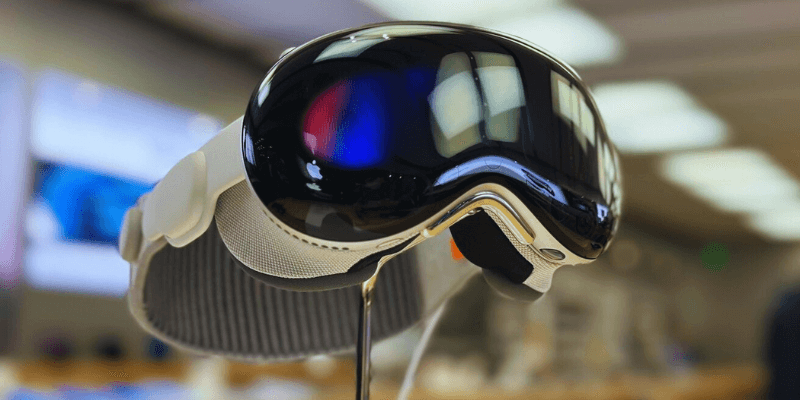
Apple's interest in larger OLEDoS panels with a lower resolution than those in the Vision Pro suggests they may be intended for a new, more affordable device . Rumors have suggested that Apple has been working on such a device for more than a year, and the latest evidence suggests that it may be designed to connect to an iPhone or Mac, eliminating the need for an expensive processor.
See also: Lufthansa: Tests Meta Quest 3 headset on Business Class passengers
The low-cost Apple Vision headset is likely to be released by the end of next year.
Source: macrumors
