

The James Webb, the most powerful telescope in the world, has brought us perhaps most iconic photo to date, a photo depicting the “Pillars of Creation.”
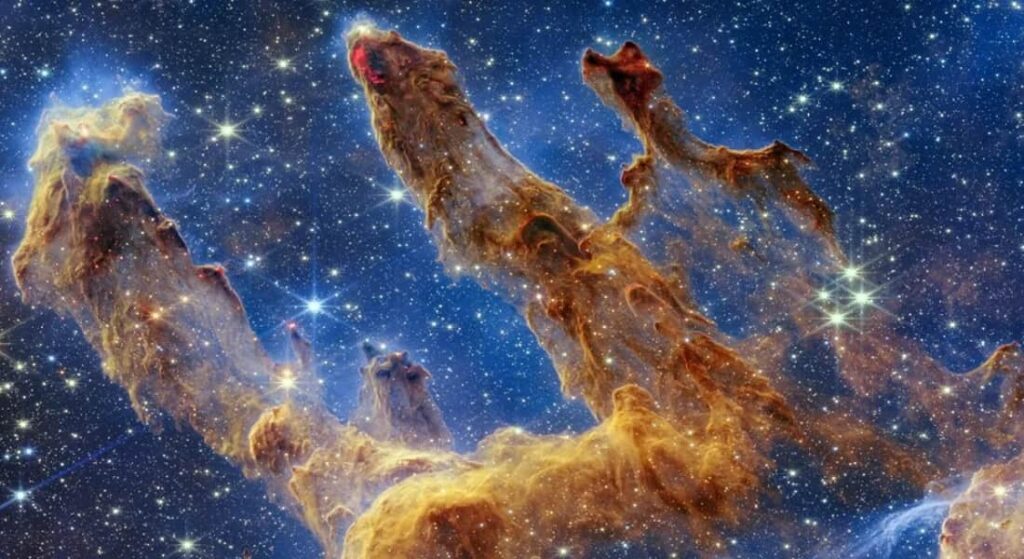
Previous images of this spectacular part of the universe were taken by the Hubble, first in 1995 and then in 2014.
See also: Black hole "vomits" stars years after swallowing them
The Pillars of Creation are dense clouds of cool interstellar gas and dust. New stars are forming. The three pillars spread out like the big fingers of a cosmic hand. The recent image, taken by Webb's NIRCam, highlights the bright red locations where new stars.
See also: NASA: Will explore Venus with a balloon
According to the James Webb Telescope science team, the small red dots at the edges of the pillars are stars, a few hundred thousand years old. The red, lava-like streaks in the clouds are caused by stars forming. These nascent balls of gas emit jets of material that strike the gas in the pillars, causing the energetic hydrogen molecules in the system to glow.
The Pillars of Creation are located in the Eagle Nebula, a cloud of dust and gas about 6,500 light-years from Earth. Although the nebula was discovered in 1745, the pillars became world famous when they were imaged by Hubble in 1995. Hubble then imaged the site in visible light in 2014. The Hubble images were considered impressive, but if we look at the Hubble and Webb images side by side (Hubble on the left, Webb on the right), we can understand the enormous potential of the new telescope.
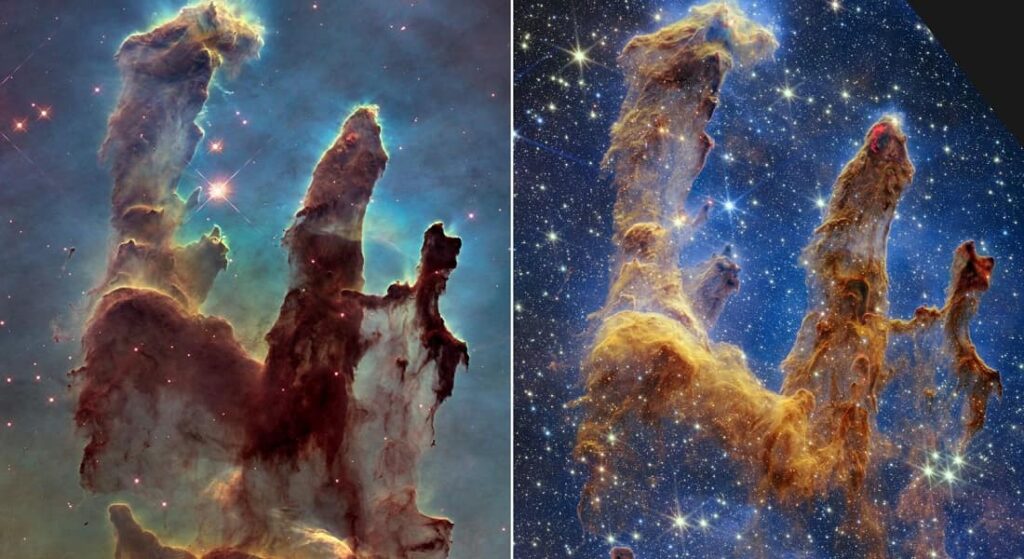
Webb's image is much clearer and shows much more detail. The Webb telescope's "infrared eye" also penetrates through dense clouds of dust and gas , allowing it to see regions of star formation that were previously unknown.
See also: NASA's new success: Finally, the DART probe changed the asteroid's orbit
In the coming months, James Webb will take more pictures of the Pillars of Creation and other parts of the universe to help researchers learn more about how stars are born, how galaxies , and more.
Source: gizmodo.com
