

A piece of space debris – too small to detect – has hit and damaged part of the International Space Station (ISS), specifically the Canadarm2. The instrument is still operational, but the space debris punctured the thermal blanket and damaged the underside of the arm. The incident is a sobering reminder that the problem of space debris in low Earth orbit is a ticking time bomb.
Space agencies around the world are aware of the problem of space debris. More than 23,000 pieces are detected and tracked in low Earth so that satellites and the ISS can avoid collisions – but they are all the size of a softball or larger. Anything smaller is difficult to detect.
Read also: NASA: SpaceX Crew-2 mission to the ISS launched!
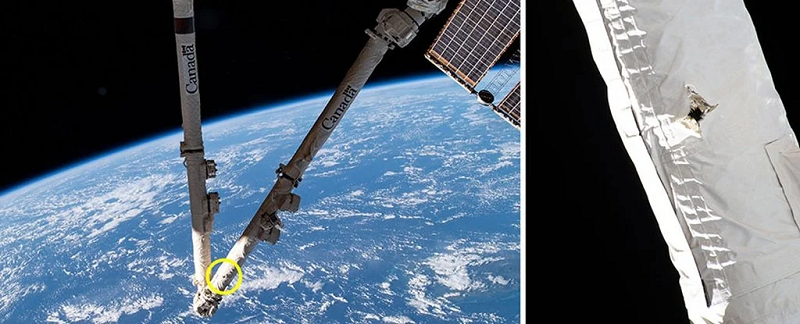
Canadarm2 the Space Station Remote Maneuvering System (SSRMS) – was designed by the Canadian Space Agency (CSA). It is a robotic system that has been on the space station for 20 years. It is a multi-jointed titanium robotic arm that can help with maneuvering objects and maintaining the station.
It is unclear when the impact occurred. The damage was first observed on May 12, during a routine inspection. NASA and the CSA worked together to obtain detailed images and assess the damage.
The CSA said in a blog post: “Despite the impact, the results of the current analysis indicate that the performance of the arm remains unaffected. The damage is limited to a small portion of the arm and thermal blanket. Canadarm2 continues to perform its planned functions.”
See also: NASA Curiosity: New impressive images show clouds on Mars
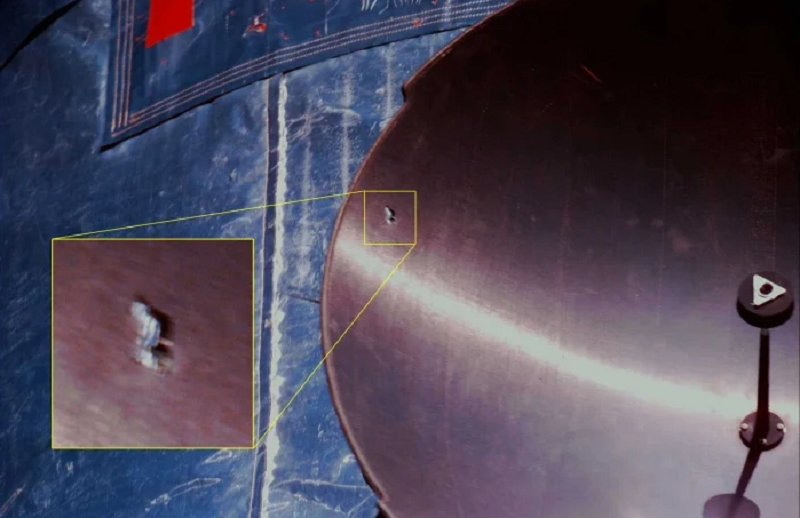
While the ISS appears to have gotten lucky this time, the space debris problem appears to be growing. Last year, the ISS had to perform emergency maneuvers three times to avoid collisions with space debris at an altitude of about 400 kilometers (250 miles).
Since the launch of Sputnik 1 in 1957, space debris has been accumulating. According to a report by the European Space Agency (ESA), about 130 million pieces of man-made material smaller than one millimeter are currently orbiting Earth. This estimate does not include space dust.
Proposal: NASA detects mysterious radio signals from deep space
Last year, Tim Florer, Head of ESA's Space Debris Office, said: "To continue to benefit from the science, technology and data collected in space, it is vital to achieve better compliance with existing space debris mitigation guidelines in spacecraft design and operations. This is essential for the sustainable use of space."
Robotic operations on the ISS using Canadarm2 will continue as planned for the foreseeable future, the CSA said. However, both space agencies will continue to collect data in order to conduct an analysis of the incident, both to understand how it happened and to assess potential future risk.
Information source: sciencealert.com
