

Tesla is preparing a major expansion of its charging infrastructure in Europe, aiming to support the arrival of its truck Semi in the European market. The company plans to install more than 100 megawatt charging stations in 21 locations, initially covering markets such as Germany, France, the United Kingdom, Sweden and the Benelux countries.
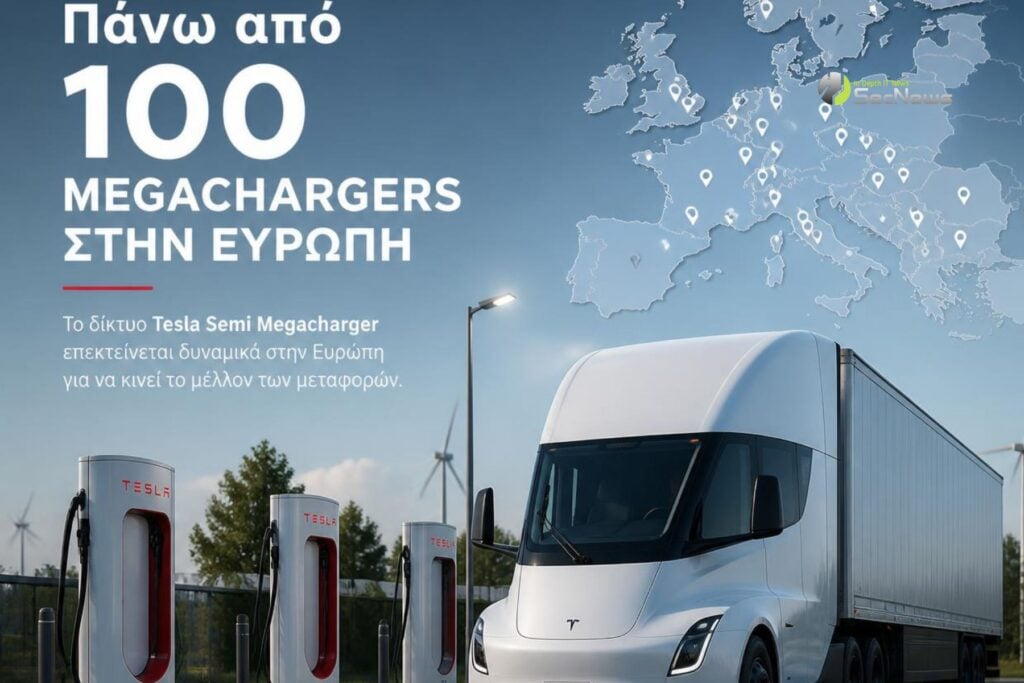
The announcement was made by Dan Priestley, head of Tesla Semi development, at the IAA Transportation show in Hanover, where electrification of heavy-duty vehicles was one of the main topics of discussion. The Semi is scheduled to arrive in Europe in 2027, but Tesla has not yet given a specific timeline for the completion of the new stations.
Charging up to 1.2 MW for electric trucks
Tesla 's new stations will use equipment rated at up to 1.2 MW , while the European Semi will be able to absorb a maximum power of 800 kW. These are power levels clearly aimed at the needs of heavy electric vehicles, where the time spent at a charging station is a critical factor for transport efficiency .
See also: California: Tesla opens first Megacharger station for Semi customers
For an electric truck that travels long distances, the ability to quickly recharge can directly impact a fleet’s daily schedule. The less time a truck takes to charge, the longer it can remain in operation, while reducing delays associated with stops.
The most important thing: The chargers won't be exclusive to Tesla
However, the most interesting aspect of the announcement isn't just about the number of new stations. Dan Priestley mentioned that Tesla's network will also be available to electric trucks from other manufacturers.
This choice is particularly important for the European market, as the transition of heavy transport to electric mobility cannot be based on a single brand. If high-power stations operate as an open infrastructure, they can serve different fleets and contribute to the creation of a more unified charging ecosystem.
The common MCS standard changes the data
The Tesla Semi and the new chargers use the MCS 3.2, a seven-pin megawatt standard designed specifically for very high-power charging in heavy-duty electric vehicles.
Using a common standard instead of a Tesla-exclusive connector means the Semi will be able to tap into megawatt infrastructure from other providers. Tesla is also expected to offer CCS adapters, further expanding charging options.
The company has already begun creating the relevant infrastructure, with a prefabricated eight-place Supercharger in Bavaria installed in September.
See also: Geely TT launches at $19,100 — half the price of a Tesla

Milence invests even more
Tesla, however, is not alone in this area. Milence, a joint venture of Daimler Truck, Traton and Volvo,
The company inaugurated the first European megawatt charger at the port of Antwerp-Bruges in February 2025. It has since expanded its activity and operates 13 charging stations in six countries, while inviting other manufacturers to use its facilities for testing.
Milence's plan is particularly extensive. Through the MILES, for which it has secured €111.5 million in funding from the European Union, it is planned to deploy 284 megawatt charging points and 264 CCS points in 71 locations and 10 member states by the end of 2027.
Europe is building a network, but the electricity grid is the big obstacle
The development of this infrastructure is not a direct obligation imposed on manufacturers. European legislation provides for specific requirements for heavy vehicle charging infrastructure, with points every 60 km on the core road network and every 100 km on the extended network, as well as a minimum power of 350 kW and full coverage by 2030.
Megawatt chargers are therefore a business and technological initiative that goes beyond the minimum requirements.
The biggest problem, however, lies elsewhere: the ability of the electrical grid to support such high consumption. A charging station for electric trucks requires much more power than a conventional electric car station, especially when it has to charge multiple vehicles simultaneously.
See also: Slovenia becomes sixth EU country to approve Tesla's FSD
For example, a Megacharger system costs around €163,000, while a 120 kW Basecharger costs €17,000 and is available in pairs. The cost of the equipment is only part of the total investment, as connecting a large installation to the grid can take a significant amount of time.

2027 will be a critical year
The arrival of the Tesla Semi in Europe in 2027 will be a crucial test not only for the truck itself, but also for the continent's readiness to support large-scale electric freight transport.
The creation of megawatt stations by Tesla and Milence shows that the market is moving towards a model where charging should be fast, at strategic points and with as much interoperability as possible. The question now is not only how fast electric trucks can charge, but whether Europe's energy infrastructure can keep up with the pace at which the demands of electromobility are increasing.
