

Astronomers believe they may have seen one of the rarest images in space: the collision of two planets around a distant star.
See also: Rare 'planetary parade' returns to the sky this week
The collision appears to have occurred about 11,000 light-years from Earth, around a Sun-like star called Gaia20ehk, near the constellation Puppis. The researchers say the collision may be reminiscent of the giant impact thought to have created the Earth and Moon billions of years ago, offering scientists a rare opportunity to understand how celestial bodies form. The results of the study were published March 11 in The Astrophysical Journal Letters.
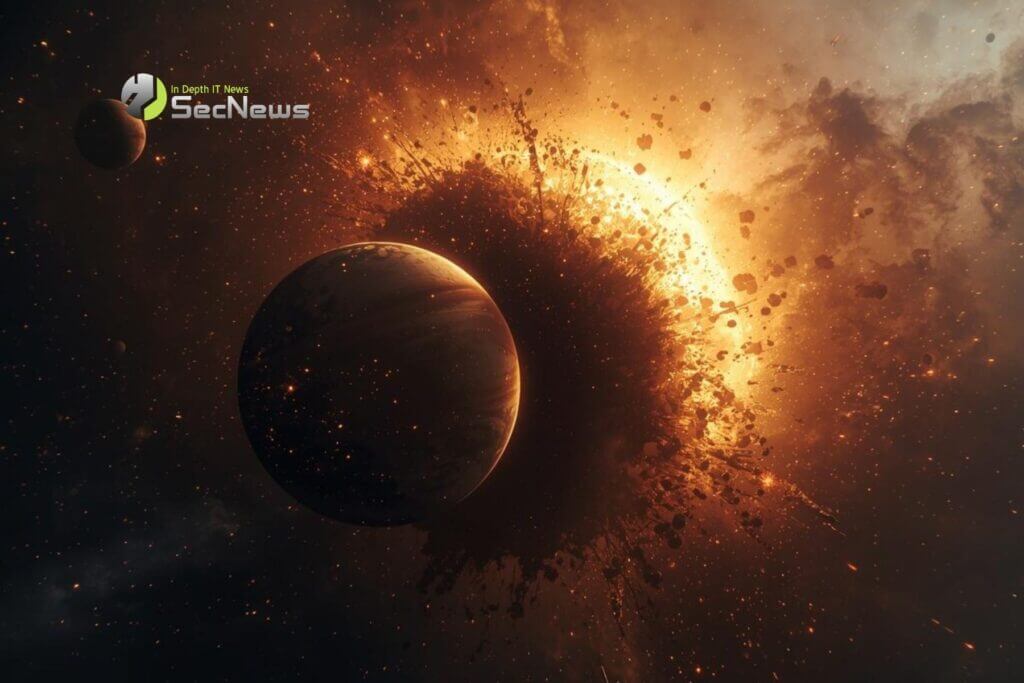
Planetary collisions are thought to occur frequently in young star systems, but they are difficult to observe. To be detected, planets must have orbits that bring them directly in front of their star, so that the collision debris blocks some of the star's light — something telescopes can detect and measure in both the visible and infrared spectrums.
See also: In this planetary system everything is upside down!
Researcher Anastasios Tzanidakis found the first clue by examining data from telescopes, including observations from NASA's SPHEREx mission. In 2016, Gaia20ehk appeared to be an ordinary, stable star. But about five years later, its brightness suddenly decreased by a factor of three, and then things quickly became chaotic.

This finding led the research team to conclude that a collision between two planets—although rarely observed—is the most likely scenario, as two planetary bodies could eject hot dust and rocks into an orbit that agrees with the observational data.
The researchers also believe that the planets may not have collided in a single moment. The three initial decreases in Gaia20ehk's brightness may correspond to successive, surface-level collisions as the two bodies spiraled closer and closer to each other.
See also: The exoplanet Theia likely created the Moon
The team hopes that the powerful Simonyi Survey Telescope at the Vera C. Rubin Observatory will be able to help detect other planetary collisions in the future, which are usually very difficult to observe.
