

Harvard scientists have created metallic hydrogen for the first time on Earth, a new material on our planet whose existence was predicted 80 years ago.
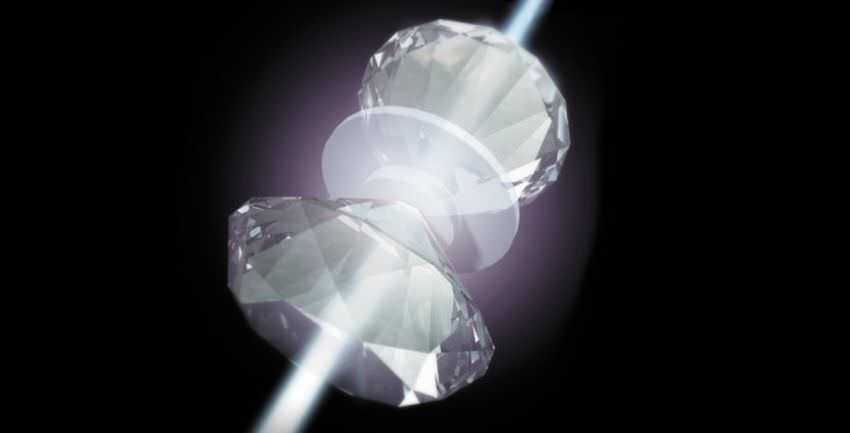
The Harvard research team has managed, as they claim, to compress hydrogen molecules with the help of synthetic diamonds, exerting enormous pressures of the order of 495 GPa (gigapascals), much greater than those exerted at the center of our planet and at a temperature just above absolute zero, -270 °C, or 5.5 Kelvin or -450 degrees Fahrenheit.
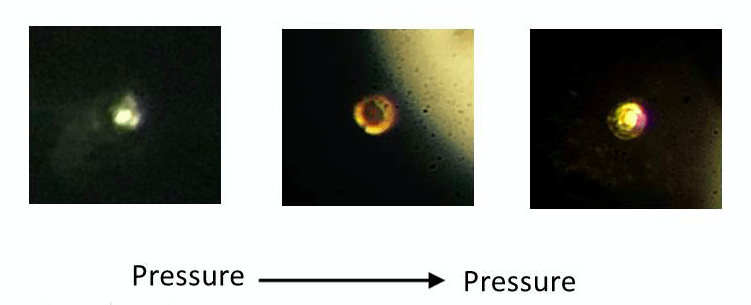
As the scientists increased the pressure, they began to observe the transparent hydrogen turning black. Finally, at a pressure of 5 million times our own air pressure, the hydrogen became reflective. The researchers presented this phenomenon as evidence that the hydrogen atoms had acquired a regular 3D structure, like a metallic object, a physical state first predicted by physicists Hillard Huntington and Eugene Wigner in 1935.
The discovery and observation of a metallic form of hydrogen will be significant not only because it will solve a long-standing scientific mystery, but also because of the material’s potential. The new material has almost zero electrical resistance, making it the best conductor of electricity on our planet. The scientists say in their paper, published online in the journal Science yesterday, that metallic hydrogen will be “an important material for solving energy problems and could potentially revolutionize rocket technology as a powerful propellant.”
In addition, such a material is metastable, meaning it will remain metallic as the pressure that forced it to change form from a gas to a solid drops to normal levels. However, changing it from a solid back to a gas through some other external influence would release enormous amounts of energy, thus revolutionizing rocket technology.
Metallic hydrogen in liquid form is thought to be a key component of the giant planets Jupiter and Saturn, a theory that the Juno spacecraft hopes to detect, according to NASA.
This is not the first time that scientists have claimed to have discovered metallic hydrogen. German scientists had also made a similar statement in 2012, which turned out to be untrue. This is why several physicists in various countries (USA, Britain, France), according to “Nature”, have stated that they are not at all convinced that metallic hydrogen has actually been created and are reserving their opinion until more experiments are carried out.
