

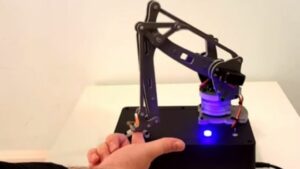
A robot that can decide whether or not to inflict pain has been built by artist and robot builder Alexander Reben from the University of California, Berkeley.
The basic machine is capable of pinching a finger, but it is programmed not to do so every time it can. Mr. Reben nicknamed it “The First Law,” after a set of rules devised by science fiction author Isaac Asimov.
He said he hopes it will spark further discussion about robotic Artificial Intelligence. “The real concern about AI is that it’s getting out of control,” he said.
“Tech giants say it’s a matter of time, but let’s think about it now, before it’s too late. We’re proving that harmful robots can exist now. We absolutely need to address it.”
Mr Reben's work suggests that perhaps an AI "kill switch", such as that developed by scientists at Google's artificial intelligence division, DeepMind, and the University of Oxford, may be useful sooner rather than later.
In an academic paper, researchers describe how in the future intelligent machines could be coded to prevent learning from bypassing human input.
“It will be interesting to hear what the kill switch is proposing,” Mr. Reben said. “Why wouldn’t a robot be able to override its kill switch, if it had become that smart?”
In a set of three laws of robotics written by Isaac Asimov, originally included in a short story published in 1942, the first law is that a robot must not harm a human being.
Mr Reben told the BBC that the “First Law”, which in its worst form can draw blood, was a “philosophical experiment”. “The robot makes a decision that I as its creator cannot predict,” he said. “I don’t know who it will harm or not.”
"What's interesting is that it causes pain for no reason - so we move into an ethical question about robots that are specifically built to do things that are morally questionable."
The simple machine costs about $200 (£141) and took a few days to build, Mr Reben said. He has no plans to advertise or sell it.
Mr Reben has created a series of robots based on the theme of the relationship between technology and humans, including one that offers head massages. In doing so, he wants to show that a machine built for another purpose can ultimately cause harm.
