

The House of Letters and Arts of the Onassis Foundation hosts an innovative exhibition, especially for Greece's data, that captures the evolution of digital technology. Digital Revolution shows the impact of digital technology on the development of the arts, design, music, fashion, cinema, and video games, as well as how modern creators use it.
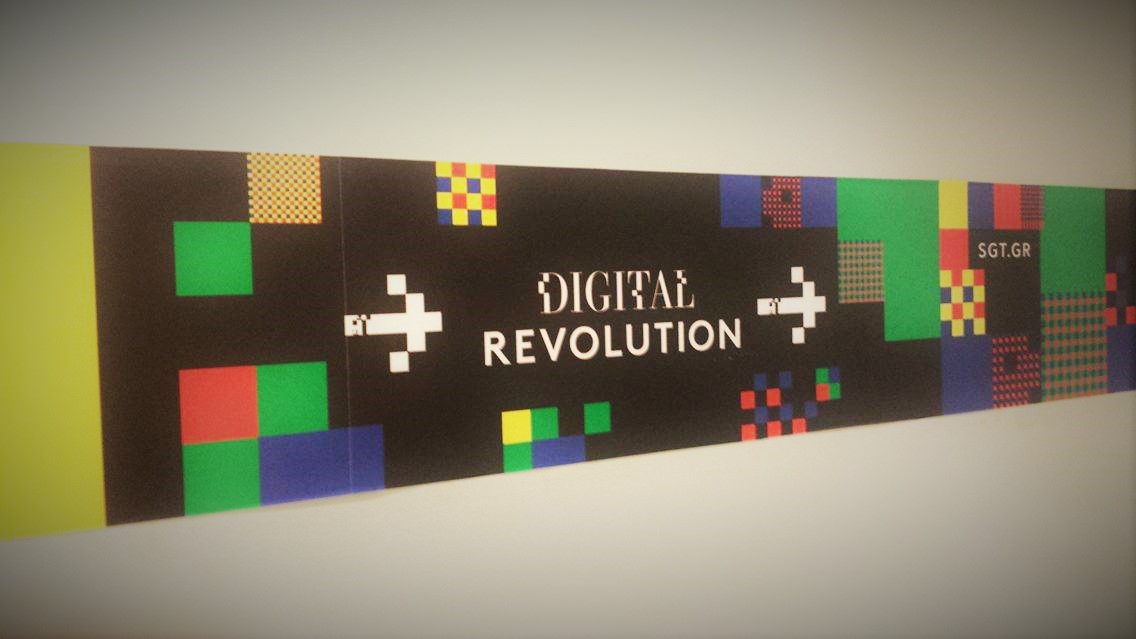
26 years after the invention of the World Wide Web by Sir Tim Berners-Lee, the Digital Revolution exhibition will show you every step of evolution and will blow your mind whether you belong to the generation that grew up with the first consoles or to the generation that has grown up with smartphones and tablets.
The larger part of the exhibition is hosted in the exhibition space -1 of the Shelter, as well as on other floors and in 2 areas surrounding the main building.

Once you descend into the main exhibition space, the first exhibit you will see on your right is the installation Pyramidi(2014), will.i.am & Yuri Suzuki. For this work, which is the first he created for an exhibition space, will.i.am also composed a new song, which is performed by three robotic instruments and accompanied by a stage with an augmented reality video projection! Very simply, both the image and the music will captivate you! Watch the video:
[su_youtube url=”https://www.youtube.com/watch?v=YFPvFnDZF-8″ width=”580″ height=”380″]

Next you will see a large part of the exhibition which is Digital Archaeology. Perhaps two words opposite to each other but now in our time we can really talk about Digital Archaeology. Here you can enjoy the moments and devices that were a milestone for the evolution of technology. This section is divided chronologically and records the period from 1970 to 2010 by decade.

Steve Wozniak, who had previously built the Apple I, created a color computer so he could play Breakout there, the arcade game he and Steve Jobs had developed as a sequel to Pong. The result was the Apple II, the first successful home computer. The future trajectory of video games and computers had now converged.

The computer models Apple II, Tandy's TRS-80, and Commodore PET sold millions of copies and are today known as the Holy Trinity of 1977. They are the machines that sparked the home computer revolution. Designed by Chuck Peddle, the PET (Personal Electronic Transactor) was Commodore's first computer. Its all-in-one design received a satisfactory reception, but ultimately the high-resolution color graphics of the Apple II made it a more popular choice. Commodore responded with an offer for U.S. schools, giving a free one with each computer purchase, even renaming the machines to Teacher’s PET.

The Fairlight CMI that was developed in 1979 by the Australian sound engineers Peter Vogel and Kim Ryrie was the first synthesizer with sound sampling (samples).


The Quantel Paintbox, which was released in 1981, brought a revolution to television graphics and was the predecessor of the combination of tools of the Wacom tablet and Adobe Photoshop, which modern graphic designers and illustrators love so much.
Naturally, from Digital Revolution our beloved gaming consoles and favorite video games could not be missing. Pacman, Tetris, Super Mario Bros, all there!


The second part of the Digital Revolution exhibition is called We Create, where we see how the content consumer himself becomes a content producer through the use of various digital tools, most of which are available for free.
The third section is called Creatives Spaces and shows how conventional notions of time, space and storytelling can be reshaped using digital tools. The section begins with a look at the world of visual effects (VFX) in Hollywood cinema. Artists and developers also use technology on the Internet to experiment with the creation and evolution of storytelling.


The Clouds is an interactive documentary that uses a storytelling engine driven by digital data, placed in a virtual real-time environment, to create a constantly evolving discussion. Including excerpts from interviews with more than forty different artists, programmers and hackers, this project examines the phenomena of programming and its community
The fourth section of Digital Revolution is entitled Sound & Vision, which examines the visualization of music, through the eyes of musicians, visual artists, filmmakers and set designers.


The fifth section is called Our Digital Futures and presents a selection of some of the most experimental and future-focused artists, architects and designers. With a particular emphasis on the body and our environment, the projects cover the areas of cyborgs and wearable technologies, drones and “big” data.
Google could not be missing from such an exhibition! It has its honorary place in the final section of the exhibition, which is Google Devart, which directly challenges the widespread perception of what programming code is and what art is. It is a celebration of the art created with code, by artists who push creative possibilities – where technology serves as their canvas and code is their raw material.


There, next to it you will also find a unique artwork that captures the attention of all viewers, titled “Wishing Wall”, a digital wishing well by creators Mar Canet & Varvara Guljajeva. You can approach one of the three, specially designed for this artwork, and whisper your wish in English. After you whisper it, the application will turn it into a beautiful hand written animation displayed on the wall, which gradually will transform into a cocoon and finally into a butterfly. And not only that, you can extend your hand in front of the butterfly and see it fly away from the wall and land on your hand! In this way your wish can become reality!
[su_youtube url=”https://www.youtube.com/watch?v=e3tayqPE4Z8″ width=”580″ height=”380″]
The Digital Revolution does not stop at its exhibition space -1. On the ground floor of the Art of Letters and Arts you can see the installation Petting Zoo (2013), Minimaforms, a robot that listens to your movements! On the third floor you will see the installation Together (2014), Universal Everything where you can make your own sketch on a touch screen that can follow the exhibition in its new home! The fourth floor hosts the Indie Games/ Independent Video Games section where you can become a child again! The independent video game creators are funded by their own audience in exchange for active participation in shaping the final product!
The Digital Revolution expands even outside the Roof building! Behind the main building you will find the Assemblance(2014) installation, Umbrellium where you can dance with lasers! The Assemblance is an environment full of three-dimensional interactive lighting constructions, which you create, manipulate and modify! With gestures and gentle movements that leave trails of light behind and around them, you become the protagonist in a performance, collaborating with others to build complex shapes – or even destroy them, if you are not particularly careful.
In the end we left the most popular exhibit of Digital Revolution, The Treachery of Sanctuary (2012) by Chris Milk, which reaches 6 meters and had to be hosted at Odeon Star City next to the Roof. The interactive installation shows the journey from birth to death through a play of shadows.
[su_youtube url=”https://www.youtube.com/watch?v=qgoh9zZSLEg” width=”580″ height=”380″]
The pioneering Digital Revolution exhibition of the Barbican Centre in London is hosted at the Arts and Letters Pavilion of the Onassis Foundation until Sunday 10 January, so we think you have found what you will do this weekend!
