

In today's stop Morris Worm #5 fromthe long journey of the deadliest viruses in history we will encounter worms...
But not like this...!!

…But computer worms, the so-called computer worm. So what is a computer worm?
A computer worm is a self-replicating and malicious computer program that uses a computer network to send copies of itself to other nodes (computers on the network) and can do so without user intervention. This is due to security vulnerabilities in the target computer.
Computer worms are often confused with computer viruses, because they have many similarities in their function. However, there are some important differences in how they are transmitted and the area of the system they infect, which makes them stand out.
A worm is one thing, a virus is another. What are the differences?
Unlike a computer virus, a worm does not need to attach itself to an existing program. Worms almost always cause at least some damage to the network, even if it means consuming bandwidth, while viruses almost always corrupt or modify files on a target computer, leaving the network unharmed.
Since the beginning of the first worm research at Xerox PARC, there have been attempts to create useful worms. The Nachi family of worms, for example, attempted to download and install patches from the Microsoft website to fix system vulnerabilities. In practice, although this made systems more secure, it created a significant problem in network traffic, causing the system to reboot during patching, without the consent of the computer owner or user.
Some worms, such as XSS worms, have been created to investigate their propagation factors, such as social activity and changes in user behavior.
Another study proposed the first computer worm that operates at the second layer of the OSI model (Data Layer link), exploiting topology information, such as Content-addressable memory (CAM), tables, and information stored on switches to propagate and probe vulnerable nodes until the entire enterprise network is covered.
The term “worm” was first used in John Brunner’s 1975 novel “The Shockwave Rider.” In this novel, Nichlas Halfinger designed and unleashed a data-gathering worm in an act of revenge against some powerful people who operated a national electronic information network that encouraged mass compliance.
The first worm in history..
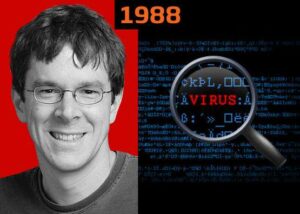
On November 2, 1988, Robert Tappan Morris, a graduate student in computer science at Cornell University, unleashed a worm that became known as the “Morris worm,” disrupting perhaps 10% of the computers on the Internet at the time. In 1989, Morris became the first person to be charged under the U.S. Wire Fraud and Abuse Act.
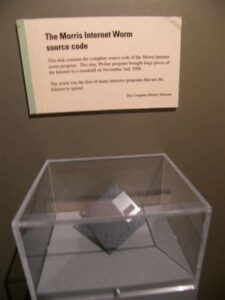
The Morris Worm or "The Internet Worm" was created in November 1988 and was one of the first computer worms to be distributed over the Internet. It was the first virus to gain significant media attention at the time.
The chronicle:
It was 1988, when online devices were very limited and mainly concerned university and research facilities, when a student at the famous Cornell University, Robert Morris, accidentally developed the virus that affected 6,000 computers, almost 10% of the world's Internet-connected machines.
Morris's electronic program was released and spread uncontrollably, forcing the technology industry to take measures to limit the infection and, of course, avoid similar malicious actions.
With the then infamous "Morris Worm" forcing the technology industry to take measures to limit the infection and of course avoid corresponding malicious actions.
The eponymous virus was, according to its "father" Robert Morris Jr., now a famous mathematician and cryptographer, "the work of a bored undergraduate student." The young Morris is now a professor at MIT.
The brilliant student had - according to his claim - no intention of turning the early electronic world upside down: a few errors in the program code turned the software into a self-replicating "death machine", which did not take long to be considered sabotage, since we are talking about the Cold War years.
The list is long… and the continuation is certainly possible!
We have a lot to learn from the journey through the history of the deadliest viruses!
Stay tuned with us on secnews

