

Alpha School and Forge Prep are the most prominent examples of a new trend gaining ground in the US: wealthy families are paying tens of thousands of dollars a year to educate their children through artificial intelligence, instead of sending them to traditional schools. Essentially, the children are acting as beta testers of AI education. This phenomenon, which highlights deeper inequalities in the education system, is causing intense concern among educators, economists and political analysts worldwide.
Shaun Johnson, a venture capitalist based in San Francisco, told the Wall Street Journal that he plans to send his son to Alpha Kindergarten , which costs $75,000 a year. “We recognize that education is probably broken as it is today, and there are going to be entrepreneurs who are going to try to fix it,” he said. Similarly, Ankur Jain, whose son did well in public school in New Jersey, chose Forge Prep because it focuses on practical skills like entrepreneurship, product design, and problem-solving — skills he says he only acquired in his twenties.
See also: Blacon High School: Closed due to ransomware attack
Alpha School and Forge Prep: What do these AI schools offer?
Alpha School and Forge Prep are positioning themselves as pioneers of a “spiritual transformation” of education, not just a technological upgrade. Their programs combine AI tutors with interactive , project-based workshops, while emphasizing life skills like negotiation, sales, and public speaking. Alpha School co-founder MacKenzie Price has said she intends to keep hot-button social issues out of the classroom — a stance that, in the current political climate, could exclude topics like women’s rights, the history of slavery in America, and the country’s immigrant heritage from teaching.
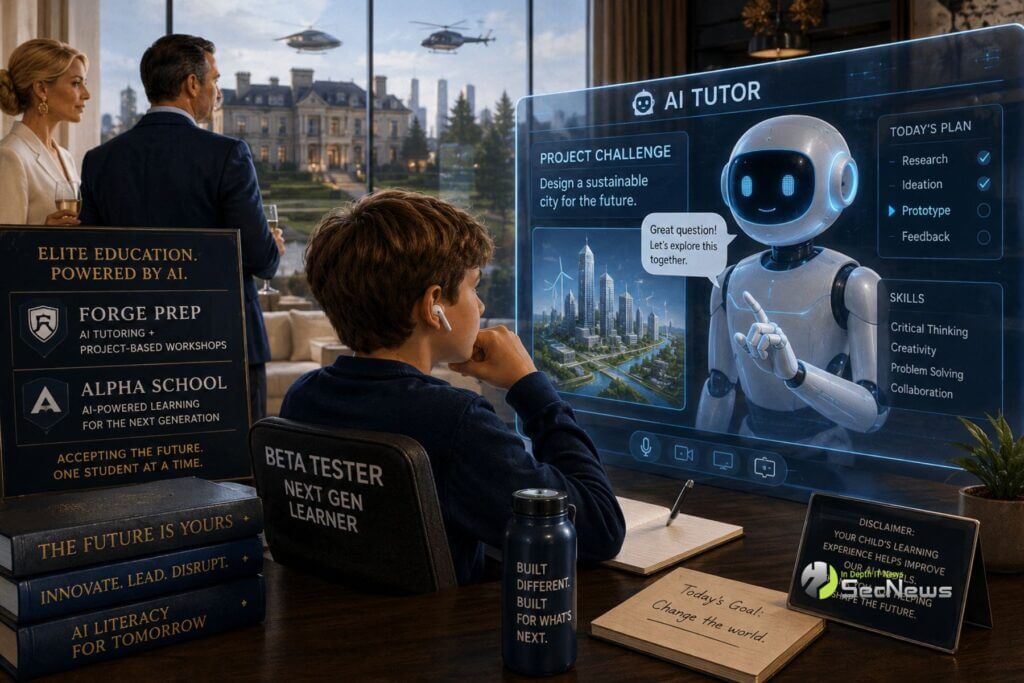
A critical problem is the lack of measurable results. Companies like Forge Prep don’t release performance data, so there’s no evidence that these AI-led private schools are improving educational outcomes. Moreover, experts point out that AI’s ability to reduce cognitive effort is a threat to education — not despite its effectiveness, but precisely because of it, as it can hinder deep learning processes.
Alpha School and inequality: A two-speed educational system
This phenomenon highlights a deeper inequality in education. According to researchers, wealthy families are gaining access to a hybrid model that combines human teachers with AI, while lower-income families rely solely on AI. This stratification risks creating a new type of scissors in society, where access to quality education depends even more on parents' financial ability.
See also: Infinite Campus: Data breach affects 137,000 school staff accounts
Economists and technologists are divided over the long-term implications. Dario Amodei argues that AI could lead to a large universal basic income for all, mitigating the economic hardship from job displacement. Marc Andreessen argues that AI will make expensive things cheap or free. In contrast, Ray Dalio warns that AI will boost productivity but greatly reduce jobs, creating a huge generator of wealth inequality.
On the political level, Senator Elizabeth Warren has pointed out that AI was trained with our ideas, funded by our tax dollars, and powered by the commons, challenging the narrative that technology belongs exclusively to a few. Senator Bernie Sanders has warned that the vast wealth generated by AI should be used to improve the lives of all of us, not further enrich the already wealthy. Meanwhile, the NSF AI Education Act, a bipartisan bill, aims to expand scholarships and professional development so that the next generation is ready for workplaces that will be transformed by AI.
See also: HMND 01 Alpha Bipedal: The robot that learned to walk in 48 hours
The question that remains unanswered is whether schools like Alpha School are truly innovative or just an expensive experiment at the expense of children from wealthy families. According to The Verge, these companies are essentially using families as beta testers for AI tutors , without providing evidence of improved educational outcomes. In a world where artificial intelligence reshaping the job market, access to quality education — whether traditional or AI-enhanced — cannot remain the privilege of the few.
