

Smartphones have become our most personal technological object. Within a few inches of screen , contacts, conversations, photos, location, work emails and – often – payment details are concentrated . In this environment, app permissions are the main access control mechanism. But when does an app cross the line and ask for more than it really needs?
What are permissions and why do they exist?
Permissions are designed to protect users by allowing each app to access only the functionality necessary for it to function. For example, a navigation app needs access to location, while a camera app requires access to the camera and storage.
The problem begins when this logic is violated. Modern operating systems, Android and iOS, have significantly improved permission control, but the final decision remains with the user – and that's exactly where many apps are betting.
See also: Arsink Rat: Steals sensitive data from Android devices
The first "red flag": Unrelated rights
One of the clearest signs of overkill is irrelevant permissions. If a flashlight app asks for access to contacts, microphone, or SMS, something is wrong. Similarly, a simple game that requires access to real-time location or call history has no obvious reason to do so.
Often, developers justify these requests in the name of “experience improvement” or “personalization,” terms that function more as general excuses than as technical necessity.
When permissions become a data collection tool
Beyond functionality, permissions are a valuable tool for data collection. Access to contacts, location, or device identifiers allows for the creation of detailed user profiles, which can be exploited for advertising purposes or resold to third parties.
See also: GhostChat Spyware Targets Android Users

In darker scenarios, excessive permissions pave the way for malicious exploitation. Malicious apps disguised as “mod” or “pro” versions of popular apps request extensive access and then record SMS, calls, or even audio from the microphone.
Android vs iOS: Which protects better?
Android has been criticized for its flexibility and ability to install apps outside of the Play Store over time. In recent years, however, it has introduced runtime permissions, "just this once" options, and automatic permission revocation for inactive apps.
iOS ,on the other hand, follows a stricter model, with clear warnings about location tracking and limited access to data like photos. However, Apple's ecosystem is not immune either, as apps have emerged there that ask for more than they need, exploiting users' trust.
The most "dangerous" permission categories
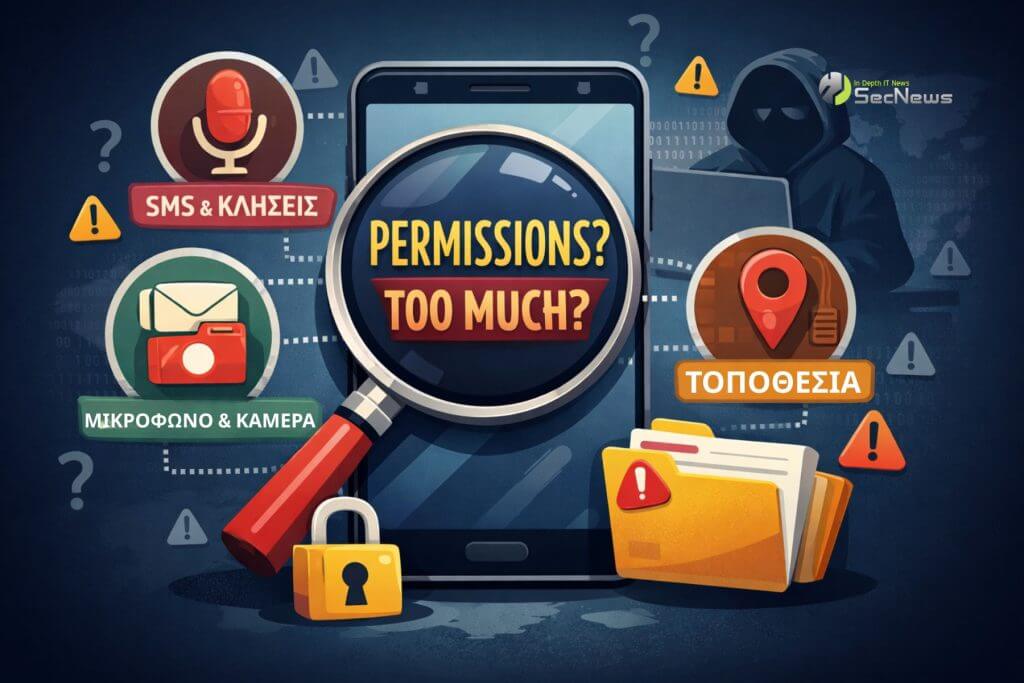
Certain rights are considered particularly sensitive and require increased attention:
- Access to SMS and calls, which can lead to interception of one-time passwords.
- Microphone and camera, which can turn the mobile phone into a surveillance device.
- Real-time location, revealing daily habits and movements.
- Full access to files, allowing reading and modifying personal data.
When an app requests more than one of the above for no apparent reason, it's worth a second thought.
See also: Google calls Android's new sideloading 'high-friction'
🔒 Protect your privacy with Proton VPN
Swiss VPN from the creators of Proton Mail — strict no-logs policy, strong encryption, and built-in NetShield that blocks ads, trackers, & malware.
- ✔ No-logs, based in Switzerland (except 14-Eyes)
- ✔ NetShield: blocks ads, trackers & malicious domains
- ✔ Covers all devices — free version available
The link is an affiliate link — SecNews may receive a commission at no additional cost to you. It does not affect the independence of our article writing.

What can the user do in practice?
Defense does not require specialized cybersecurity knowledge. A more critical attitude. Checking permissions before and after installation, using the “only while using the app” option, and regularly reviewing permissions in the mobile settings can significantly reduce the risk.
Furthermore, it is advisable to avoid applications from unknown sources and "hacked" versions of popular apps, as they are a frequent vehicle for malware.
The fine line between convenience and security
Permissions are essential to the functioning of modern applications, but their misuse is a serious privacy issue. In an era where data is of immense value, the question is not whether an application requests access, but whether it truly justifies it. Conscious user choice remains the most effective filter against excess – and often against digital risk.
