

A set of five exploitable vulnerabilities in Arm's Mali GPU driver remain unpatched months after the chipmaker patched them, potentially leaving millions of Android devices exposed to attacks. Essentially, the Mali GPU has a "patch gap."
Various phone brands, including Google, Samsung, Xiaomi , and Oppo, are currently affected by the problem and are awaiting a fix.
A report published by Google's Project Zero team highlights the "patch gap" plaguing the Android supply chain, as it typically takes several months for firmware security updates to reach affected devices.
OEM partners need time to review fixes and integrate them into their devices, a process that really takes a long time.
See also: Microsoft warns about the dangers of Boa Web Server

Defects and impacts
In June 2022, Project Zero discovered two security vulnerabilities which were CVE-2022-33917 and CVE-2022-36449.
An unprivileged user can use CVE-2022-33917 to access free memory segments by performing improper GPU processing operations. The vulnerability affects Arm Mali GPU Valhall kernel drivers r29p0 through r38p0.
CVE-2022-36449 allows unprivileged users to access freed memory, write outside buffer boundaries, and reveal details of memory mappings.
It affects Arm Mali Midgard GPU kernel drivers r4p0 to r32p0, Bifrost r0p0 to r38p0 and r39p0 before r38p1, and Valhall r19p0 to r38p0 and r39p0 before r38p1.
See also: Ducktail:Phishing campaign via WhatsApp targets Facebook Ad Accounts
Project Zero is tracking these issues as 2325, 2327, 2331, 2333 , and 2334 and has revealed technical details for each of them, along with demo code.
Although the severity rating is moderate, these issues are still exploitable and have a large impact on many Android devices.
The Valhall drivers are used in Mali G710, G610 and G510 chips found inside the Google Pixel 7, Asus ROG Phone 6, Redmi Note 11 and 12, Honor 70 Pro, RealMe GT, Xiaomi 12 Pro, Oppo Find X5 Pro and Reno 8 Pro, Motorola Edge and OnePlus 10R.
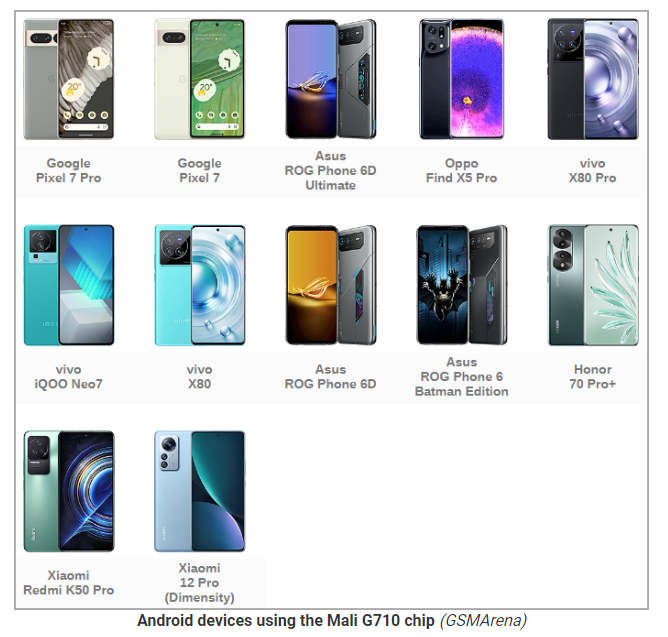
Bifrost drivers are used in the older (2018) Mali G76, G72 and G52 chips used by the Samsung Galaxy S10, S9, A51 and A71, Redmi Note 10, Huawei P30 and P40 Pro, Honor View 20, Motorola Moto G60S and Realme 7.
The Midgard drivers are used in even older (2016) Mali T800 and T700 series chips, which are mainly found in the Samsung Galaxy S7 and Note 7, the Sony Xperia X XA1, the Huawei Mate 8, the Nokia 3.1, the LG X, and the Redmi Note 4.
There is nothing users can do to mitigate these flaws, other than wait for the vendor to provide the appropriate patches.
See also: 34 Russian hacking groups: This year they stole 50 million passwords
Older models using the Midgard driver are extremely unlikely to receive a fix patch, so they will need to be replaced entirely.
Arm has created a fix for the problem, but it's still in beta testing on Android and Pixel devices. In a few weeks, Android will send the patch to partners , who will then be able to use on their own devices.
Information source: bleepingcomputer.com
