

The brain is the ultimate computing machine, so it's no wonder researchers are eager to try and emulate it. New research has taken an exciting step in that direction – a device that is able to "forget" memories, just like our brains do.
It's called a second-order memristor (a mix of "memory" and "resistance"). The clever design mimics a human brain synapse in the way it remembers information, then gradually loses that information if it's not accessed for a long period of time.
While the memristor doesn't have much practical use right now, it could eventually help scientists develop a new kind of neurocomputer – the foundation of artificial intelligence systems – that fulfills some of the same functions a brain does.
In a so-called analog neurocomputer, on-chip electronic components (such as memristor) could take on the role of individual neurons and synapses. This could both reduce the computer and speed up calculations at the same time.
Right now, analog neurocomputers are hypothetical, because we need to see how electronics can mimic synaptic plasticity—the way active brain synapses strengthen over time and inactive ones become weaker. That's why we remember some memories while others fade, scientists say.
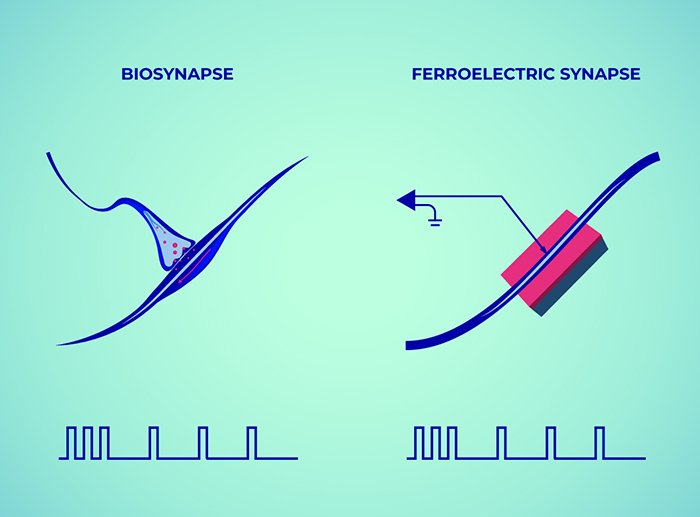
Previous attempts to produce memristors used nanoparticle conductive bridges which would then weaken over time, in the same way that memories could decay in our minds.
“The problem with this [first-order memristor] solution is that the device tends to change its behavior over time and breaks down after prolonged operation,” says physicist Anastasia Chouprik from the Moscow Institute of Physics and Technology in Russia.
"The mechanism we used to implement synaptic plasticity is more robust. In fact, after changing the state of the system 100 billion times, it still worked normally, so colleagues stopped the stress test."
In this case, the team used a ferroelectric material called hafnium oxide in place of the nanobridges, with an electrical polarization that changes in response to an external electric field. This means that low and high states can be tuned with electrical pulses.
What makes hafnium oxide ideal for this, and puts it ahead of other ferroelectric materials, is that it is already used to make microchips by companies like Intel. This should mean it is easier and cheaper to introduce memristors if and when the time comes for an analog neurocomputer.
The real “delay” is implemented through an imperfection that makes it difficult to develop hafnium-based microprocessors – defects at the interface between the silicon and hafnium oxide. These same defects allow the memristor’s conductivity to drop over time.
It's a promising start, but there's still a long way to go: these memory cells still need to be made more reliable, for example. The team also wants to explore how the new device could be integrated into flexible electronics.
“We will examine the interplay between the various mechanisms that change the resistance in our memristor,” says physicist Vitalii Mikheev, from MIPT.
"It turns out that the ferroelectric effect may not be the only one involved. To further improve devices, we will need to discern the mechanisms and learn to combine them.".
