

Ctrl-labs: Controlling your mouse pointer with your mind may sound like a science fiction scenario, but Ctrl-labs, a startup based in New York, is working to make it a reality.
In June, the company raised $28 million from companies such as: Lux Capitals and GV (formerly Google Ventures), and the venture capital group of Alphabet (Google's parent company).
What convinced the tech giants to fund the new company was the idea and, of course, the executives who make up the scientific team.
Thomas Reardon, the founder and CEO of Ctrl-labs, is a graduate student in mathematics from MIT and led a Microsoft project for Internet Explorer. A few years later, he enrolled at Columbia University, where he studied neuroscience and managed to get his doctorate.
In 2015, Reardon, along with fellow neuroscientists Patrick Kaifosh and Tim Machado, created Ctrl-labs, which has a specific mission:
To answer the biggest questions in the fields of computer science, neuroscience and design.
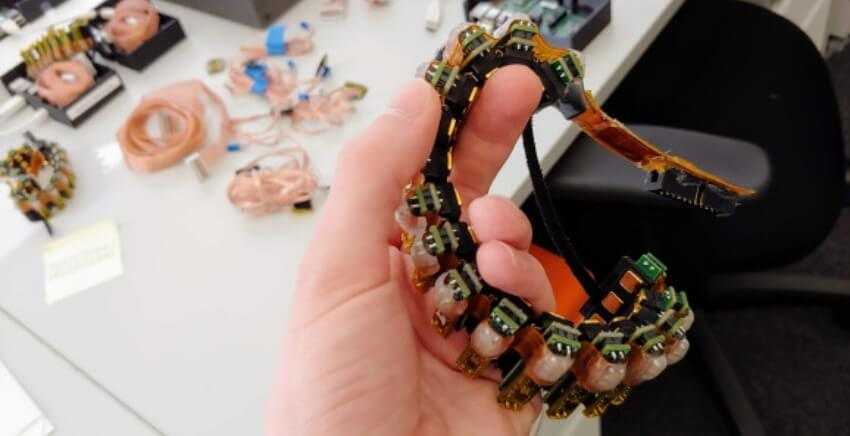
The team soon built its first product: an armband that reads signals from the brain to the hand.
The armband, which features small circuit boards soldered with gold, is designed to adhere tightly to the skin, although it’s still in its early stages. A cable connects the contacts to a Raspberry Pi, which in turn connects wirelessly to a PC running Ctrl-Labs software.
The armband uses differential electromyography (EMG) (first observed in 1666 by Italian physician Francesco Redi) to translate brain intention into action.
How does it do this?
By measuring changes in electrical potential caused by impulses traveling from the brain to the muscles in the hands via motor neurons. This information-rich pathway in the nervous system consists of two parts: the upper motor neurons that connect directly to the center of the brain, and the lower ones that correspond to muscle fibers. Neurotransmitters run the length of this long nerve pathway and turn on or off individual muscle fibers. In case you didn’t get it, we’re talking about the biological equivalent of ones and zeros.
The armband is quite sensitive:
“It acts like an antenna and is therefore prone to interference.”
The data from the armband’s 16 electrodes is processed by Ctrl-labs software, which, with the help of a machine learning algorithm, is trained using Google’s TensorFlow to distinguish the individual impulses of each nerve.
Below you can see the revolutionary technology in action, in two videos published by VB:
____________________________
- Google Assistant with new AI features and functions
- Voidtools Everything easy and fast Windows search
- Facebook: exposes your friends who are spreading fake news
