

Speaking at a security conference in Buenos Aires, Argentina, security researcher Alfredo Ortega revealed that you can use your hard drive (HDD) as a rudimentary microphone to listen to nearby sounds.
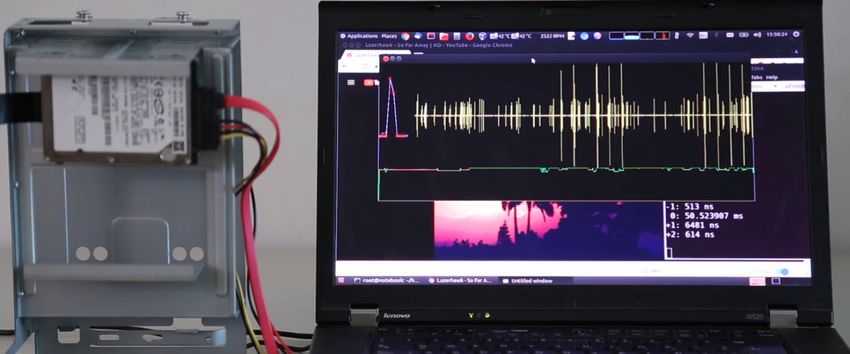
This is possible because of the way hard drives are designed to work. Sounds near a hard drive cause vibrations, which are nothing more than sound waves that cause the hard drive's platters to vibrate.
By design, a hard drive cannot read or write information to a spinning platter when there is vibration, so the hard drive must wait until the vibration stops before taking any action.
Because modern operating systems come with utilities that measure an HDD's activities down to nanoseconds, Ortega realized he could use these tools to measure the latencies in hard drive operation.
The longer the delay, the louder the sound or the more intense the vibration it causes. These read-write delays allow the researcher to reconstruct the sound that caused the vibration on the HDD platters.
The researcher said he is not yet able to listen to conversations, but he said there is research that can recover voice data from very low-quality signals using pattern recognition.
When asked how he came up with the idea of turning his hard drive into a microphone, Ortega said he knew that sound interferes with the hard drive's functions. There are vibration limits in the specifications of most hard drives. That's why drives are often lined with rubber or other vibration-isolating material. So it was easy to conclude that a hard drive could be used to detect sound.
Below you can see a video from the expert's speech at the conference, showing how he listens to a song playing from a nearby speaker from a hard drive.
But Ortega didn't limit his experiments to picking up sounds. The researcher also looked at how sound waves affect the operation of a hard drive. The researcher said that an attacker could use sound waves to launch a resonance attack against a hard drive. This type of attack could cause the hard drive to stop any read-write process (DOS – Denial of Service) or physically damage the device.
In another video, the researcher shows how playing a 130Hz sound caused a hard drive to stop responding to commands. "The Linux kernel will completely disconnect after 120 seconds," Ortega said.
These attacks – or more accurately “accidents” – have happened in the real world. In September 2016, a fire drill involving a simulated gas installation fire at ING Bank’s main data center in Bucharest, Romania, brought down servers for about ten hours.
The noise resembling a loud hiss caused by the development of fire-fighting gases (such as CO2) triggered an unexpected coordination attack that destroyed hard drives and halted bank operations across Romania – including ATM withdrawals, PoS payments, web and mobile banking applications.
“I am aware of the Romanian bank incident,” Ortega told BuzzFeed. “The attack on my speech used resonance to amplify vibrations, so it only takes a very small volume to cause the same effect. However, with enough energy, any sound contradicts the rotation of the hard drive.”
But let's also remember the famous video "Screaming at the Datacenter", filmed at Sun's data center in 2008, when Brendan Gregg showed the world, for the first time, that he could read-write errors on hard drives simply by shouting at them.
