

The old saying «you don’t know what you have until you lose it»» seems more relevant than ever in the digital age, according to the new research by Kaspersky Lab, which shows that, while people claim they understand the value of their data, in reality they do not appreciate its importance until they lose it.
Even a cold sweat can wash over people with the thought that they have lost data they previously considered «insignificant».
These findings, which are part of Kaspersky Lab’s “My Precious Data” survey, reveal how distressing data loss can be – even when that data is not necessarily considered “important” or particularly valuable by its owner.
During the survey, people agreed that their most personally important data (“private and sensitive photos and videos”) was also the most frightening type of data they could lose. However, even losing data that people might consider less important was also surprisingly traumatic.
For example, the prospect of losing contact information is considered particularly concerning for many, placing it among the three most frightening types of data loss, despite the fact that contact information is generally ranked much lower regarding the «significance» of the data.
The research revealed in this way the contradictions regarding the importance that people assign to their data and the reality of the distress they experience when they lose data that they initially did not consider important.
Within the scope of the research, Kaspersky Lab collaborated with psychologists from the University of Wuerzburg to measure people's physical reactions to data loss through a series of three experiments. While the psychologists expected to encounter much stronger reactions to the loss of significant data, they were surprised that participants showed signs of distress even in the loss of data that were almost insignificant to them.
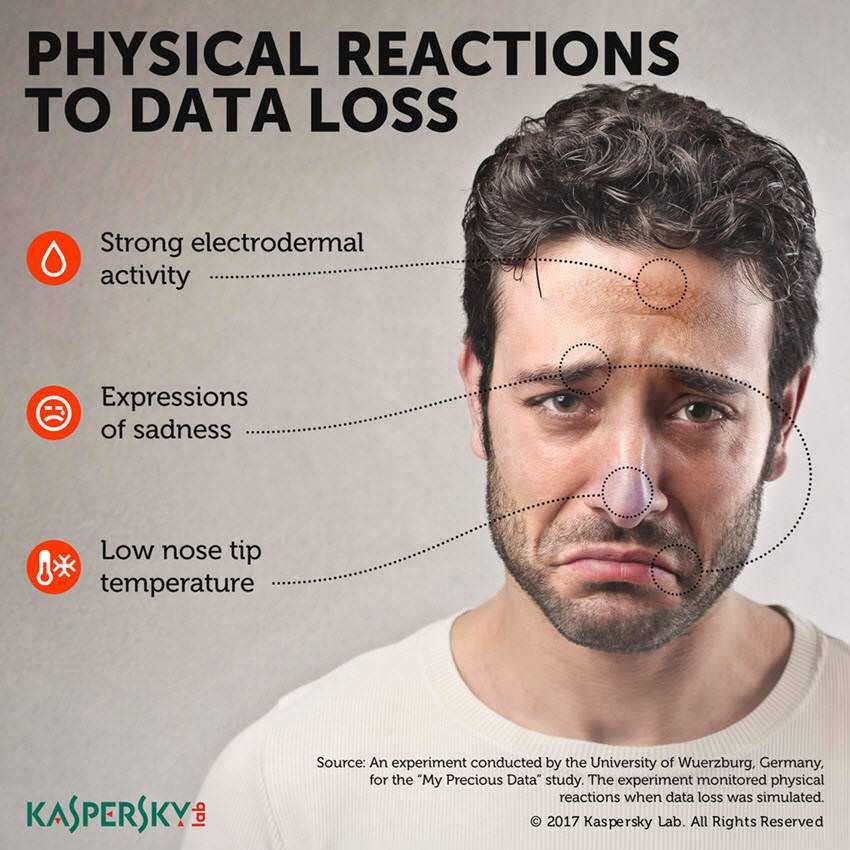
During the test, psychologists measured electrodermal activity (changes in the skin's sweat glands), and while users were more likely to sweat when they believed they had lost significant data, sweat levels were not as low in cases where they thought they had lost less significant data.
The same pattern was found during the other two experiments.
For example, the temperatures at the tip of people's noses decreased when the loss of significant data was simulated. This physical stress indicator showed that the respondents literally «freeze from their fear».
However, the temperature of the tip of the nose decreased even in cases where respondents believed they had lost insignificant data, and the difference was not as large as psychologists expected. Similarly, when systematic facial expressions were measured, the experiment detected expressions of sadness when the loss of both significant and insignificant data was simulated.
Although the experiments showed that the idea of data loss makes people break out in cold sweat and are plagued by intense discomfort, the differences in electrodermal activity, the temperatures of the nose tips, and expressions of sadness were surprisingly small when the loss of important and insignificant data were compared. This indicates that even the loss of insignificant data has negative physical manifestations, with respondents realizing how important this data is to them when they thought they had lost it.
Dr. Astrid Carolus, Media Psychologist at the University of Wuerzburg, said:
«Our experiment shows that people – at least so far – rarely consider their data valuable. It is one of our future challenges that will help people understand what companies already know: data is valuable. Therefore, it is important to point out what data represent and what they mean personally to people. To appreciate their data, people must understand or even feel, for example, that photos are not just images and contacts are not just addresses. These categories of data are probably the most precious memories of people's lives and their representation in social connectivity and coexistence. The value of data must be communicated. Only then can people realize how valuable their data are».
Andrei Mochola, Head of Consumer Business of Kaspersky Lab, commented:
«The research reveals that the issue of data loss triggers emotional and physical reactions in people. However, the reality appears to be that people do not actually know which category of data is most valuable to them until it is lost, with people having intense physical reactions even when they think they have lost insignificant data. Perhaps this explains why people do not give the data they store on smartphones, tablets, and computers the love and protection they deserve, despite the emotional attachment they claim to have to them. They still need to truly understand the value of their data and take appropriate measures to protect it».
For more information about the experiment and the study, you can refer to the report as well as the related video.
