

In addition to ever more sophisticated smartphones and tablets and improved wearable gadgets, biometric applications were one of the protagonists last week at Mobile World Congress (MWC).
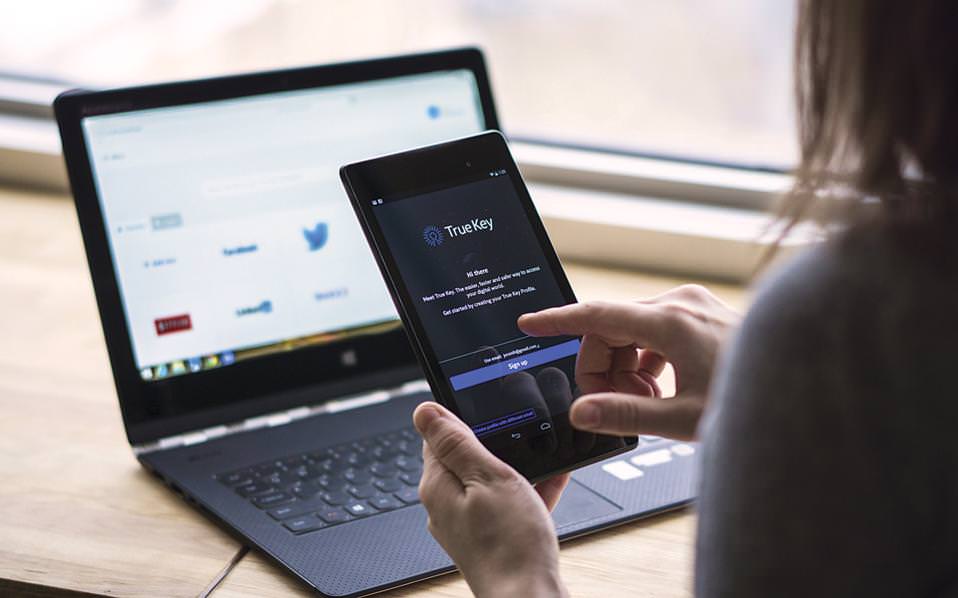
MWC 'slargest telecommunications event, showed this year that one of the dominant new trends is solutions that utilize biometric data as electronic "keys".
Thus, several technologies that recognize the user's identity from their eyes, fingerprint or voice "paraded" through the stands of the exhibition held as part of the event. Such systems are intended for the increasing number of people around the world who make online purchases or transfer sensitive data via the Internet, at a time when passwords are often not enough to protect them effectively, while there are now so many that it is difficult to remember them. That is why these applications aim to offer additional security or even completely eliminate passwords, replacing them with some biological characteristic.
Naturally, alternative solutions with which a user can confirm their identity are not only being considered by companies that develop hardware and software, but also by financial institutions that are active in e-commerce, such as Visa. “My personal opinion is that codes are not going to be completely removed from the spotlight, but their role will certainly be limited,” notes Jonathan Vaux, executive director of Visa Europe, speaking to “K” on the sidelines of MWC. “Thus, although biometric applications are not the only option, they are one of the best ways to authenticate, since they combine security with convenience and speed,” he notes.
Indeed, these technologies have a greater appeal among young people, as recent research by Visa in the United Kingdom showed, among individuals aged 16-24. Of the participants, 76% responded that they would trust a biometric application for their online transactions.
For’ this purpose, most gave a «vote of confidence» to fingerprints, followed by the «scanning» of the eye. «What the research essentially showed is that, thanks to the familiarity younger generations have with technology, such options are already very popular» adds the Visa executive.
These options were enriched at MWC by Qualcomm, which presented a new fingerprint sensor for "smart" devices, which works even with wet or... dirty fingers. At the same time, Fujitsu showed a prototype smartphone with a special camera that works with infrared rays and "reads" the iris of the eye even if the user is wearing glasses.
Many biometric applications follow the standards of the FIDO Alliance, a consortium that includes Visa, together with banking institutions and tech giants such as Microsoft and Google. The FIDO Alliance develops open specifications that are available to any manufacturer developing a biometric component, while also allowing any internet service or software to easily support all these sensors. «The logic of the open platform I think is the most effective way for these technologies» adds Vaux in «K».
Anyway, according to the Visa executive, besides biometric systems, other technologies will make identification easier in the future. “For example, location tracking will play an important role, so that the user can determine how to conduct online transactions, e.g., only from home or from his office»,” he concludes.
MWC: Digital wallet
According to the executive director from Visa Europe Jonathan Vaux, several technologies that have been developed in recent years are now opening the way so that increasingly more consumers begin to use their «smart» mobile as a «digital wallet». «For example, a significant obstacle that existed until recently was the fact that one could not easily check how much money is available at any time, as one does with a traditional wallet by counting banknotes. However, the applications that have been created lately give the same sense of control to those who use them» he notes.
The dominant trend is that the smartphone functions essentially as a terminal, from which the user gains Internet access to an «intangible slot» in the cloud, where it stores in digital form all his debit and credit cards. «This logic has several advantages, such as in the case of loss or theft of the real card, where the digital copy of the new credit card will be ready to be used within a few minutes. Also, it addresses the fact that many people already use more than one device to access the Internet, from which they may at some point want to make an online purchase» adds.
Source: kathimerini.gr
