

Bittorrent has always had two fundamental problems: the non‑existent indexing services and the lack of anonymity. Over time, several solutions have been published to eliminate the latter weakness, and they all rely on the use of virtual private networks or proxies. Regarding the first issue, i.e., a viable alternative solution for indexing services, there seems to be nothing noteworthy.
Tribler , which was released publicly in the summer of 2014, attempts to change all that. It was developed by researchers at Delft University of Technology who wanted to create an anonymous system that was impossible to shut down at the same time .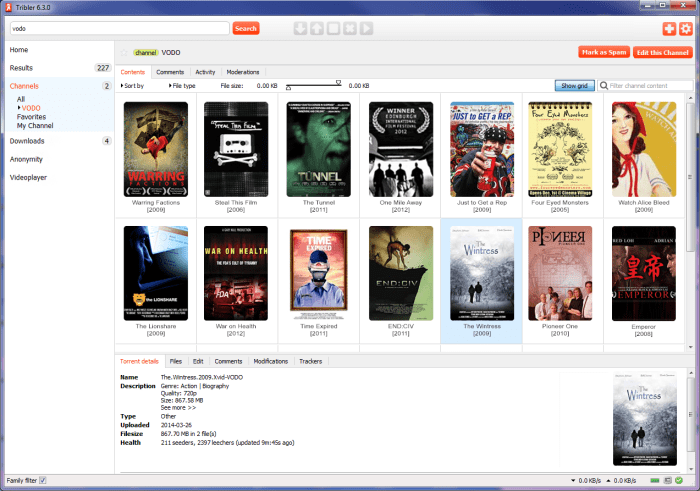
Tribler incorporates both services we mentioned earlier, the indexing of torrents as well as the anonymity of each client directly, which means it does not rely on third‑party services or other websites.
The major feature of Tribler is the provision of anonymity, which is now possible with its latest version. It uses a system similar to that offered by the Tor network, but it has its own network which is not compatible with Tor.
Detailed information about the application is available on Github. The routing of requests appears to be done through each user's various systems automatically. Instead of downloading the files directly from the seeder, they are downloaded and relayed through other users.
This means that every user of the Tribler network is a node used to transfer data to other users who, in turn, can affect the overall download speed and your ability to seed files.
The packets received in this way are encrypted except for the header, which carries only an identifier used to determine where the packet should be sent.
Tribler also comes with built-in search options that you can use to find torrents directly from your application without needing any website. It also supports channels, with collections of torrents offered by other users, which users can vote on to improve their visibility in search.
The idea of Tribler seems sensible, but it is too early to say whether it will be accepted by the online audience. The security and anonymity of the service must be subjected to third‑party review, so we can be sure that everything works as the researchers developing it promise.
You can download the application from here.
