


And we continue look back at the most famous and deadly viruses in computer history. Our journey began in 1971 with the malicious program “Creeper”, which, as we saw at the beginning of our journey, is the first self-replicating computer program that was transmitted via the US military’s ARPAnet network, which is also the “forerunner” of today’s Internet. The virus could use any connection made to the network to infect connected computers, displaying the message “I'm the creeper, catch me, if you can” on the terminal screen.
Let's now move on to 1982 and “Elk Cloner,” the first virus reported to spread outside the system or lab it was created in. Elk Cloner was written by a talented 15-year-old student, Richard Skrenta, with the intention of infecting Apple II computer systems.
[signoff icon=”icon-target”]The Apple II was the second 8-bit home computer, introduced by Apple in April 1977. It succeeded the Apple I, but was essentially the company's first mass-produced computer.[/signoff]
Cloner had no destructive intentions and was created by teenager Skrenta as a prank. The fifteen-year-old student saved the program on a floppy disk (there were no other storage media at the time) and distributed it to his classmates.

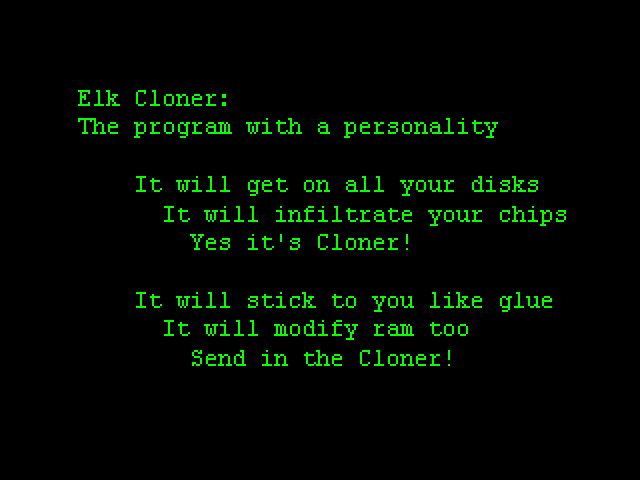
Elk Cloner, upon booting the computer, infected any other floppy disk in the system and after the fiftieth boot, displayed the following message (the Greek version is in parentheses):
Elk Cloner: The program with a personality
It will get on all your disks
It will infiltrate your chips
Yes it's Cloner!
It will stick to you like glue
It will modify ram too
Send in the Cloner!
Although this virus started as a joke, it nevertheless managed to spread to a significant number of computer systems, thus earning a place in the history of the most important viruses.
And of course, our review doesn't end here, on the contrary, it has just begun, so stay tuned as we follow along on our journey through the most famous and destructive viruses in computer history...

