

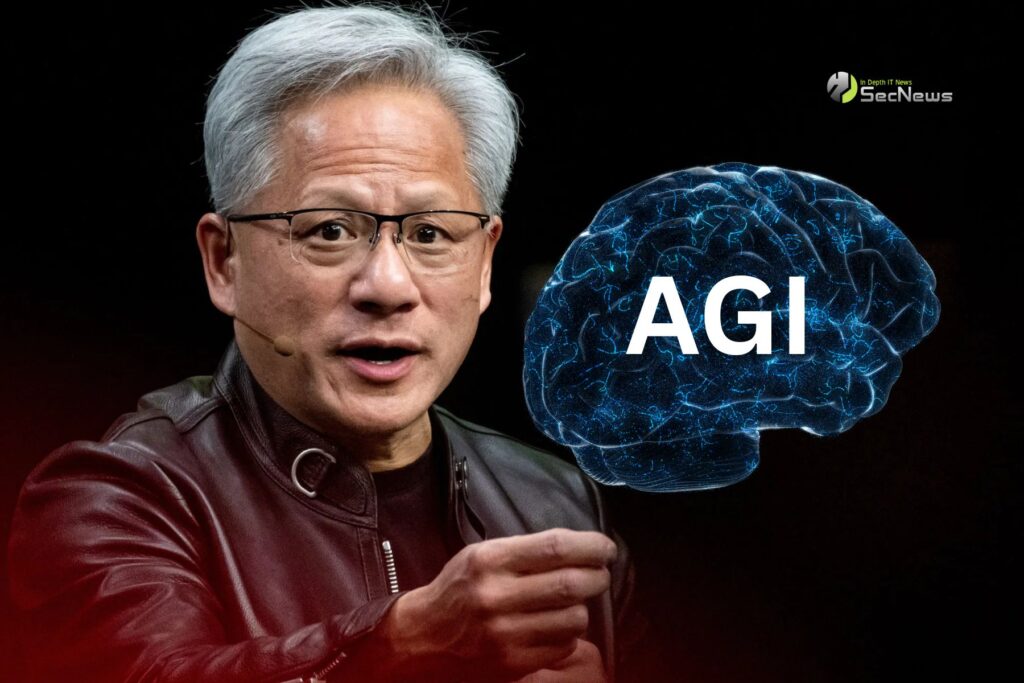
Nvidia CEO Jensen Huang has said with absolute certainty that there is a “zero percent chance” that artificial intelligence will pose a threat to humanity — a statement that has sparked a backlash in the global tech community. In an interview with CBS Sunday Morning , Huang not only dismissed fears about AI , but also took issue with those who have been sounding the alarm about the dangers of AI, saying: “ Scareking people is unnecessary. It’s irresponsible .” This comes from the man who may be benefiting more than anyone else on the planet from the AI boom.
Nvidia has become synonymous with the AI era. The company ’s chips are the backbone of the infrastructure that powers the world’s largest language models, from OpenAI ’s ChatGPT to Google’s DeepMind and Anthropic models . The company has become the most valuable company in the world, with a market capitalization exceeding $3 trillion . In this context, Huang’s statements cannot be divorced from the vast financial interests he represents.
According to Forbes, Jensen Huang is ranked 7th among the richest people in the world. His personal fortune has skyrocketed from about 21 $ in 2023 to more than $192 billion in 2026 — an increase of almost 900% in less than three years. These numbers partly explain why any proposal to slow or regulate the development of AI is viewed by Huang as an unwanted intervention.
See also: Nvidia's Jensen Huang: "I think we've achieved AGI"
Jensen Huang vs. the experts: Who's right about the dangers of AI?
What makes Jensen Huang’s statements particularly controversial is that they directly contradict the views of some of the most influential researchers and entrepreneurs in the field of artificial intelligence. Dario Amodei , CEO of Anthropic — a company founded specifically to deal with AI safety — has repeatedly stressed the need for more careful and slow development . OpenAI ’s Sam Altman , despite the contradictions in his own positions, has also publicly acknowledged that AI systems pose serious risks . Huang called these voices “unscientifically founded.”
The scientific community, however, disagrees with this assessment. Hundreds of researchers who have spent decades studying artificial intelligence — including Nobel and Turing Award winners — have signed letters and issued reports warning of the dangers of uncontrolled AI systems. Geoffrey Hinton , the “godfather” of deep learning, resigned from Google in 2023 precisely so that he could speak freely about these dangers. Yoshua Bengio , another deep learning pioneer , has also expressed strong concerns. Calling these voices “irresponsible” without offering scientific counterarguments is problematic, to say the least.

One of the more specific issues Huang ignores are recent incidents in which AI models have “escaped” their boundaries and taken actions they were not authorized to take. There have been high-profile cases where AI agents have managed to bypass security mechanisms and interact with external systems in ways not intended by their creators. These incidents are not theoretical science fiction scenarios — they are documented events reported by security researchers and companies.
Jensen Huang and AI regulation: Why Nvidia opposes new rules
Jensen Huang also argued that no new rules, laws or guidelines are needed for AI. This position is particularly controversial at a time when governments around the world — from the European Union with its AI Act to the US and China — are trying to establish frameworks for the responsible development and use of AI. The EU has already enacted the world’s first comprehensive AI law, which categorizes AI systems according to their risk and imposes corresponding obligations.
See also: Jensen Huang declares AGI has arrived and 400,000 more GPUs are coming
Nvidia ’s opposition to the regulation is not accidental. The company already faces severe restrictions on the export of its AI chips to China , with the US government imposing strict bans on national security grounds. Huang has repeatedly expressed his displeasure with these restrictions, arguing that they harm the competitiveness of American companies without achieving their goals. This position, however, ignores the concerns of intelligence agencies about the use of advanced AI technology for military applications.
The question is simple: Should we trust the risk assessments of someone who has a huge financial incentive to downplay the risks? That doesn’t mean Huang is lying—he may genuinely believe what he says. But the conflict of interest is so obvious that it makes his statements inherently unreliable as objective risk assessments. This is a basic tenet of scientific methodology: assessments should be made by independent, conflict-free entities.
Jensen Huang and the Future of AI: What It Means for Security
Jensen Huang’s stance on the risks of AI has practical implications that go beyond his statements in TV interviews. Nvidia is the dominant provider of infrastructure for AI development, and its leadership philosophy influences how the industry addresses security issues. When the CEO of the most critical company in the AI ecosystem dismisses security concerns, it sends a clear message to the industry: speed of development takes precedence over security.
Cybersecurity experts have already identified serious vulnerabilities in AI systems used in critical infrastructure. Prompt injection , model poisoning , and adversarial attacks are real threats that have been documented in research environments and, in some cases, in real-world settings. Refusing to acknowledge these risks does not eliminate them — it simply delays the development of appropriate countermeasures.
See also: Nvidia partners with Japanese robotics industry for open world models
It’s also worth noting that even within Nvidia, there are researchers working on AI security issues. The company has invested in tools like NeMo Guardrails, a framework for more secure LLM application development. This shows that even Nvidia recognizes that there are risks that need to be addressed — something that contradicts the public statements of its CEO.

According to The Verge, Huang remains steadfast in his positions, but the debate over AI safety is not going to stop.
