

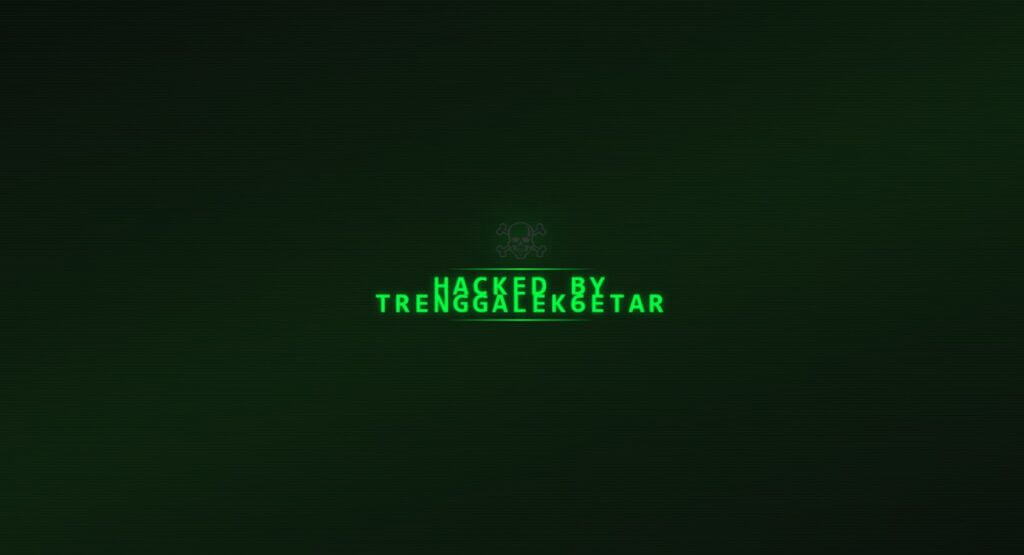
A new incident of cyberattack targeting a public body in Greece was recorded in recent hours, as the official website of the Unified Food Control Body (EFET) was hacked by unknown individuals, resulting in the message "HACKED BY TRENGGALEK CETAR" appearing on its home page, accompanied by the characteristic icon of a skull.
The incident resulted in the website being taken out of normal operation, temporarily depriving citizens and businesses of access to electronic services and announcements. So far, there has been no official information on the full extent of the breach or whether internal information systems and data were affected.
Initial evidence points to web defacement attack
Based on the indications so far, this is a web defacement, one of the most well-known forms of website hacking. A defacement attack is a type of “vandalism” of a website, where hackers infiltrate the website and replace its content with their own messages. It is usually used to cover up something larger, which is in the background, while the messages can carry a political or religious message, inappropriate content, or a notification that the website has been hacked.
See also: Stelios Kouloglou: Pegasus' target while investigating wiretapping
Common targets of defacement attacks are government figures and websites, or religious websites, while attacks are most often committed by activists (hacktivists), who prefer large pages with many viewers.
The extent of the breach is currently unknown
The most important question that remains unanswered is whether the attack was limited exclusively to changing the homepage or whether the perpetrators also gained access to databases, administrative accounts, or other information systems of the organization.
In several cases internationally, attacks that initially appeared as simple web defacement later turned out to be part of a broader data collection or malware installation. For this reason, investigations following such an incident are not limited to restoring the website, but extend to a thorough examination of the entire digital infrastructure.
The competent technical services are already working to restore the website's operation and analyze the digital traces left by the attackers, in order to determine the exact login method.
Why public organizations are a frequent target
Cyberattacks on public organizations have increased significantly across Europe in recent years. Cybercriminals often exploit outdated systems, weak authentication mechanisms or known vulnerabilities in website management software.
Even when the goal is not data theft, a successful breach can cause significant damage to an organization's credibility, disrupt citizen service, and raise doubts about the level of protection of the government's digital infrastructure.
See also: NetNut / Popa: Google disrupts residential proxy network
Experts remind that cybersecurity is not limited to installing protection software, but requires continuous system updates, regular security audits, separation of critical services, strong multi-factor authentication, and ongoing administrator training.
Political reactions after the incident
The cyberattack also sparked political reactions. In a statement, SYRIZA called the breach a "wake-up call" for the cybersecurity of the Greek State, arguing that the incident highlights weaknesses in the protection of critical digital infrastructure.
At the same time, he asked the government to provide answers regarding the manner in which the attack was carried out, the extent of the breach, the possibility of data leakage, and the measures being taken to prevent similar incidents in the future.
🔒 Protect your privacy with Proton VPN
Swiss VPN from the creators of Proton Mail — strict no-logs policy, strong encryption, and built-in NetShield that blocks ads, trackers, & malware.
- ✔ No-logs, based in Switzerland (except 14-Eyes)
- ✔ NetShield: blocks ads, trackers & malicious domains
- ✔ Covers all devices — free version available
The link is an affiliate link — SecNews may receive a commission at no additional cost to you. It does not affect the independence of our article writing.
By the time of writing, no official technical update had been released by EFET regarding the causes of the attack or the findings of the initial investigation.

What to expect from now on
Full restoration of the website is only the first step. The critical stage is digital forensics , which will determine whether the attackers gained access beyond the public environment of the website or whether the attack was limited solely to the alteration of the home page.
See also: ToddyCat: New Umbrij malware targets corporate Gmail accounts
At the same time, it is expected that logs, management accounts and security mechanisms will be examined, in order to identify the perpetrators' entry point and rule out the possibility of them remaining in the system.
The incident serves as a reminder that cyber threats are constantly evolving and that even a seemingly “simple” website vandalism can be the tip of a much more complex security incident. For public organizations, early detection, immediate response and transparency in informing citizens are now essential prerequisites for maintaining trust in the digital functioning of the state.
