

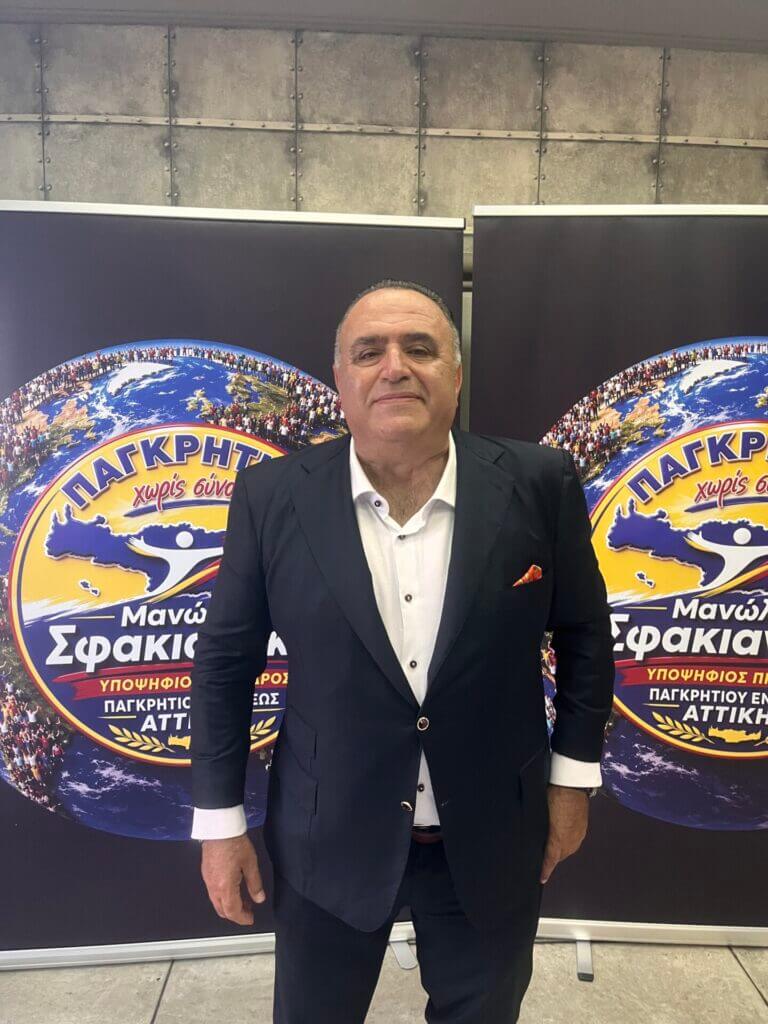
Manolis Sfakianakis is running as a candidate for president of the Pancretan Union of Attica, one of the largest and most historic Cretan associations in the country, which is entering a pre-election period with particular interest in its digital renewal. At the center of the campaign is the candidacy of Manolis Sfakianakis, known for his many years in the field of information security and cybercrime, who is running for president with a clear and structured vision for the “Pancretan Union of the next day”.
See also: Manolis Sfakianakis: International award for his work in cybersecurity
The Sfakianakis candidacy and the stakes
Manolis Sfakianakis does not see Pankritio simply as a traditional cultural association, but as a living organization that can evolve into a global network of Cretans. Through his statements at the recent event at “Aori” in Athens – where, as the relevant publication notes, he addressed a call to the Cretans of Attica with the message that “Pankritio is changing levels and entering a new digital era” – he highlighted that the goal of his candidacy is to move the association into a new digital era, with substantial extroversion, structured services to members and active networking of the Cretan diaspora.
Sfakianakis' candidacy gains special weight precisely because it "fits" in an environment where technology, information security and digital identity are no longer optional elements, but critical factors for the operation of every modern institution. He attempts to transfer this experience to the historic association of the Cretans of Attica, proposing a management model that combines tradition and innovation.
Manolis Sfakianakis: Candidate for president of Pancreti with a vision of "Crete without borders"
See also: Manolis Sfakianakis: Commissioner for Digital Services
Digital ecosystem for Cretans around the world
A central element of his program is the creation of a digital ecosystem that unites Cretans regardless of country and city. Through a new application, Pankritios aspires, if Sfakianakis is elected, to map the global Cretan community: entrepreneurs, professionals, young people, students and families who share a common origin and identity.
The presidential candidate describes a practical, functional system: the Cretan from Athens traveling to Melbourne or London will be able to locate Cretan restaurants, hotels and businesses, connect with the local community and take advantage of special benefits and discounts. This is an approach that transforms the “compatriots’ club” into a tool for networking, financial support and social cohesion for the diaspora.
The "Cretan Identity" and its privileges
In the same context, Sfakianakis introduces the concept of a digital “Cretan Identity” – an electronic identifier that each member will carry on their mobile phone or digital wallet. This identity will be linked to collaborating businesses, restaurants, hotels and shops, offering privileged access to services and discounts, both in Attica and internationally.
In practice, presidential candidate Manolis Sfakianakis proposes a win–win model: entrepreneurs in the Cretan community gain a targeted network of customers with a strong emotional bond, while members of Pancreti benefit from financial incentives and more organized access to the structures of the diaspora. Thus, the association is transformed into a platform that produces added value, rather than being limited to symbolic events.
Culture, identity and security in the digital age
Although the Sfakianakis candidacy has strong technological characteristics, it is not cut off from the core of Cretan tradition. The enhancement of music, dance, customs and the Cretan language is part of a more organized, digitally supported framework, where culture is not only a "stage and event", but content that travels, is archived and shared.
Sfakianakis’ experience in digital security issues adds an additional dimension to his candidacy: the transition to applications, digital identities and electronic services requires a serious approach to issues of data protection and system reliability. The message is clear: Pankritios can become “digitally global” without sacrificing the security and reliability of its members.
See also: Manolis Sfakianakis: The CSI Institute in Mykonos

What does the election of Sfakianakis mean in practice?
If Manolis Sfakianakis' candidacy prevails in the upcoming elections of the Pancretan Union of Attica, the association is expected to follow a trajectory of greater extroversion, digital upgrading and systematic utilization of the Cretan diaspora. For the field of cybersecurity and technological innovation, this development constitutes an interesting case study: how a historic cultural organization attempts to redefine its role through digital tools and a networking strategy.
For the Cretan community, the stakes are even more immediate: the election or not of this specific candidacy will determine whether Pankritios will remain in the traditional model of an association based in Attica or whether it will transform into a digital platform that unites Cretans "without borders" and offers them essential services on a global level.
