

Tesla has quietly made a significant change to the way its Full Self-Driving (FSD) system works, now requiring drivers to provide feedback whenever they intervene in autonomous driving. The new behavior was introduced via FSD v14.3.2 and software update 2026.2.9.9, without initially being officially mentioned in the company's release notes.
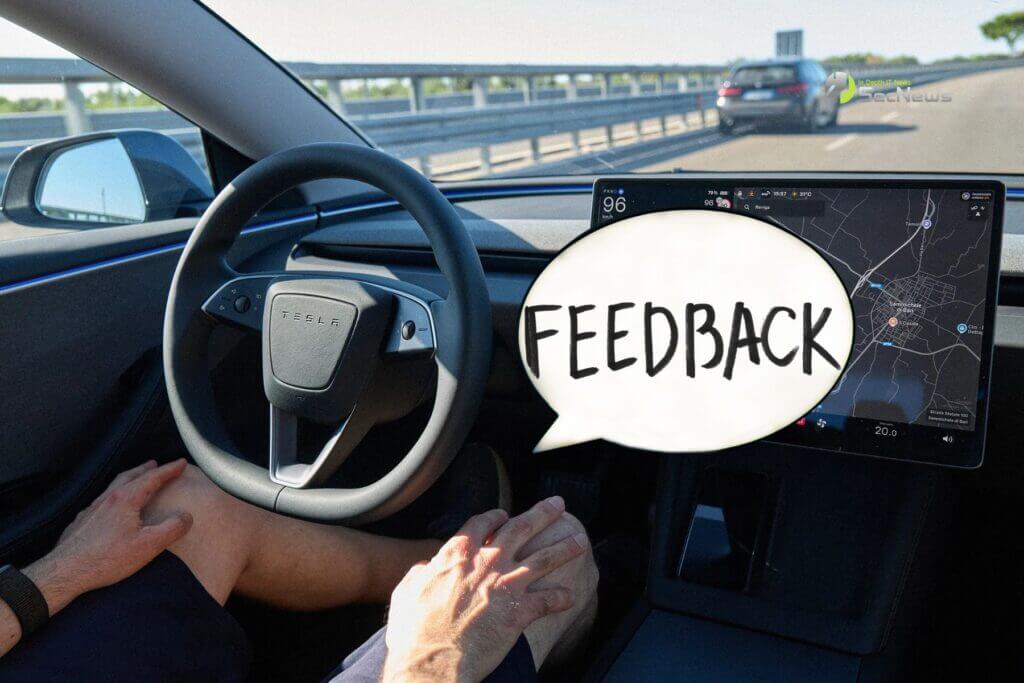
The change may seem small at the user interface level, but it reveals a lot about Tesla's strategy around data collection, training artificial intelligence models, and the future of autonomous driving.
Tesla: What's changing in the driving experience
Until recently, when a driver took control from the FSD, a small window would appear on the touchscreen, optionally requesting feedback on the reason for the intervention. If the user ignored the notification, it would automatically disappear within a few seconds.
See also: Tesla Solar Roof: In critical condition as it turns to panels
With the new version, the window remains permanently on the screen until the driver selects a specific reason category or sends a voice message. Available options include “Preference”, “Discomfort”, “Navigation” and “Critical”. There is no cancel button or time limit for disappearance.
Tesla has already tweaked the system three times in a short period of time, showing that it is continuing to experiment with how it gathers feedback. The latest version reduces the size of the window so that it doesn't cover critical controls, such as climate control or navigation, but the basic logic remains the same: the driver must interact with the system.
In fact, several users have discovered an unofficial way to quickly dismiss the notification by double-tapping the microphone button on the steering wheel to send a blank voice recording. The fact that this solution is considered a “hack” and not an official feature says a lot about the design of the new experience.

Why Tesla is so insistent on collecting FSD
The answer lies at the core of Tesla’s philosophy around artificial intelligence. Full Self-Driving relies on massive amounts of real-world driving data to continuously improve machine learning models.
See also: Tesla postpones Model S/X Signature delivery event
Every time a driver intervenes, the system considers that a potential failure or weakness in the algorithm. Until now, many of these interventions were recorded without sufficient context, which made it difficult to analyze the causes. With the new mandatory categorization, Tesla obtains much “cleaner” training data.
The company now has nearly 500,000 active FSD subscribers, essentially acting as a massive data collection network in real-world traffic conditions. With more than 10 billion miles driven through FSD, even a small improvement in the quality of feedback can translate into a huge benefit for the system’s evolution.
Tesla had already introduced the ability to provide voice feedback after interventions in 2023, but until now the process was completely optional. The move to mandatory feedback shows that the company now sees driver data as a key pillar of the development of autonomous driving.
Safety and distraction concerns
Despite the benefits for training AI models, the new approach has caused strong reactions in the Tesla driver community.
The main problem is timing: the notification appears at the exact moment the driver takes control of the vehicle, which is likely to be in a critical situation where absolute concentration on the road is required. The requirement to interact with the touchscreen can easily act as an additional source of distraction.
See also: Tesla recalls cheaper Cybertruck due to possible wheel detachment

At the same time, many users argue that the available categories don't always reflect the actual reason for the intervention. As a result, many choose random answers just to make the notification disappear, thus undermining the reliability of the data Tesla is trying to collect.
The fact that the notification remains even when the vehicle is stopped or parked reinforces the sense that the system was rushed. While FSD v14.3 is considered by many to be one of the most mature versions of the autonomous driving platform, the new feedback model shows that Tesla is still balancing innovation, user experience, and the need for ever more AI data.
