

Scientists may have overturned a theory that has prevailed for over 100 years about what supports Earth's largest mountain range, the Himalayas.
See also: Research: Melting glaciers are causing more frequent volcanic eruptions
The Himalayas were formed by the collision of the Asian and Indian continents about 50 million years ago, when tectonic forces compressed Tibet so strongly that the region was deformed and its surface shrank by almost 1,000 kilometers. The Indian tectonic plate eventually subducted beneath the Eurasian plate, doubling the thickness of the Earth's crust beneath the Himalayas and the Tibetan Plateau to the north, which contributed to their uplift.

For a century, the prevailing theory was that this doubling of the crust alone supported the weight of the Himalayas and the Tibetan Plateau. Research published in 1924 by Swiss geologist Émile Argand depicted the Indian and Asian crusts as stacked on top of each other, reaching together to a depth of 70 to 80 kilometers below the Earth's surface.
But the new study reveals that there is a section of mantle trapped between the Asian and Indian crusts. This explains why the Himalayas rose so high and how they remain so high today, the authors of the study, published Aug. 26 in the journal *Tectonics*, wrote.
See also: The largest Martian meteorite was sold for $4.3 million
The mantle is the layer of Earth that lies just below the crust. It is much denser than the crust and, therefore, does not liquefy at the same temperatures. In contrast, the crust is so light and buoyant that it behaves similarly to an iceberg — the thicker it becomes, the higher it rises above the Earth's surface.
Sternai and his colleagues discovered the existence of this “enclosed” mantle by running computer simulations of the collision between the Asian and Indian continents. The model showed that as the Indian plate subducted beneath the Eurasian plate and began to liquefy, pieces of it rose up and became attached not to the bottom of the Asian crust, but to the base of the lithosphere — the rigid outer layer of the planet, which is made up of the crust and the upper part of the mantle.
The study presents strong evidence to support this model, but the overturning of Arnaud's 100-year-old theory is controversial, given its widespread acceptance. Douwe van Hinsbergen, a professor of global tectonics and paleogeography at Utrecht University in the Netherlands, who was not involved in the study, disagreed with the characterization of the results as controversial. "This is a nice new finding and an elegant interpretation," he said.
See also: NASA: Nuclear reactor on the Moon by 2030
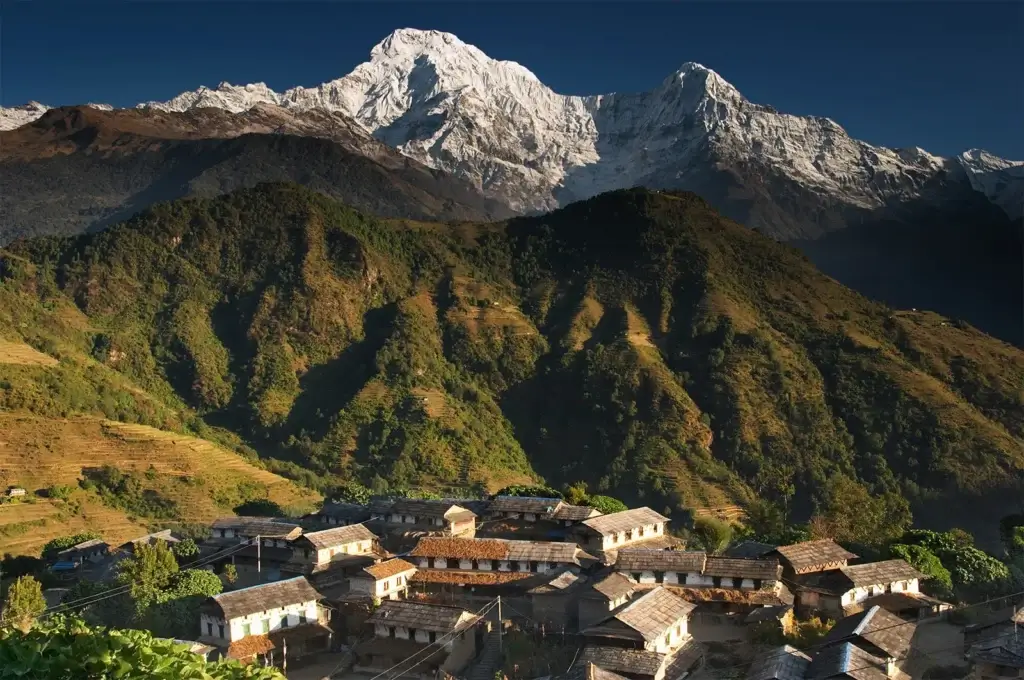
The Himalayas are the highest mountain range in the world, spanning five Asian countries: Nepal, India, China (Tibet), Bhutan, and Pakistan. Their name comes from Sanskrit and means “abode of snow.” They include the world’s highest mountain, Mount Everest (8,848 meters), as well as several other peaks over 8,000 meters, such as Kangchenjunga and Lhotse. The Himalayas form a natural barrier between Tibet and the Indian subcontinent and strongly influence the region’s climate, preventing monsoons from passing north. The mountain range was formed by the collision of the Indian and Eurasian tectonic plates, a process that continues today, making it geologically active.
In addition to its geographical and climatic importance, the Himalayas also have enormous cultural and religious value. They are considered sacred by many religions, most notably Hinduism and Buddhism. Thousands of pilgrims and climbers visit the region every year, while they host unique ecosystems and rare species of plants and animals.
