

Astronomers have studied in detail a rare and extremely violent cosmic phenomenon, caused when an unlucky star gets too close to a supermassive black hole. The research team hopes that this phenomenon will help to understand how such events, known as "tidal disruption events" (TDEs), affect the evolution of the galaxies that host them.
See also: Rare black holes "roam" our galaxy
These violent collisions between stars and the relentless gravity of black holes — with masses millions or even billions of times greater than the Sun — result in the stars being torn apart and swallowed by the black hole. This “cosmic cannibalism” produces bursts of light that can outshine all the stars in the galaxy where the TDE occurred, drawing the attention of scientists.
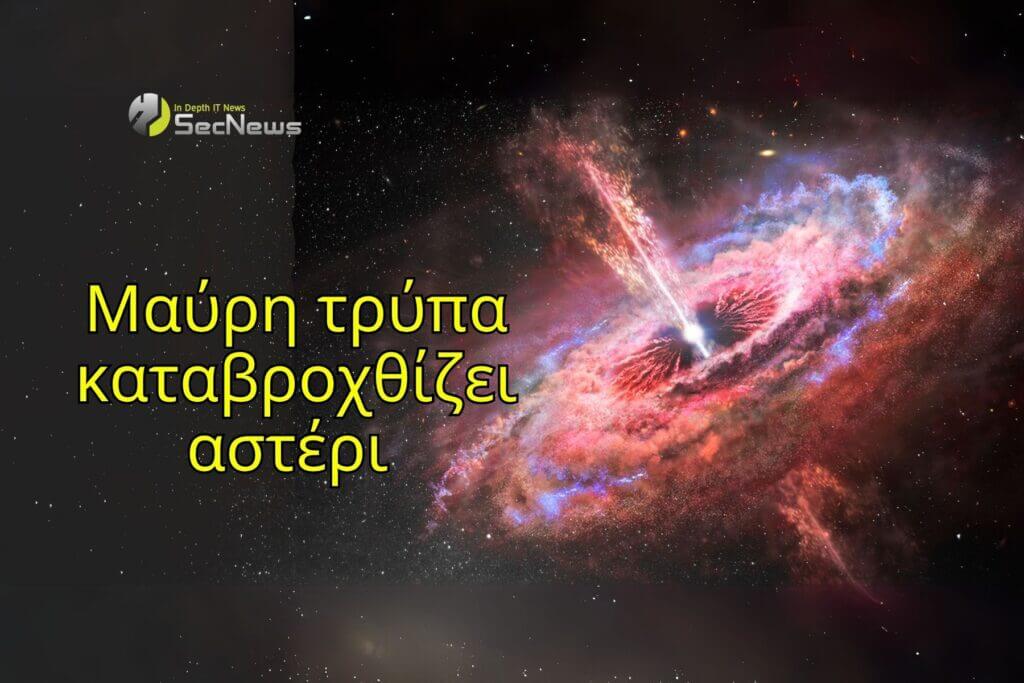
The TDE, dubbed AT 2022wtn , occurred in a galaxy about 700 million light-years awayis in the early stages of merging with a neighboring galaxy.
The galaxy hosting the TDE is known as SDSSJ232323.79+104107.7 and is the smaller of the two galaxies colliding. The other galaxy participating in this merger is at least ten times larger than SDSSJ232323.79+104107.7.
The two galaxies in this merging system are believed to have already made a close pass by each other. This is only the second time a TDE has been detected in galaxies in the process of interacting — a surprising finding, given that a popular theory holds that the early stages of a merger create the right conditions for these violent phenomena to occur.
See also: The world's first color images of black holes

As with all TDEs, AT 2022wtn began when the orbit of a doomed star brought it too close to the central supermassive black hole at the center of its galaxy.
This resulted in the black hole's enormous gravitational pull causing strong tidal forces within the star. These forces compress the star horizontally and stretch it vertically, a process characteristically described as "spaghettification."
Some of the remnants of the collapsed star begin to spin around the black hole like spaghetti around a fork, forming a flat, rotating disk of plasma, known as an accretion disk. However, not all of this matter ends up being sucked into the black hole. A significant portion of the stellar material is ejected outward as powerful, high-speed outflows, or jets.
See also: James Webb discovers lost supermassive black hole
In the case of AT 2022wtn, these outflows produced a brief but intense radio emission from the TDE, as well as extreme variations in the velocity of light-emitting elements around the phenomenon.
Source: livescience
