

American neurotechnology startup Paradromics announced the successful completion of the first brain-computer interface (BCI) implantation, marking a critical milestone on its path towards clinical utilization of its technology.
The trial was conducted on May 14at the University of Michiganin a patient who was already undergoing neurosurgery for epilepsy. The device was implanted and removed within 20 minutesduring the scheduled surgical procedure.
According to the company, the technological system called Connexus Brain-Computer Interface has successfully recorded neuronal activity, demonstrating not only its biocompatibility, but also functionality in the human brain. This development comes to seal a decade of research and development.
See also: Neuralink: FDA approval for device that helps people with speech problems
“We’ve already shown that our device is best-in-class in terms of data and longevity, and now we’ve also shown that it’s compatible with humans,” Paradromics CEO and founderMatt Angletold CNBC. “That gives us optimism for the first clinical trials.”
The company is now awaiting regulatory approval to proceed with a clinical trial, aiming to study the long-term safety and effectiveness of the Connexus BCI.
BCI (Brain-Computer Interface) technology works by decoding brain signals and converting them into commands for electronic devices. Paradromics is initially aimed at supporting people with severe motor disabilities, offering the ability to communicate via computer — a potentially revolutionary solution for people with paralysis or speech loss.
See also: Neuralink Blindsight: FDA approval for vision restoration implant
Paradromics: The road to commercialization of BCI is long
Although Paradromics ' brain-computer interface (BCI) technology has not yet received FDA approval , the company considers its recent surgical implantation in humans a significant success — and a crucial step toward clinical and commercial maturity.
The company's founder and CEO, Matt Angle, said the implant process, which was completed in May, was the result of years of preparation and intensive research. "You've done all the work, you've tested the hardware, you're confident that everything is going to be fine. But when you finally see it work exactly as you designed it, it's a deeply satisfying experience," he told CNBC.
Although the technology has not yet passed the regulatory approval stage, institutions like the University of Michigan can — under conditions — conduct research trials with experimental medical devices, as long as they demonstrate that they do not pose a significant risk to patients.
In this trial, the clinical part of the procedure was led by Dr. Oren Sagher, a professor of neurosurgery at the university. The research part, including the placement of the Paradromics device, was coordinated by Dr. Matthew Willsey, an assistant professor of neurosurgery and biomedical engineering.
See also: Neuralink: Patient with brain chip plays chess with his thoughts
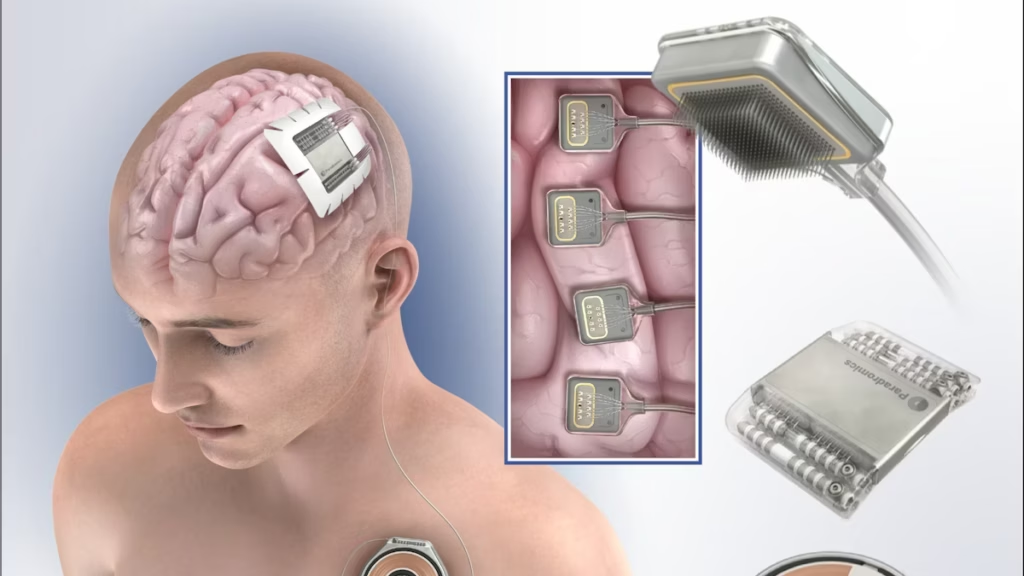
Paradromics is not the only company investing in the development of BCI technologies. Interest has skyrocketed in recent years with the entry of other innovative players into the field, such as Elon Musk 's Neuralink .
Each company’s BCI is slightly different, but Paradromics is designing a BCI that can record brain activity at the level of individual neurons — something that sets it apart from other competing approaches in the space. Matt Anglelikened the technology to placing microphones inside rather than outside a stadium: “Inside the stadium, you can hear individual conversations clearly. Outside, all you hear is the noise of the crowd.”
Elon Musk's Neuralink has also implanted its own chip into a patient. Musk also believes the company's technology could help treat various neurological disorders, such as dementia, depression and epilepsy. Neuralink's technology could also allow humans to synchronize with artificial intelligence, offering an alternative solution to the problem of AI superiority.
Source: www.cnbc.com
