

Even in the clearest starry night sky, with minimal interference from light pollution, the stars in the sky appear as blurry round spots even with binoculars.
See also: Hubble telescope detects a voracious black hole
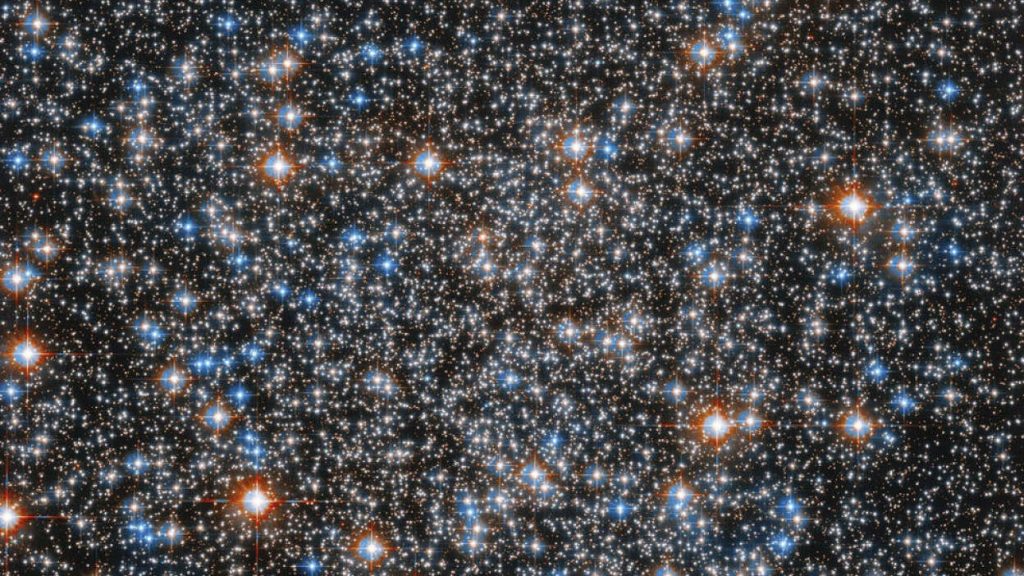
In a newly released image from the Hubble Space Telescope , the star-filled Sagittarius star cluster appears like an exquisite display of sparkling jewels against a midnight sky. Brilliant and majestic, star clusters are captivating, rich spheres of stars that sparkle like cosmic disco balls across the universe. This celestial beauty is known as Messier 55, or the “Summer Rose Star.”
The Hubble telescope has an advantage because of its low Earth orbit ,which allows it to distinguish individual stars within clusters. Although telescopes on Earth can also detect stars in M55, their number is significantly smaller. By harnessing Hubble's capabilities, astronomers have been able to revolutionize our understanding of star clusters, allowing them to observe what kinds of stars live within them. Researchers are fascinated by how asteroids evolve over time, as well as the role gravity plays in their structure.
The Hubble Space Telescope has made a significant contribution to our understanding of “blue stragglers,” a phenomenon observed in star clusters like this one. These objects earned their nickname because of their bluish hue and relative youth compared to the surrounding stars.
See also: Hubble NASA: New image shows an "intergalactic bridge"
In some cases, stars receive additional fuel that results in an energy boost, making them brighter and more massive. Astronomers hypothesize that phenomenon results either from a star pulling in matter from another nearby cosmic body or when two stars collide with each other. This remarkable phenomenon causes blue stragglers to age in reverse, from old age to the most youthful stage of their stellar life.

Messier 55 is an incredible star cluster, with 100,000 stars, monitored by NASA and the European Space Agency. This photo is just a glimpse of the entire expanse, spanning 100 light-years.
In 1752, a French astronomer in South Africa first discovered the star cluster. Unfortunately, Charles Messier failed to recognize the beauty of Messier 55 when he compiled his collection of nebulae and star clusters. This lack of recognition could be due to the fact that he couldn't see its stars well, NASA notes.
See also: NASA and SpaceX want to extend the life of the Hubble telescope
The sheer force of gravity exerts its influence on the stars of this cluster, causing them to gather together and form a spherical shape. This cluster contains 55 variable stars, whose brightness fluctuates over time.
Throughout March, astronomers of all backgrounds – amateur and professional – are aiming to observe each of the 110 Messier objects visible in the northern hemisphere. Naturally, Hubble has photographed almost every one of them.
