

It is official: Farfarout is the most distant (known) object of our solar system.
The planetoid (minor planet) Farfarout was first detected in 2018, at an estimated distance of 140 astronomical units (AU) from the sun – the furthest away from any object we know of. (An AU is the average Earth-Sun distance – about 93 million miles, or 150 million kilometers. To put that into perspective, Pluto orbits at an average distance of about 39 AU.)
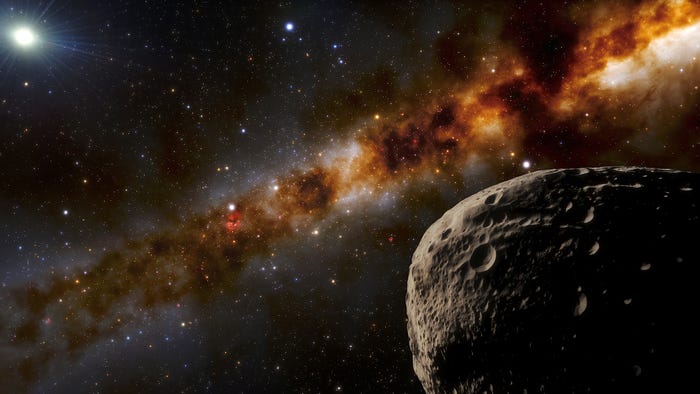
Farfarout's intrinsic brightness suggests a world about 250 miles (400 kilometers) wide, enough to qualify as a dwarf planet. But the size estimate assumes the world is largely made of ice, and that assumption could change if scientists identify other details.
And speaking of more observations: The detection team has now gathered enough data to confirm Farfarout's existence. As a result, the planetoid has just received an official designation from the Minor Planet Center in Cambridge, Massachusetts, which identifies and calculates the orbits of small objects in our solar system.
This definition, announced on Wednesday (February 10) in an electronic circular of the Minor Planet Center, is 2018 AG37.
Astronomers spotted Farfarout using the 8-meter (26.2-foot) Subaru Telescope on Maunakea, Hawaii, and tracked its orbit using the Gemini North and Magellan telescopes.
Farfarout is about 132 AU from the sun, according to the researchers, and its orbit is now known to be highly elliptical.
The team that discovered Farfarout is known for detecting objects in the dark and cold outer solar system. For example, in 2018, researchers found the distant object Farout and a distant dwarf planet called “The Goblin”.
And to be clear: Farfarout's distance record refers to current location . There are many other objects, such as the dwarf planet Sedna, that are much further away than Farfarout's location.
Information source: space.com
