

Google said it will start highlighting websites it considers fast in Chrome, starting with the Android mobile browser.
When users long-press on a link, Chrome for Android will add a "Fast link" label if the website in question "has historically been fast for other users," the company said.
“The labeling is based on signals from Core Web Vital metrics that quantify key aspects of the experience , as experienced by real Chrome users,” the publication said.
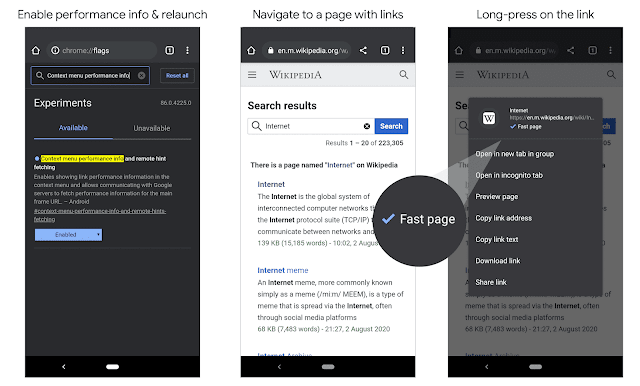
“Core Web Vital metrics measure dimensions of web usability, such as load time, responsiveness, and the stability of content as it loads, and establish thresholds for these metrics to set a bar for providing a good user experience.”
The label/label is initially rolling out in the beta channel of Chrome version 85 for Android , and users will need to use lite mode or hand over anonymous browsing data to Google via the “Perform searches and better browsing” setting in Chrome.
“We believe the web plays a critical role in our lives, and we hope that fast highlighting proves useful to users who experience slow or poor network. Over time, we may also experiment with highlighting in other parts of the Chrome web interface,” he said.
In May, Google said it began incorporating Core Web Vital metrics into search rankings.

At the same time, the giant company said it will end the use of AutoFill in mixed forms and will begin warning users when they start entering data into a mixed form that is not secure.
“These ‘mixed forms’ (forms on HTTPS sites that do not submit to HTTPS) pose a risk to user security and privacy ,” it said
“Information submitted on these forms can be visible to eavesdroppers, allowing malicious parties to read or alter sensitive form data .”
When a user submits a mixed form, the browser will display a warning page asking if they want to continue.
Google said that the password manager in Chrome will still work with mixed forms, despite changes to form that are set to arrive in version 86.
"Chrome's password manager helps users enter unique passwords , and it's safer to use unique passwords even on securely submitted forms than to reuse passwords," he said.
Last week it was announced that Chrome 86 would begin testing hiding the full URL in the address to combat phishing. Google said it would randomly assign users to test the functionality.
When users hover over the URL, it will expand to show the full address.
Version 86 is also set to arrive with the ability to detect and offload heavy ads, as well as JavaScript for better battery performance.
