

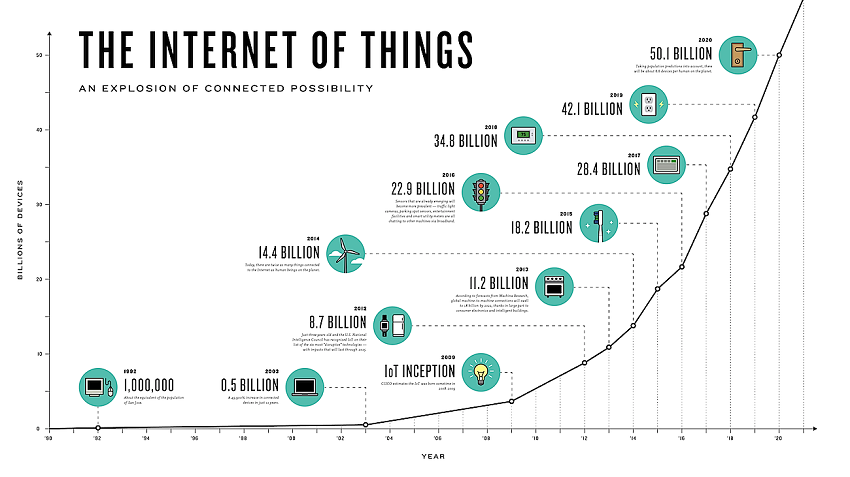
The number of IoT devices is growing rapidly. According to analyst firm Gartner, there will be more than 26 billion connected devices worldwide by 2020. The difference with previous years is significant, since in 2016 there were only 6 billion IoT devices.
This is easily explained, since it is the core technology behind smart homes, self-driving cars, etc.
However, many IoT devices have become targets of attacks, negatively impacting the trust not only of consumers but also of businesses. Below, we will look at the 9 most critical security facing IoT devices.
- Old software and hardware.
The majority of IoT devices do not have enough updates, and some of the devices have not done even one. This means that these products are safe at purchase, but become vulnerable to attacks when hackers discover bugs or security issues.
When these issues are not fixed with regular updates for both software and hardware, devices remain vulnerable to attacks. In general, for anything connected to the Internet, even the smallest device, frequent updates are essential.
- Use of weak credentials.
IoT devices often come with default credentials. Hackers need the username and password of a device to perform an attack. When they know the username from the start, they can brute-force attacks to achieve what they want. That's why credentials should be changed immediately after acquiring the device.
- Malware and Ransomware.
Due to the evolution of connected devices, the types of cyberattacks are increasing. Given that these systems contain personal information and data, users may be asked for a monetary fee to recover their data.
- Prediction and prevention of attacks.
Hackers constantly discover new cyberattacks. Thus, it is imperative not only to fix system vulnerabilities but also to predict attacks from the outset.
- Difficulty in identifying an infected device.
The issue with IoT devices is that users, most of the time, do not know if they have been attacked. This happens because when there are many devices, simultaneous monitoring of all of them is not easy.
- Data protection.
In this series of connected devices, protecting data has become very difficult because it is transferred between many devices in a matter of seconds. Almost never all devices through which data, since a leak can always occur.
- Use of data management systems.
The amount of data entering the connected devices is large. Thus, it will undoubtedly require the use of AI tools to manage them. The risk here lies in the fact that even the smallest configuration errors can cause a service interruption. This is critical, especially for large enterprises.
- Home security.
Now more and more buildings and apartments are becoming smart, since they are equipped with IoT devices. The problem is, not everyone knows the best cybersecurity. When hackers gain access to the devices, the user's personal information, such as home address and contact information, is compromised. This fact leaves the possibility open for other attacks.
- Security in autonomous vehicles.
Self-driving cars can be “hijacked” by hackers from a distance. In this way they will have control and the ability to cause accidents and put the driver, the passengers, and also the surrounding vehicles at risk.
