

How does Facebook who your friends are, and even better than you do?!
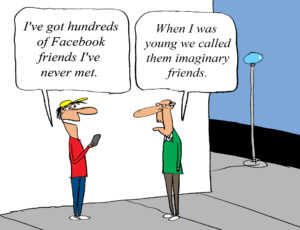
The social media giant uses a mix of complex science and mathematics to display your suggested list of friends!
Have you ever wondered how Facebook can and does accurately predict your friends, sometimes even those you've long forgotten?!
https://www.secnews.gr/102234/olh-h-python-language-se-mia-eikona/See also: The entire Python Language in a single image… see it!
Last week, a Redditor named easyJet posted a thread on Reddit in which he claimed to have signed up with an email address he never used. He even provided false personal information and other personal information. However, Facebook was able to accurately predict and recommend a huge number of his real-life acquaintances, including a woman he had dated 19 years ago!!!

So how does Facebook know who your friends are? Did it gain access to your phone and your list of names and numbers? Did it run a reverse-image search of your picture?
No. Facebook didn't try any sneaky or malicious way to find our friends. It uses a fairly complex academic field called . . . network science.
In short, every time you sign up for a Facebook account, it asks you for permission to look at your email contacts, if you're on a computer, or your phone contacts, if you're on a smartphone. When permission is granted, it searches your contacts for users already on the network, and looks for uploaded contacts related to you from other contacts.
https://www.secnews.gr/102163/free-pdf-password-remover-software/Read: Break PDF passwords with 4 Free Password Remover Software! 😉
This gives Facebook a basic idea of who you are, your social circle. This information often proves to be better than your memory.
Armed with a basic idea of you, Facebook begins to refine its database by asking you for more information about yourself, asking questions like: where did you go to school, when were you born, what city do you live in?.
Unbeknownst to you, each of these fields you fill out on your Facebook profile and every interaction you make through that profile automatically doubles the data source that feeds Facebook's mapping algorithms.
Once Facebook knows the structure of your social network, it can analyze it and predict (with astonishing accuracy), not only the people you are most likely to know now, but also the people you are most likely to meet in the future. What FB does is not magic, it simply plays with variations and combinations.
https://www.secnews.gr/102239/debian-linux/btn-large” variation=”btn-success”]Read more: Debian Linux: Understanding the Universal Operating System!
So, the next time you see that Facebook has introduced you to a long-forgotten friend, don't be surprised!!... that's the power of statistics.
