

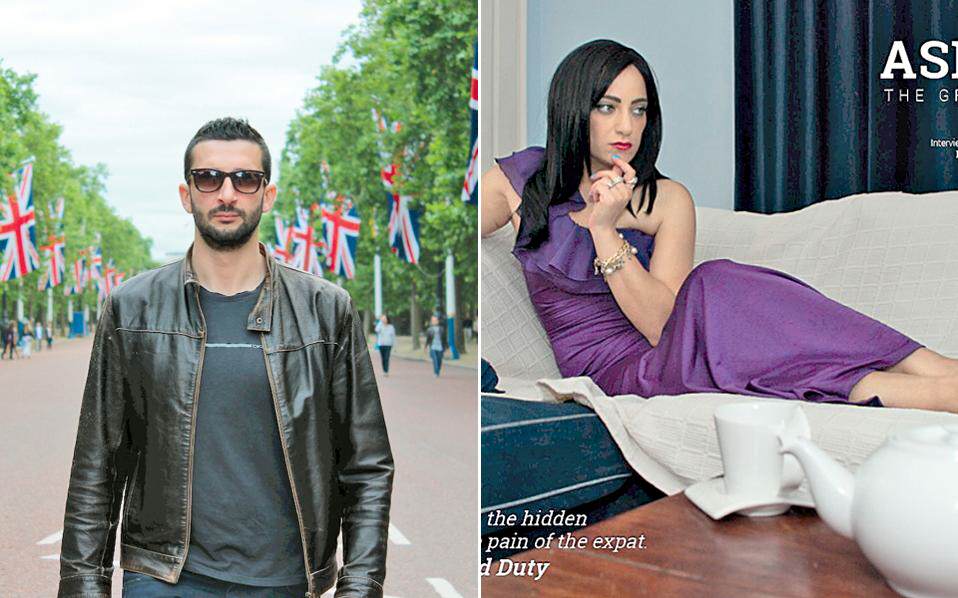
What will happen when Alexandros Gatsampeas, scion of a well-known bourgeois family, persecuted after his father's arrest for debts to the State, decides to leave Glyfada and emigrate? What will happen to Kotsos Bozidis, who emigrates, angered by the milk cartels that crushed the family business in Kilkis? Pontian Kotsos and Glyfadiotis Alexandros, like Aunt Maria from the Occupied Territories, the ruthless stockbroker Angela Deli or the promising academic Zisis Daskalopoulos, we could well meet on a walk in metropolitan London, if they were not fictional heroes created by the pen of Asimida Koutsidiou, born Sofia Giusou.
The 34-year-old blogger laid the foundations for a digital short story, “The Bitter Tea of Abroad,” which presents the everyday life of Greeks abroad with a strong dose of humor and a sense of self-criticism. “Living in England for over ten years, I receive all kinds of questions every day from potential immigrants,” Sofia tells “K,” “from how to find a house to what vaccinations they should give their dog.” One of the conclusions of her daily communication is the omnipotence of stereotypes. “In the minds of many, the Greek in London has specific characteristics and a predetermined -bright- future,” she explains. "So, we all automatically progress as soon as we cross the border, we are paid handsomely despite racism against Greeks, we are tormented by nostalgia for our homeland and we do not deviate even a millimetre from the Greek way of life." But is it not always like this?
The deep-rooted beliefs, which have been based on personal but isolated experiences, are being satirized by the online digital series, which will consist of short videos, a written summary of each episode, video clips with songs, and even scenes in the form of a photo novel. Since the end of April, the "universe" of the series, which has its own website (www.pikro-tsai.gr), a Facebook page and a Twitter account, has begun to be set up. Sofia initially set the axis, but the heroes, the episodes and the development of the plot are shaped dialogically following suggestions from Greeks on both sides, as well as from active contributors, such as graphic designer Konstantinos Papakonstantinou, the music band Niavent, cameraman Kostas Velianos, etc. “The cultural origins of all of us are common, they come from the Greek cinema of past decades, the television series, the best-selling books and the urban myths with which we grew up”. This is also highlighted by the subtitle: “London. Pain. Immigrants. Only two pregnant women”.
Asimida Koutsiidou herself, who with her intense makeup and mysterious gaze leaves an indelible mark on the project, is an exaggerated caricature, "inspired by the great ladies of the theater, TV presenters and actresses, completely unaware of their imperfections." The other characters are as diverse as the population mosaic of modern immigrants, including the “poor but honest young man”, the “spoiled rich kid”, the “visionary student”… The universe of “tea”, which replaced coffee due to the British environment, is so solid that it often creates the illusion that the screenwriter is a real person who gives interviews to “Hellno” (an anagram of the British gossip magazine “Hello”), writes books, addresses profound sayings to her followers on Facebook, while the acclaimed series is played in the prime zone of British television. “I’ve been asked if Asimida and I are twins, because… we look alike!” says Sofia teasingly.
Hesitations
As, of course, the boundaries of satire are blurred and the issue of immigration extremely sensitive, the contributors do not hide their hesitations. “I am afraid of possible failures,” confesses Sofia, who is now meeting each of the 30 Greek actors in London who are interested in participating on a non-profit basis. “As I emigrated long before the crisis, I may find it difficult to identify with those who are now forced to leave, at an old age, with wives and children,” she notes. “But I also faced difficulties, hardships and loneliness. However, I firmly believe that living in another country can offer you a lot. Let’s not focus, therefore, only on nostalgia.” This reality, after all, is embodied in the way the project is implemented: the actors "steal" time from their jobs, stay up late discussing script details, and shoot on Sundays. For their own pleasure.
Source: kathimerini.gr
