

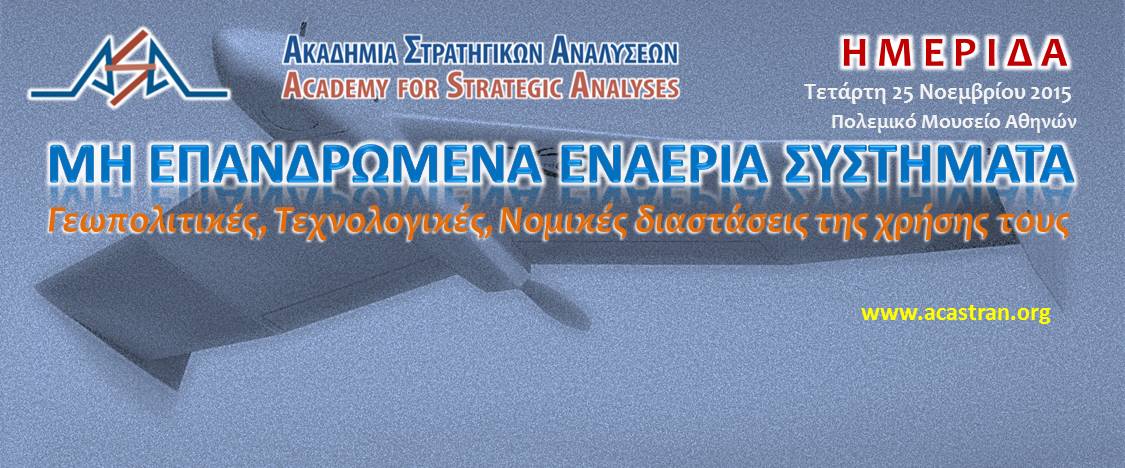
The Academy of Strategic Analyses, within the framework of its activities, with particular interest in Strategy and Security, is organizing a Conference on the topic: Unmanned Aerial Systems – Geopolitical, Technological and Legal Dimensions of their Use
The purpose of the Conference is to present the Unmanned Aerial Systems in use and under development, their technical characteristics, their development prospects, the environment of their use, the possibilities offered and the limitations imposed, the military and civilian applications. Also, to describe the legal framework of their use, the issues of human rights protection and other related issues that arise. Finally, to bring experts from the military and civilian fields, organizations, services, industry, universities, research centers, into contact with Unmanned Aerial Systems.
The Conference will take place in Athens, at the War Museum amphitheater, on Wednesday, November 25, 2015, from 09.30-14.30.
Three sections will be organized with the following topics:
1. Presentation of MSEs, Trends and Limitations
2. Technological developments – Research projects for the development of MES
3. Fields of application & operational exploitation of the MES
Other information about the organization of the Conference will be published on the ASA website (www.acastran.org) and on its Facebook page.
Organizing Committee Secretariat: asa@acastran.org
CONFERENCE OVERVIEW
GENERAL – PURPOSE
The Academy of Strategic Analyses, within the framework of its activities, with particular interest in Strategy and Security issues, is organizing a Conference on the topic: "Unmanned Aerial Systems: Geopolitical, Technological and Legal Dimensions of their Use".
The purpose of the Conference is to:
• present the Unmanned Aerial Systems in use and under development, the technical characteristics of modern UAS, and the prospects for their further development,
• present the environment of their use, the possibilities offered and the limitations imposed,
· describes the legal framework of their use, the protection of human rights and other related issues that arise,
· present the military and civilian applications of MES and the prospects for their use in the future, both in the operational environment and in civilian sectors of activity.
· brings together experts from the military and civilian sectors, organizations, services, industry, universities, research centers, and Unmanned Aerial Systems
INTRODUCTORY THOUGHTS
Unmanned Aerial Systems, which are basically applications of robotics, are expected to dominate the century we are living in and to have a catalytic impact on strategic perceptions in the field of security and beyond, in the military and civilian sectors.
In particular, Unmanned Aerial Systems – commonly known as “drones” – have emerged as major force multipliers, as they can provide effective surveillance capabilities at a relatively affordable cost, thereby enhancing situational awareness and intelligence gathering for military planners and political decision-makers. They also enable the reduction of ground forces, and over the next few decades, combat drones will bring significant changes, if not revolution, to aerial combat.
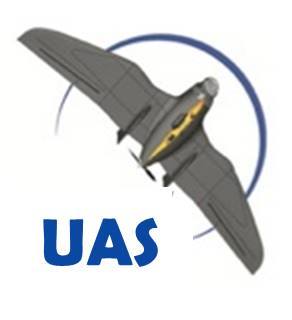 At the same time, the use of drones in non-military sectors – even by ordinary individuals – offers new, unprecedented possibilities, ranging from communications and surveillance to medicine, transportation and firefighting, while also creating problems of a technical and legal nature.
In the US, the Federal Aviation Administration (FAA) has accepted the name UAS (Un-manned Aircraft System) on the grounds that they constitute complex systems that include ground stations and other elements, in addition to the aerial vehicles themselves. On the part of the European Union, the name Remotely Piloted Aircraft System (RPAS) is adopted, in order to highlight that "the systems used are not fully automatic but always have a pilot responsible for their flight".
FACTORS UNDER ANALYSIS
The development of the use of MNEs, consequently, requires the examination of the geopolitical parameters that characterize and shape the corresponding environment and, by extension, the area of their use.
The legal dimension of the use of unmanned aerial systems refers mainly to civilian systems and in particular to their control for safety , as well as the protection of human rights from their uncontrolled use. Specifically, some restrictions are placed on their flight, such as: minimum distance from airports, special no-fly zones, flight bans over military bases, industrial facilities and other special areas.
Technology is perhaps the most important subject in the examination of drones. Technological developments in Unmanned Aerial Systems are rapid, research and development of new systems – military and non-military – is ongoing, and thus the use of new systems is expected in the near future, creating a different environment.
In Greece, there are various Unmanned Aerial Systems in the research & development phase, both for military and civilian uses, in industry, in university research laboratories, research centers, etc. In several of these, participation in transnational programs and collaborations is involved. It is therefore useful and appropriate to present these developments in research and development.
ORGANIZATIONAL
The Conference will take place in Athens, at the War Museum amphitheater, on Wednesday, November 25, 2015.
Three sections will be organized with the following general topics:
1. Presentation of MES, Trends and Limitations
2. Technological developments – Research projects for the development of MES
3. Fields of application & operational exploitation of the MES
Organizing Committee
§ Dr. Ioannis Parisis, President of the Board of Directors of the Hellenic Medical Association
§ Dr. Georgios Geroulis, Vice President of the Board of Directors of the Hellenic Medical Association
§ Dr. Nikitas Nikitakos, Member of the Board of Directors of the Hellenic Medical Association
§ Dr. Georgios Kougioumtzis, Member of the Board of Directors of the Hellenic Society of Athens
§ Dr. Ioanna Malagardi, Member of the Greek Academy of Sciences
§ Dr. Marinos Papadopoulos, Member of the Hellenic Medical Association
Other information about the organization of the Conference will be published on the ASA website (www.acastran.org) and on its Facebook page.
Organizing Committee Secretariat: asa@acastran.org
