

The predictability of humans can hardly be overstated. This predictability can easily be exploited when it comes to things like passwords, secret words, PINs, and more. Many of us use names, birth dates, and other easy-to-guess things as passwords, not to mention the really obvious “12345,” which is still surprisingly popular. But what about lock screen patterns, are we predictable when we create them? As it turns out – we are.
Researcher Marte Løge from the Norwegian company Itera, conducted an analysis of what patterns people actually create when asked to do so for three scenarios: a shopping app, a smartphone lock screen, and online banking, respectively. The results are quite impressive.
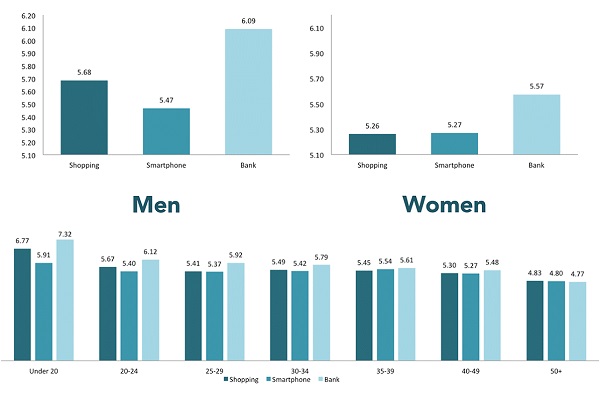
First, there is a strong correlation between the type of app someone wants to lock and the strength of the pattern. People tend to use less strong patterns to lock their smartphone screen than they do for online banking or even shopping apps.
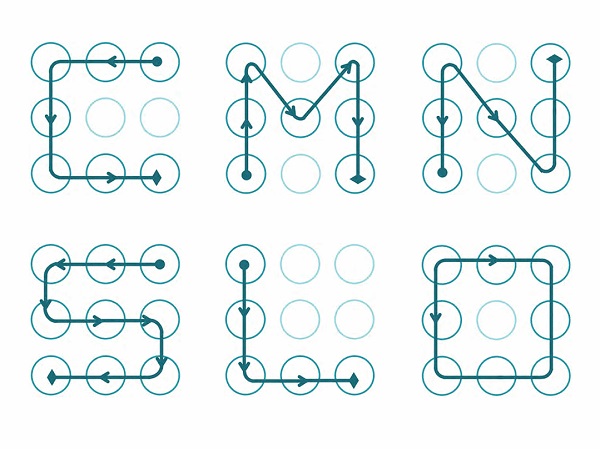
Secondly, many people, around 10% of the thousands surveyed by Løge, are using letter-like patterns, which are equivalent to the codes "12345" and by any means cannot be considered strong enough to protect anything.
Third, there are about 390,000 combinations that a hacker can guess, but the number of combinations can be reduced due to human error. The majority of the combinations mentioned above contain eight or nine digits, but unfortunately these are not used. Instead, the actual number is about 100,000 combinations.
Another strange fact is that women tend to use weaker patterns than men. And a person's age also plays a role: the younger you are, the more likely you are to use a stronger pattern. So knowing a person's gender and age can really help predict the pattern he or she is using.
What can we learn from this research? Basically, if you use patterns for your Android lock screen or certain sensitive apps, and you really want to protect your data, the best strategy is to act like no one else. And these are our tips:
1. Never use obvious combinations such as patterns that look like letters. Using this weak pattern is like not using a pattern or password at all.
2. Use one of the rarely used starting points: the best ones are in the middle of the right side. The bottom right corner is also very good.
3. The best lengths for a pattern are 8 points or 9 points: First, it gives you a huge number of possible combinations and second, these lengths are less popular.
4. And of course, consider switching from a password to a pattern. It can be easier to remember a password, even a very long one, than a fairly strong pattern.
