

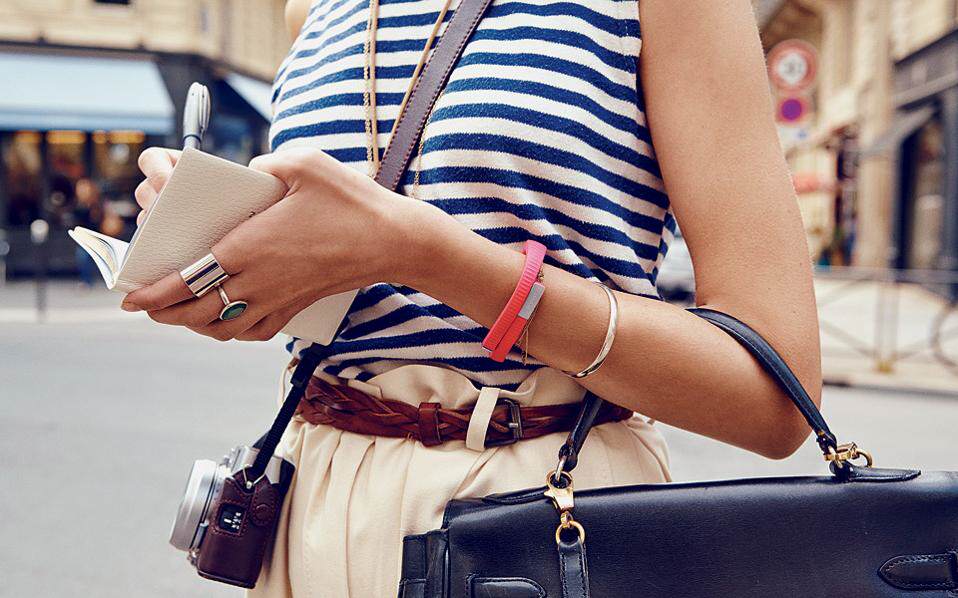
The slogan of the advertising of the Californian company Jawbone, which has been causing a stir for several days with its latest upgrade to the UP, a rubber electronic bracelet with an accelerometer and Bluetooth that communicates wirelessly with your smartphone and records physical activity, calorie consumption, duration and quality of sleep. The main idea: you wear it (after of course you have purchased the advanced model at the price of 149.99 dollars), you download the corresponding application (for iPhone and soon Android) and you register everything you eat (by photographing or scanning the barcode or choosing from the predefined food list). That keeps… score, counts calories (approximately), records habits, encourages weight loss and puts you in a process of competition with your “friends” via social networks and a constant confrontation with yourself.
Even if you're not completely honest and hide, for example, the huge chocolate bar a colleague bought you at the office or the whiskey you needed after a hard day at work, the tracking method is said to be fruitful, as it ensures awareness and helps with comparison, day by day. The bracelet counts your steps (with a daily base goal of 10,000), vibrates when you spend more than an hour motionless (this is adjustable), "wakes up" with a light pressure when you exercise, knows when you fall asleep and when you get up, vibrates again to wake you up at the right time. And all of this, in a magical way, is combined, evaluated and gives you a relatively complete picture of how you are doing as a person who (claims to) be concerned about his health. The company says it's now working on integrating with restaurant menus (at least for American consumers) to further simplify the user experience. What the bracelet "feels" is displayed on the phone with pleasant, clear graphics, comparison bars, points, and everything else required to get you started on the stressful process of self-monitoring.
Jawbone's bracelet-application is one of the most popular on the market, but not the only one, as the technological world turns towards the "Internet of Things", commonly devices that will communicate remotely with each other and with the user, just as Mark Weiser, director of technology at the Xerox PARC research center, predicted 25 years ago: "The most pervasive innovations are the invisible ones, the ones that become one with our daily lives to the point where you don't notice them." A recent survey in the US showed that 70% of respondents would even accept the analysis of their bodily secretions by sensors in the toilet, as long as this helped save money on check-ups. "Data is power," Renee Blodgett, vice president of marketing at Kolibree, the world's first "smart" and interconnected electric toothbrush (!) told the Guardian. "For the first time, we're capturing real-time information about where, how and how much we brush our teeth and how we can improve. In the past, we waited for our annual visit to the dentist for a cleaning.".
It goes without saying that the health and wellness sector is the most promising for the manufacturers of these gadgets, who are already engaged in fierce competition in technology and impressions and are all anxious for the moment when Apple will invade their “field”, as is rumored. According to a study by the market research company Canalys, 17 million wearable technology devices, including fitness trackers and smart watches, are expected to be sold in 2014 alone. Next year, the number will rise to 23 million and in 2017 it will exceed 45 million. “Although the market is currently relatively small and aimed at fitness enthusiasts, bracelets promise enormous growth opportunities in the health and wellness sector,” the research said. In this context, some manufacturers are already advertising unrealistic functions. HealBe claims that the GoBe bracelet can even measure glucose levels, and when the New York Times reporter asked how this is done without giving a single drop of blood, they started chewing him out, like "uh, it's not a medical device, nor is it completely accurate, nor do we recommend it for use by diabetics.".
In the US, which is by far the most mature market for these gadgets, many journalists have spent weeks and months testing wristbands from various manufacturers, coming to the general conclusion that they all have their weaknesses. One wristband showed that he was walking while sitting at a desk, another showed that he was stationary while cycling, and so on. “These technologies will gain enormous potential over time, but I think it will take many years,” said Dr. David Blumenthal, a former health adviser to President Obama. Until then, everyone is struggling to gain a comparative advantage.
The company Bodymedia measures sweating and muscle temperature (!), Basis Science also measures sweating, temperature and heart rate, while Jawbone… made a UP tester angry when it warned him that, “by going to bed 30 minutes later than your average, the next day you are likely to take 971 fewer steps”. The ultimate goal is to create personalized records of eating habits, which will assess how healthy you eat and will recommend, for example, when you enter “fried egg”, to accompany it with wholemeal bread. A common denominator in user comments is that the bracelets generally favor activation in the first period, but from then on they require alertness and discipline. Just like a healthy life without them…
Source: kathimerini.gr
