

Legal Escalation: On Monday, August 3, 2026, Apple filed a motion for a preliminary injunction against OpenAI in the Northern District of California Federal Court, as well as a simultaneous motion for expedited discovery, bringing the trade secrets to a new phase. The two companies have been publicly sparring with harsh language, while OpenAI has published an article exposing procedural errors by Apple's lawyers and emails showing that Apple employees were requesting information from their former colleague Chang Liu after he left — not the other way around. The Greek guide to the Apple OpenAI lawsuit explains exactly what Apple is seeking, who the names of those involved are, why OpenAI is fighting back so aggressively, what the emails show, and what the case means for Greek businesses and iPhone users.
See also: Claude or Copilot in a Greek business: AWS Bedrock for GDPR and DORA compliance
Contents:
- Apple sues OpenAI: What exactly is it accusing and what is it asking for?
- The new request for a temporary injunction of August 3
- What specifically are Tan and Liu accused of?
- OpenAI counterattack: Emails expose gaps in Apple's approach
- The role of Jony Ive and io Products
- Is ChatGPT affected on iPhone? The clear answer
- Impacts for Greek businesses and users
- Legal precedents: Why the case remains uncertain
- Frequently Asked Questions about Apple's lawsuit against OpenAI

Apple sues OpenAI: What exactly is it accusing and what is it asking for?
The lawsuit, Apple Inc. v. Liu et al., No. 5:26-cv-07078, was filed on July 10, 2026, in the U.S. District Court for the Northern District of California. The defendants include the OpenAI Foundation, OpenAI Group's commercial subsidiary PBC, hardware startup io Products LLC (which OpenAI acquired in May 2025 for approximately $6.5 billion), and two former Apple executives: Tang Yew Tan, now OpenAI's Chief Hardware Officer and former vice president of iPhone and Apple Watch design, and Chang Liu, a former Apple senior electrical systems engineer.
Apple alleges that over 400 former employees are now working at OpenAI and that the mass defections constitute a coordinated effort to steal trade secrets. The main charges under the Defend Trade Secrets Act (18 USC § 1836) and the California Trade Secrets Act:
- Four counts of trade secret misappropriation against OpenAI, io Products, Tan and Liu
- Two counts of breach of confidentiality agreement — only against Tan and Liu, since only they signed it
- Request for a permanent injunction prohibiting the possession, use or disclosure of the secrets
- Requirement to return all Apple hardware and terminate access to systems
- Damages, disproportionate profits, alternative reasonable royalty, punitive damages for malicious act
- Request for a jury trial — an aggressive strategic choice
U.S. District Judge Edward J. Davila is presiding over the case, while Magistrate Judge Nathanael M. Cousins is handling discovery matters. The first case management conference was scheduled for October 13, 2026, but Apple's move yesterday could speed up the process.
The new request for a temporary injunction of August 3
On Monday, August 3, 2026, Apple's lawyers filed a motion for a preliminary injunction, asking the court to immediately prohibit OpenAI and the two former employees from accessing, obtaining, using, or disclosing the confidential information. Apple's argument is clear: "Apple would suffer irreparable harm without a preliminary injunction"as OpenAI accelerates its efforts to create specialized AI hardware.
At the same time, Apple filed a motion for expedited discovery, asking the court to order sworn depositions from at least four people:
- Chang Liu — former Apple engineer, now OpenAI
- Tang Yew Tan — former Apple vice president, current Chief Hardware Officer OpenAI
- Yu-Ting Peng — OpenAI employee who may have relevant knowledge
- An anonymous OpenAI employee who previously worked at Apple
- Corporate representatives of OpenAI and io Products
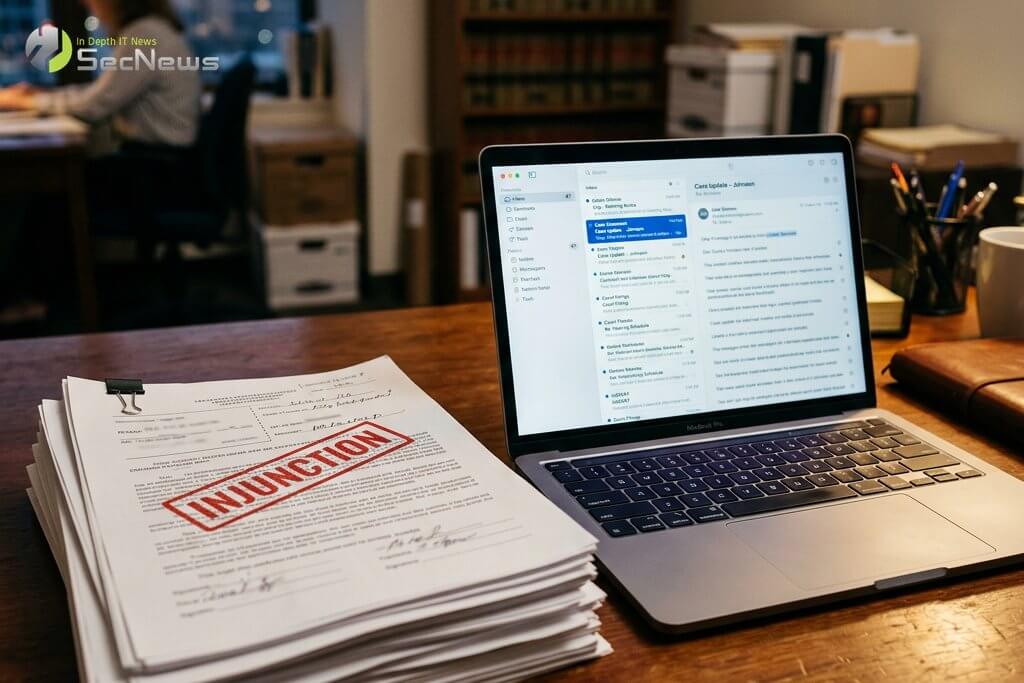
Apple's legal strategy is to trap OpenAI in a time-suffocating discovery timeline so it can obtain evidence before OpenAI cleans up the data internally. At the same time, the request for a temporary injunction, if granted, would immediately stop any use of the information at issue, even if the main case drags on for years.
What specifically are Tan and Liu accused of?
The allegations against Tang Yew Tan are particularly serious. Apple alleges that during interviews at OpenAI, Tan instructed candidates who were still active Apple employees to disclose confidential information. Most strikingly, Apple alleges that Tan asked candidates to bring actual parts from Apple to interviews for show and tell sessions — that is, to physically transport prototypes, components, and batteries so that his team could glean additional confidential information.
The charges against Chang Liu are equally serious but of a different nature:
- Apple claims he stole Apple laptop before he left
- He maintained constant communication with an active Apple employee, who continued to share internal information with him
- More seriously, Apple claims he exploited a software bug that allowed him continued access to Apple's internal file servers after he left on January 22, 2026.
- Download over 1,000 confidential technical specifications documents
Apple says it first raised its concerns with OpenAI in February 2026, writing about the alleged misuse of confidential information. According to Apple, OpenAI never responded — a point that OpenAI has now explicitly disputed.
Also useful: OpenAI ChatGPT Work: The new AI agent for businesses that runs workflows
OpenAI counterattack: Emails expose gaps in Apple's approach
OpenAI's response was unusually aggressive for such an early stage of the case. Rather than simply respond through the courts, the company published an extensive article on the official OpenAI blog titled Apple is getting this wrong. The main excerpt:
🔒 Protect your privacy with Proton VPN
Swiss VPN from the creators of Proton Mail — strict no-logs policy, strong encryption, and built-in NetShield that blocks ads, trackers, & malware.
- ✔ No-logs, based in Switzerland (except 14-Eyes)
- ✔ NetShield: blocks ads, trackers & malicious domains
- ✔ Covers all devices — free version available
The link is an affiliate link — SecNews may receive a commission at no additional cost to you. It does not affect the independence of our article writing.
"Apple is one of the greatest companies of all time and has built a reputation for its obsession with the smallest details. This negligent, aggressive and paradoxically personal lawsuit unfortunately does not live up to that reputation," the company officially stated.
OpenAI exposes three procedural gaps that it claims show Apple's lack of preparation:
- Apple's outside lawyers sent an email to the wrong person , confusing two Asian surnames. Apple only admitted it after OpenAI pointed it out.
- Apple claimed to have had a conversation with OpenAI's General Counsel. OpenAI claims the conversation never took place, and Apple has now admitted it.
- Apple did not bring the exact allegations of the lawsuit to the table before its filing — instead, it had told OpenAI that it was “resolving any issues,” which OpenAI interpreted as closure.
The most striking element of the backlash is the publication of emails that, according to OpenAI, show that Apple employees were reaching out to Liu after he left, not the other way around. Liu allegedly received messages from former Apple colleagues asking him to help locate files and answer technical questions.
“Apple is now trying to shift the blame to residual access, but it also fails to disclose that this is a common problem at Apple caused by its failure to properly manage access to systems when people leave,” OpenAI says. In effect, it claims that former employees are still accessing Apple files without meaning to, due to Apple’s own mismanagement of access.
For Tang Tan, the company clearly states: “Tan has always been clear with the team that we do not want, and should not use, any confidential information from other companies.” And it closes the statement: “Apple’s request for a temporary injunction is based on false information and is completely unnecessary, because we do not have nor want any of their trade secrets.
The role of Jony Ive and io Products
The legendary Jony Ive, Apple's former Chief Design Officer who left in 2019, is not named personally as a defendant. However, his company, io Products LLC, is a primary target. It was founded by Ive and acquired by OpenAI in May 2025 for about $6.5 billion, with the goal of creating AI-native hardware — rumored to be a wearable smart speaker or ChatGPT companion device, with an announcement in 2026 and a launch in 2027.
PP Foresight analyst Paolo Pescatore told Reuters: “Apple sees OpenAI turning from a partner into a potential rival, while OpenAI is trying to reduce its reliance on the iPhone and build a direct relationship with consumers. Even if the allegations are not proven, the lawsuit could set back OpenAI’s hardware ambitions and further weaken an already increasingly fragile partnership.
Meanwhile, the io has its own legal battle — a trademark dispute with the iyO platform, which led to a temporary injunction preventing OpenAI from using the io for hardware. The deadline for a formal dismissal or joint status update in the mediation is August 6, 2026.
See also: Perplexity Finance: The free AI Bloomberg killer has arrived on Wall Street
Is ChatGPT affected on iPhone? The clear answer
Many Greek iPhone users are worried whether the lawsuit will remove ChatGPT from iOS. The answer is clear: No.The lawsuit targets OpenAI's hardware development exclusively, not the software integration that runs on iPhones. Practically:
- ChatGPT remains available as a Siri fallback for knowledge questions
- Works normally in Writing Tools, Image Playground and Visual Intelligence
- Access from the iOS Settings menu for ChatGPT Plus subscription remains active
- Apple has not announced any changes to the integration
- The main reason: Siri no longer relies on ChatGPT. Starting in January 2026, the new Siri will be powered by Apple Foundation Models in conjunction with Google Gemini, through a multi-year non-exclusive deal worth ~$1 billion per year.
Apple's strategic diversification predates the lawsuit and allows it to launch a legal attack without operational risk to Siri. Essentially, Apple waited to free itself from technical dependencies before taking legal action.
Impacts for Greek businesses and users
For the Greek market, the lawsuit has three distinct dimensions:
- Greek iPhone users: No immediate impact. ChatGPT integration remains, as does the new Siri with Gemini backend. Greek natural language support remains unchanged
- Greek businesses with OpenAI Enterprise: Not technically affected, but the legal front introduces vendor stability risk that must be documented in DORA compliance for regulated sectors. Potential delays in product launches and higher legal costs may impact OpenAI's IPO (target Q4 2026)
- Greek tech startups: Case creates strong legal precedent for employee-based trade secret protection. IP protection and NDAs with executives who defect to competitors become critical, especially for startups in the AI hardware or software sector
The SecNews technical team recommends that Greek banks and insurance companies that have integration with OpenAI for regulated workloads review exit strategy plans according to DORA Article 30. Despite the absence of an immediate risk of service discontinuation, the legal front makes the choice of an AI provider based outside the European Union more vulnerable to compliance audits.

Legal precedents: Why the case remains uncertain
Despite the aggressive nature of the indictment, trade secret law experts express skepticism about Apple's chances of success:
- In dismissing Elon Musk's similar xAI lawsuit (June 2026), Judge Rita Lin ruled that "mere possession of trade secrets does not constitute misappropriation." Proof of active use is required.
- OpenAI has not released a hardware product yet, so it is difficult to prove actual harm.
- In California, non-compete clauses are void under California Business and Professions Code § 16600. An employee has the right to change employers freely.
- OpenAI has already achieved significant legal victories in similar cases — in May 2026, it won a high-profile trial against Elon Musk
- The emails that OpenAI published show that the responsibility for the information leak can be reversed towards Apple
The SecNews editorial team estimates that the case will last at least 18-24 months before reaching a substantive decision, with a possible outcome of a settlement or limited success for Apple on individual counts. The temporary injunction, if granted, would be a critical turning point.
Frequently Asked Questions about Apple's lawsuit against OpenAI
Will ChatGPT stop working on my iPhone?
No. No changes have been announced by Apple. ChatGPT integration remains active in Siri fallback, Writing Tools, Image Playground, and Visual Intelligence. The lawsuit concerns OpenAI's hardware effort only, not the iOS software integration.
When will we see OpenAI's ChatGPT hardware product?
The initial timeline was for an announcement in 2026 and a launch in 2027. The lawsuit could delay plans, force OpenAI to undergo more rigorous internal reviews, and make it more difficult to work with suppliers. In addition, the iyO trademark dispute prevents the commercial use of the io.
How is OpenAI's upcoming IPO affected?
OpenAI filed a confidential Form S-1 in June 2026, targeting a valuation of more than $1 trillion. Apple's lawsuit must cite updated risk factors as a material adverse event. This could delay the IPO or reduce the valuation, especially if a temporary injunction is granted against OpenAI.
Is it legal to hire employees from a competitor?
In California, yes — absolutely. Non-compete clauses are void by law. An employee has the right to change employers freely. However, transferring specific trade secrets or using confidential documents from a previous employer is not allowed — that's where Apple focuses.
What is the chance that Apple will get the temporary injunction?
Medium to low. Judges grant temporary injunctions only when there is clear irreparable harm and a high probability of success in the main case. OpenAI's objections to the emails and the excessive injunction limit the chances. However, expedited discovery is more likely to be granted.
How can Greek startups learn from this case?
Four key points. First, strict IP and confidentiality agreements with all employees. Second, exit interviews with deletion of access and immediate return of equipment. Third, monitoring for mass departures to a competitor. Fourth, internal review documentation for every hire from a competitor, especially for technical positions with access to trade secrets.
What does the case mean for Apple and OpenAI?
The filing of the lawsuit and OpenAI’s aggressive response mark the end of a partnership that began in 2024. While ChatGPT integration in iOS technically continues, Apple has already switched to Google Gemini for Siri and OpenAI is developing its own hardware. The two companies are now on a competitive, not collaborative, path.
Apple ’s lawsuit against OpenAI is the most significant legal battle in the AI space for 2026, with immediate implications for employee mobility, IP protection and enterprise vendor risk. The August 3rd injunction request and the emails published by OpenAI in response make the case highly uncertain. For Greek iPhone users, there is no immediate risk. For Greek businesses with OpenAI dependencies, the case adds a strong argument in favor of a multi-vendor AI strategy and documented exit plans. The SecNews technical team will monitor the judge’s decision on the injunction and the first case management conference on October 13, 2026. Sources: Invezz, OpenAI blog, Bloomberg, BBC News.
