

OpenAI ChatGPT Work is a new, comprehensive AI platform for businesses where AI agents don’t just answer questions, but take over entire workflows, run in the background in the cloud, and are shared across entire teams of employees. OpenAI unveiled the platform in a livestream on July 9, 2026, describing it as “the next chapter for ChatGPT” and marking the transition from an “AI as assistant” to an “AI as employee” model.
The announcement combined three separate products into a single package: the new ChatGPT Work, an upgraded desktop app with the Codex, and a hosted sites service for building AI-powered web experiences. The move shows that OpenAI has chosen not to lead with a new language model, but with an entire work platform — a sign that the next battle in the industry is being fought in the realm of enterprise adoption, not technical benchmarks.
What can new employment agents do?
ChatGPT Work ’s workspace agents can handle complete, multi-step workflows instead of individual tasks — they prepare reports, write and execute code, respond to messages, and follow processes defined by the team itself. The crucial feature is that these agents run in the cloud and continue to operate even when the user closes their laptop — which significantly differentiates them from older assistants that required an active connection.

A team can create an agent once and share it across the organization, so the same trained workflow is available to everyone with access — an approach reminiscent of the template reuse logic in automation tools, but applied to decision-making AI agents.
See also: Perplexity: Personal Computer AI is coming to Windows
Codex integrated into the desktop application
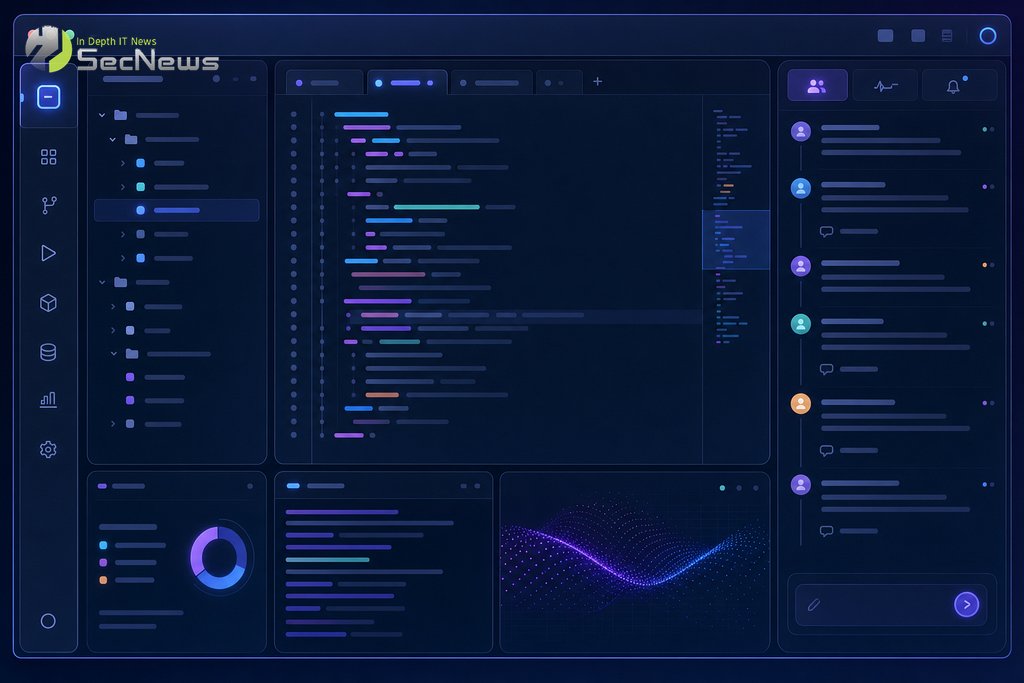
The upgraded macOS app now fully integrates with the Codex, adding a project sidebar, thread list, and overview pane for monitoring multiple parallel agent threads on long-running tasks at the same time. The app pulls pull requests directly from GitHub, allowing developers to review code and diffs produced by agents side-by-side, without switching between different tools.
Users can also directly edit Markdown or code within the app, asking Codex to review specific sections — a feature that significantly reduces the transition time between a code-writing tool and an AI tool, a friction that has traditionally slowed the adoption of AI tools in everyday software development.
Hosted Sites: Websites without a development pipeline
The new web hosting feature allows subscribers to publish AI-powered web pages directly from ChatGPT, without the need for a separate software development pipeline. Enterprise customers can create internal dashboards, reports and lightweight apps directly from within the chat interface, eliminating intermediate steps that traditionally required the involvement of a software development team.
For small and medium-sized Greek businesses that do not have an in-house software development department, such a feature could significantly reduce the cost of creating internal management tools, although the full assessment of the reliability and security of such rapidly produced applications remains an open issue for IT departments that must approve them.
See also: CaptiveCrunch: Midnight Blizzard attack on hotel Wi-Fi to steal credentials
ChatGPT for PowerPoint: Presentations from within the tool itself
In addition, ChatGPT for PowerPoint is now generally available to Enterprise customers, allowing teams to create and review editable presentations directly within Microsoft PowerPoint. Users can ask questions about the narrative and structure of slides, as well as create slides from reusable ready-made Skills and connected apps. The feature remains free for Enterprise customers until August 6, after which token-based pricing will apply.

The transition to token-based pricing
The pricing change for workspace agent executions went live on July 6, with the logic that the more a team uses agents, the more they pay — but also the more measurable and automated their output will be. This model reflects a broader trend in the AI industry, where pricing is shifting from flat subscriptions to pricing based on actual compute consumption.
For Greek companies considering adoption, the new pricing model means that costs are no longer predictable based on the number of users, but based on agent usage intensity — requiring more careful financial planning and consumption monitoring by financial services departments before full organization-wide deployment.
Access to models depending on subscription type
Free users and Go subscribers get access to the GPT-5.6 Terra, while Plus, Pro, Business, and Enterprise subscribers can choose between three editions — Sol, Terra, or Luna — by adjusting the computational effort level on a per-task basis. Pro and Enterprise subscribers also get access to Ultra mode, the highest level of reasoning power for the most demanding tasks.
🔒 Protect your privacy with Proton VPN
Swiss VPN from the creators of Proton Mail — strict no-logs policy, strong encryption, and built-in NetShield that blocks ads, trackers, & malware.
- ✔ No-logs, based in Switzerland (except 14-Eyes)
- ✔ NetShield: blocks ads, trackers & malicious domains
- ✔ Covers all devices — free version available
The link is an affiliate link — SecNews may receive a commission at no additional cost to you. It does not affect the independence of our article writing.
Competition in the enterprise artificial intelligence market
The enterprise AI market is now concentrated around a few major platforms — Microsoft Copilot, Google Workspace AI, Salesforce Agentforce , and now ChatGPT Work. The central question for businesses is no longer simply which tool helps them most at an individual productivity level, but which AI platform will “own” entire organizational workflows — a much more strategic and binding decision than simply choosing a productivity tool.
OpenAI did not explicitly mention Anthropic during the presentation, but the strategic shift toward full-fledged work platforms is an indirect response to the growing presence of competing AI products for enterprises that are developing similar autonomous agent capabilities.
Frequently asked questions
What categories of personal data do agents process when operating autonomously in the cloud?
OpenAI has not published a detailed list of data categories per use case, however, for Enterprise customers, existing data processing agreements apply that also cover the new autonomous execution feature, with the data remaining within the customer's contractual framework and not being used for model training without explicit consent.
Does staff need special training to create work agents?
The interface is designed so that agents can be defined through natural language and workflow examples, without requiring programming knowledge, although OpenAI recommends that companies appoint internal AI champions responsible for configuring and maintaining agents.
How does the Hosted Sites feature affect compliance with the European General Data Protection Regulation (GDPR)?
Websites created through the feature are hosted on OpenAI's infrastructure, which means that Greek and European businesses should carefully consider the geographical location of data storage and update their privacy policies before publishing pages that collect visitor data.
Is it possible to export or transfer an agent workflow to another automation tool?
No official export tool to third-party automation platforms has been announced, which creates a vendor lock-in issue for organizations that invest significant time in creating complex agents within the ChatGPT Work ecosystem.
What is the role of a human when an agent makes an incorrect decision in an automated workflow?
The platform maintains audit logs for every step an agent takes, allowing human supervisors to identify and reverse incorrect actions, although the ultimate verification responsibility remains with the client organization according to the Enterprise terms of use.
How much does the cost of development through Hosted Sites differ compared to traditional outsourcing?
Although there are no public comparative cost figures yet, the absence of a separate development pipeline and token-based pricing is expected to significantly reduce the initial cost for simple internal applications, although the overall cost in the long run depends on the intensity of use of each business.
