

The Chinese LineShine has emerged as the world's most powerful supercomputer, surpassing its American counterparts for the first time since 2021.
See also: US Department of Energy: Collaboration with NVIDIA & Dell for the new supercomputer
LineShine , installed at the National Supercomputer Center of China in Shenzhen, has topped the 67th edition of the TOP500 ranking, which evaluates the world 's most powerful supercomputers. The new system is already being used in various scientific and technological fields, offering researchers and developers another powerful computing platform.

The supercomputer, which went live in the first half of 2026, has a computing power of 2.198 exaFLOPS. An exaFLOP is one-fifth of a million (10¹⁸) floating-point operations per second (FLOPS), making LineShine the only supercomputer in the world to surpass the 2 exaFLOPS. It is also the first time since 2017 that China has hosted the world's fastest supercomputer. FLOPS are used as a basic measure of computing performance, with exascale supercomputers capable of performing more than one-fifth of a million such operations per second. For comparison, a modern home computer can perform about 5 trillion FLOPS.
According to the TOP500, LineShine is about 22% faster than El Capitan, the supercomputer operating at Lawrence Livermore National Laboratory in California and held the top spot since November 2024.
According to a statement from China's National Supercomputer Center, the system's computing power is the result of "a comprehensive overcoming of a series of critical technological obstacles."
See also: The world's most powerful supercomputer will have 100,000 AI chips
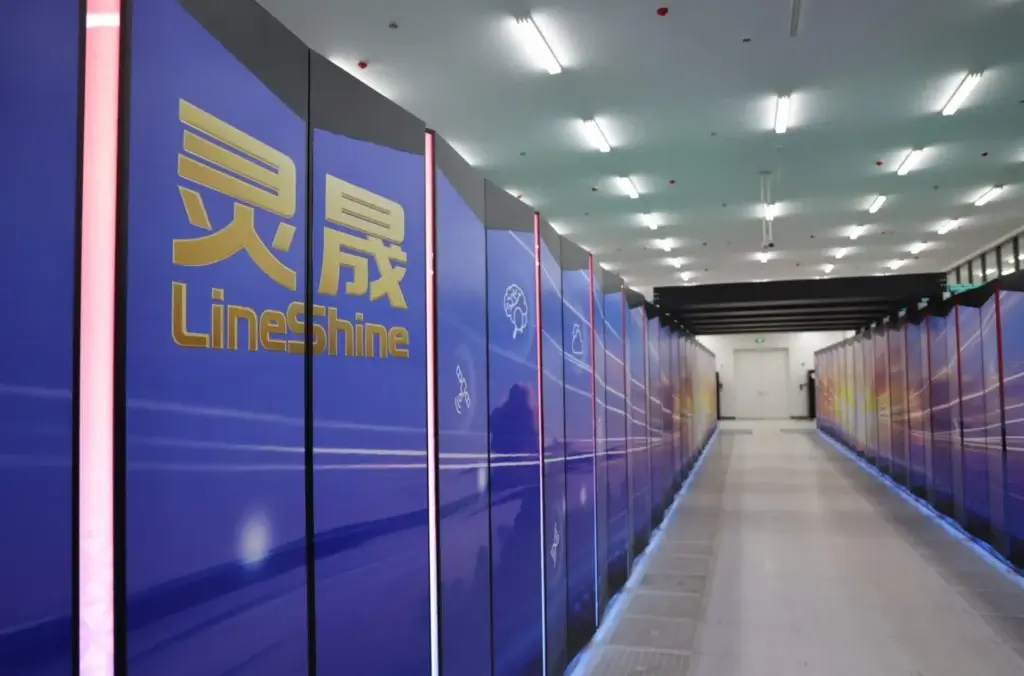
Unlike most modern supercomputers, LineShine relies solely on central processing units (CPUs) to perform calculations. Most competing systems utilize both CPUs and graphics processing units (GPUs), which accelerate performance by performing multiple tasks simultaneously through multiple specialized cores. Since 2018, the United States has imposed restrictions on exports of advanced semiconductors to China, including GPUs. However, Chinese companies such as DeepSeekhave leveraged other technological innovations, managing to train AI models with fewer and lower-powered GPUs compared to comparable systems such as ChatGPT.
As noted in the same announcement, LineShine "marks a historic leap for the supercomputing sector in China, as it overcomes foreign technological restrictions and establishes an independent and fully controlled software and hardware ecosystem."
The new system is already being used in research projects covering a wide range of scientific fields, such as atmospheric science, drug discovery and artificial intelligence. In general, supercomputers are designed to perform extremely complex calculations at speeds many times faster than conventional computers, allowing them to solve problems that would otherwise take too long or be extremely expensive.
See also: Fugaku Next: The first "zeta-class" supercomputer

Behind LineShine and El Capitan, the third and fourth places in the TOP500 were occupied by two supercomputers operating in national laboratories in the United States, while the fifth place was occupied by a system located in Germany. The top ten most powerful supercomputers in the world are completed by systems installed in Italy, Switzerland, Japan and the United States.
