

NASA 's James Webb Space Telescope has set its sights on the Crab Nebula, a supernova remnant in the constellation Taurus, 6,500 light-years away. The Nebula was first recorded by astronomers in 1054 AD. Since then, the Crab Nebula has continued to attract attention as scientists seek to understand the conditions, behavior, and effects of supernovae through extensive study of the Nebula.
See also: James Webb: Peek into the depths of a nearby supernova remnant
Using Webb's NIRCam and MIRI, a team led by Tea Temim at Princeton Universityis seeking answers about the formation of the Cancer Nebula.
At first glance, the general shape of the supernovaresembles the image released in 2005 by Hubble . In the Webb image, a clear, cage-like structure of frothy gas filaments is shown. However, in the central regions, emission from dust grains (yellow-white and green) is mapped for the first time by Webb.
Further aspects of the inner workings of the Crab Nebula are becoming more apparent and observed in greater detail in the visible light recorded by Webb. In particular, Webb highlights what is known as synchrotron radiation: emission produced by charged particles, such as electrons, moving around magnetic lines at relativistic speeds. The radiation appears here as a hazy, smoke-like material throughout most of the interior of the Crab Nebula.
This feature is the product of a rapidly rotating neutron star at the center of the Nebula. The star's strong magnetic field accelerates particles to extremely high speeds and causes them to emit radiation as they rotate around the magnetic field lines. Although it is emitted across the entire electromagnetic spectrum, the synchronized radiation is observed in unprecedented detail with Webb's NIRCam instrument.
See also: Ring Nebula: James Webb captured it in extraordinary detail
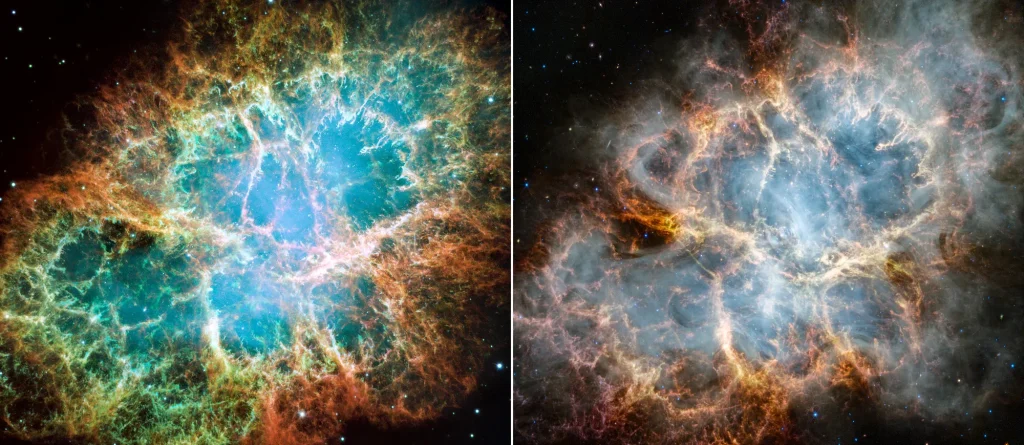
The heart of the Nebula is located by following the circular wave pattern, towards the bright white spot in the center. At a greater distance from the core, thin white ribbons of radiation are visible.
At the center left and right, the white material bends sharply inward from the edges and heads toward the location of the neutron star, as if the middle of the nebula is being squeezed. This sharp narrowing may be caused by the constriction of the wind's shape by a band of dense gas.
The wind produced by the core continues to push the shell of gas and dust outward at high speed. Within it, yellow-white and green spots form, forming large-scale loop-shaped structures that represent regions where dust grains are found.
See also: James Webb: Saturn and its rings in a magical image
The search for answers about the Crab Nebula's past continues as astronomers further examine Webb's data and consult previous observations of the remnant made by other telescopes. Scientists will have newer data to review within the next year or so after the supernova remnant is re-imaged. This will be Hubble's first contact with emissions from the Crab Nebula in more than 20 years and will allow astronomers to more accurately compare the Webb and Hubble results.
