

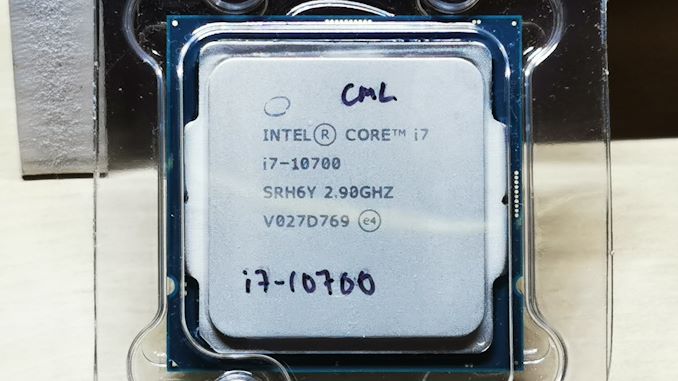
Over the years, Intel’s CPU lineup has introduced the overclocking “K” series of models and more recently the “F” series that lacks integrated graphics. However, the bulk of the lineup remains the versions , the “nones,” such as the 10th Gen Intel Core i7-10700. These processors have a TDP of 65W, while the overclockable models have 91-125W, but also have integrated graphics, unlike the “F” family. In this article, we will look at the importance of a processor’s TDP (thermal design power), while also comparing the Core i7-10700 and Core i7-10700K.

Intel's Core i7-10700 has a 65W TDP: Is it really 65W?
Understanding how Intel reports TDP values has gone through a mini-revolution in recent years. We've had nearly a decade of quad- core at 90W and 65W, and most of them would never hit those numbers even in "turbo" mode. However, Intel had to start increasing the core count. As we slowly climb the core count, from 4 to 6, 8, and now 10, those numbers seem "arbitrary" for a while.
The reason has to do with what TDP actually is. In the past, it was assumed that a processor's TDP rating was its maximum power consumption. In reality, a processor's thermal design power had almost no meaning unless absolute power consumption was taken into account. Intel defines its TDP in terms of a "base" frequency. TDP is the maximum power under a continuous workload, for which the base frequency is the minimum frequency guarantee. Intel defines a continuous workload at which the "turbo budget" has expired and the processor achieves its best frequency above the base frequency (but not in turbo modes).
Intel's TDP ratings only apply to the base frequency, not the turbo frequency. If a computer is built with maximum power consumption in mind, allowing a processor to exceed that power can have devastating consequences for the thermal performance of the system. Intel never lists turbo power levels (also known as Power Level 2 or PL2) along with other specifications, although they are technically included in the released specification documents
Motherboard manufacturers also have a say in a processor's performance. Because turbo power is an optional proposition from Intel, technically Intel will accept any value for the maximum turbo power and will accept turbo under any conditions if the motherboard manufacturer so desires. Motherboard manufacturers overspecify their motherboards to support higher turbo times (or overclocking), and so often ignore Intel's suggested PL2 values.
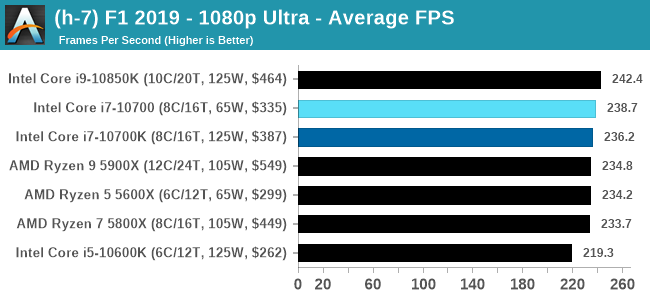
At this point, it's worth comparing the new Core i7-10700 to its overclocked counterpart, the Core i7-10700K. Aside from the suffix difference, the variant has almost double the TDP, and this is almost entirely manifested in the base frequency difference.
Even though the TDP is 125W vs. 65W, the maximum turbo frequency difference is only +300 MHz and the all-core turbo difference is only +100 MHz. In contrast, the base frequency difference is +900 MHz, and that's what the consumer ultimately pays for.
Intel likes to emphasize that the base frequency is the guarantee, however if a processor can achieve a higher frequency while power is limited, it will run at the higher frequency. This is how all AMD Ryzen processors work, however Intel only implements this when turbo is no longer available – it depends on the processor.
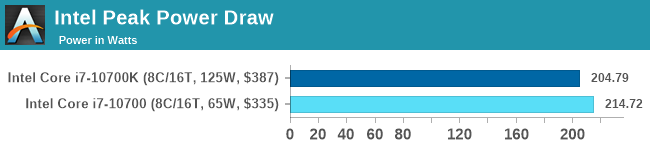
For turbo, as mentioned, Intel has recommendations for power levels and turbo timings in its documentation, but OEMs and motherboard manufacturers routinely ignore them.
The Core i7-10700 and Core i7-10700K are both members of the 10th Generation Core i7 “Comet Lake”. This means they are based on Intel’s latest 14nm process, but are essentially optimized versions of Intel’s 6th Generation Skylake Core, with the difference being that we have eight cores instead of four.
Both CPUs run dual channel memory at DDR4-2933 speeds and have 16 PCI Express 3.0 lanes with support for Intel 400-series chipsets. They are LGA1200 socket processors and are not compatible with other LGA115x motherboards.
Finally, in addition to the differences in power and frequency, another difference between the two CPUs is the price: The price of the Core i7-10700 processor is $335 (€275), while the Core i7-10700K is $387 (€318).
