

Governments around the world are struggling to address the public health and economic challenges of the coronavirus. While many have pointed out how authoritarian regimes have worsened the pandemic, we have so far focused dangerously little attention on the challenge of the coronavirus to democracy.
In democracies, citizens should be able to vote, politicians should be able to debate, and people should be able to move, meet, and act collectively. Democratic politics is a mix of mass participation and endless meetings. All of this is difficult when people can be infected with a potentially deadly virus if someone simply coughs near them. The obvious answer might seem to be to move democracy online ,but some parts of democracy translate poorly to an online world, while others are already being undermined by emergency powers (for example, Hungary’s parliament just passed a law allowing the prime minister to rule by decree) and by the rise of digital surveillance.
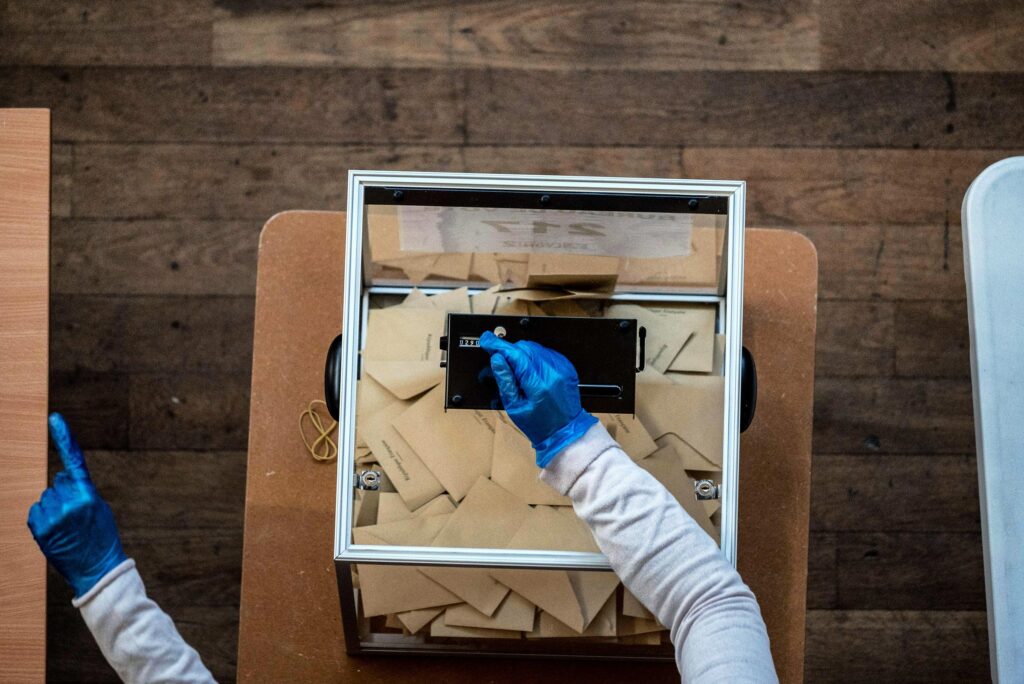
If people have to vote in person, they could be infected with the coronavirus from standing in line, pushing buttons, or handing ballots to poll workers. There is no doubt that 14 US presidential elections have been postponed so far. But postponing elections in the midst of a crisis was equally questionable, given that voting would see a dramatic drop in turnout.
The problem is even worse for elected politicians, who serve the people, holding rallies where they argue, shout, and vote (think the British parliament). Politicians may be more likely to get sick because they are nodes in densely connected social networks. They are more likely to develop complications because they are often older. Many politicians, including British Prime Minister Boris Johnson, have already been infected or quarantined. The government and Congress are slowing down as the legislature and judiciary suspend or indefinitely postpone their sessions.
The concept of democracy also exists in the streets, in political rallies, public meetings and demonstrations. It is difficult to see how these mass gatherings will return anytime soon if they continue to be dangerous or even banned for public health.
Finally, state efforts to combat the virus by monitoring citizens may undermine democracy by concentrating power in the hands of an unchecked authority. This can also happen from the bottom up. Citizens fearful of contagion may begin to prefer the idea of ubiquitous and decentralized surveillance as a service, as evidenced by the popularity of coronavirus symptom-tracking apps in the UK and elsewhere.
To see how these four problems can come together, look at Israel, which has held three elections in a year without being able to form a government. Now the country is struggling to cope with the coronavirus. If Israel goes back to the polls, citizens are at risk of infection. Israel’s parliament, the Knesset, was effectively suspended by its speaker, on the grounds that the coronavirus made voting and committee meetings dangerous . Meanwhile, the justice minister, another close ally, closed the courts on March 14. All of this means no parliamentary or judicial review of a new system to track coronavirus patients and those in their vicinity via their phones. Finally, protesters against the mass surveillance system were arrested for endangering public health by holding a public gathering. This has led some to claim that Israel is undergoing a palace coup, and we're not even going to mention the Palestinians in the West Bank or Gaza, who are facing the virus without democratic representation.
Some experts argue that information technology is the answer to democracy’s problems. There would be no risk of catching coronavirus if physical democracy became virtual. Already, government is getting bigger, electronic elections are an attractive prospect, and digital surveillance doesn’t seem as bad as it used to be.
But online voting systems, like Voatz, which was used in West Virginia in mid-2018, have critical security flaws. As cryptographer Matt Blaze says, many experts believe online voting is a bad idea. Online meetings also have drawbacks. Politics is about formal negotiation, but also gossip and informal enterprise. It’s hard to haggle over a camera, especially in a crisis. It’s even harder to move effective organizing and activism online. When people protest, they struggle to show that they care about a specific issue. Online activism, by contrast, often devolves into cheap click-tivism. It can also be misled and manipulated, creating the appearance of outrage on platforms like Twitter and Facebook.
As we try to protect democracy from the coronavirus, we must see technology as a scalpel, not a hammer.
Until we can secure digital voting systems, we shouldn’t use them. As Blaze argues, the problem is not only that such systems could be particularly vulnerable to hacking, but that they make it easy to undermine public confidence in the results of the vote. Voting by mail, combined with on-site checks and balances, remains the best option.
Virtual collaboration may be the best short-term substitute for parliaments, and it could have real benefits. A virtual congress would keep elected representatives closer to their constituents. But it would make it harder to coordinate on big issues and create a sense of collective accountability. Instead, widespread testing for the coronavirus could reduce the medical risks faced by politicians (as well as others who participate in public gatherings), allowing a return to normal politics even before a potential vaccine is developed.
More importantly, action against the coronavirus could erode fundamental democratic rights. There are urgent short-term reasons why we would want to use geolocation by phone, along with testing to track transmission and rapidly isolate infected people, as we have seen in Taiwan, South Korea, and Singapore. There are also long-term risks to democracy if these kinds of surveillance are not limited to fighting the disease and are not phased out once they are no longer necessary. If we are very lucky, we will have modest, targeted, and temporary measures that will be effective against the pandemic. If we are not, we will create an open, pervasive surveillance system that will undermine democratic freedoms while doing little to stop the coronavirus.
