

European Cyber Security Challenge 2017: The ten-member National Cyber Security Team was in Malaga, Spain, where the final of the major pan-European cybersecurity competition, European Cyber Security Challenge 2017 (ECSC '17), was held between October 30 and November 3, 2017.
The Greek team ultimately ranked 12th, down from the 1st place it held for most of the competition, after a questionable competition process designed by the Spanish organizers.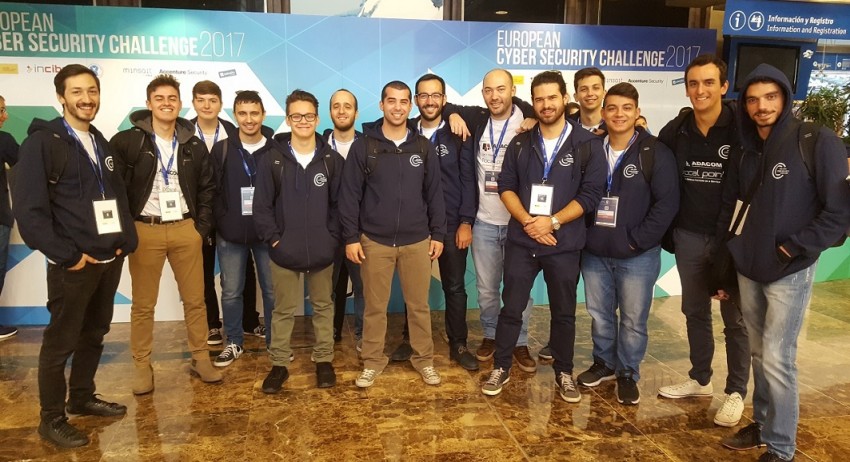
Competition timeline
Initially, the competition was delayed by over an hour due to technical problems. With the start of the competition process and while the technical problems had been partially resolved (as only 15-20% of the tests that had been planned were available), the Greek participation started strongly, remaining in 1st place for over 5 whole hours! Then, the competition platform collapsed, followed by a manual competition process, in which confusion prevailed, both in the distribution of the exercises among the 15 competing countries, and in the collection of the results. The distribution of the challenges was now done via USB memory sticks to each team separately. This process was considered flawed, as there was no central coordination and control of the material / challenge distribution. During this time, the scoreboards went out and the teams did not know their position. Each competing team that unlocked a challenge and won the flag (based on the Capture-The-Flag training process) handed it over on "papers" to the jury, which in turn recorded (now manually) the score.
The long competition process continued in the same way, with problems remaining and worsening instead of being resolved. The national teams, given the situation, competed without a goal, without a strategy, and without any information.
A few hours before the end of the competition (which had already been postponed for 2 hours later), more specifically around 16:00 and while improvised scoreboards were set up, Greece, from 1st place, appeared in the penultimate 14th place, without a clear picture of its victories and defeats per test.
The announcement of the results
The above development did not help the jury to decide on the final ranking in an absolute and transparent manner, resulting in a marathon of consultations. After the completion of the competition process, the Greek participation failed (according to the jury) to be distinguished in a high position and late in the evening, during the official dinner, it was announced that it shared 7th place with other teams. The next day, the jury came back with a new announcement where the Greek team finally took 12th place.
"A safe conclusion that we can draw from the European Cyber Security Challenge 2017 is that a lot of work and effort is needed, both at the European and national levels, to improve the know-how and skills of all of us in the field of cybersecurity," according to the head professor of the Greek mission, Mr. Christos Xenakis.
The organizing team of the national mission would like to thank the members of the national team, both for the competitive effort they made, and for their ethos and behavior during the competition. The University of Piraeus, as the central body of the National organization, will continue the effort of our country's participation in the ECSC in the coming years, aiming at the continuous education of our youth in the field of cybersecurity, which is also a key objective of the competition.
Finally, the national team that participated in ECSC 2017 would like to warmly thank the sponsors and supporters of this effort and declare that it will continue to work to establish a national line of defense for Cyber Security.
