

The US Army, wishing to find a solution to the problem of lack of communications in hard-to-reach areas, is attempting to convert unused drones into aerial Wi-Fi signal transmission systems .
The Mobile Hotspots program has been taken over by the usual suspect DARPA (Defense Advanced Research Project Agency), the research arm of the US Pentagon. The main concern of the program is to achieve the ability to transfer data, via drones, up to one gigabyte (GB) per second.
The idea was born from the existence of a multitude of unused Unmanned Aerial Vehicles, which can remain in the air for several hours. At the same time, there was also the relative impetus from the successful tests of corresponding civil programs.
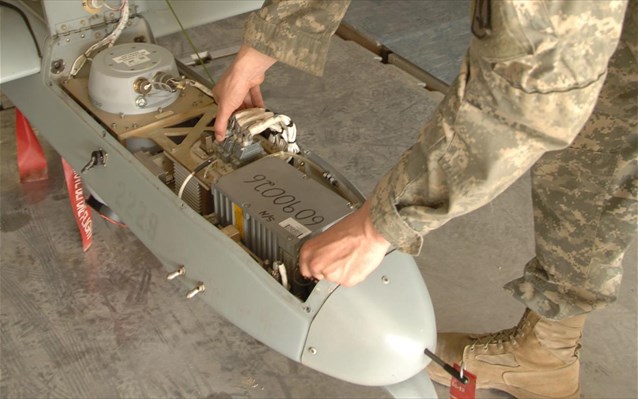
The main problem is in principle the placement of the appropriate equipment on the drones. DARPA researchers have developed small antennas that operate at particularly high frequencies, as well as special amplifiers that can promote the signal, while at the same time producing half the noise compared to common amplifiers.
All of this equipment is placed in a shell that is about 20 centimeters long and weighs less than 9 kilograms. The shell of this category can be placed on light drones such as the RQ-7 Shadow that is 3.5 meters long and weighs about 84 kilograms. Carrying this equipment, a Shadow can remain in the air for nine hours.
As noted in Medium, the next step is to successfully adapt the equipment to drones and begin testing. If the project is successful, the aerial hotspots are planned to accompany US ground forces personnel when they are deployed to remote areas with non-existent or damaged infrastructure.
