

Six full months after the rover arrived on Mars, NASA engineers decided that Curiosity was ready to start drilling. For the first time in the history of space exploration, researchers will be able to study samples from the interior of an alien rock.
After last week's drill, Curiosity's rotary-percussion drill bit drilled a 6-centimeter-deep hole into a flat, sedimentary rock. In the coming days, the fine-grained dust sample will be transferred to the rover's onboard laboratory instruments to confirm that the rock formed in the presence of water.
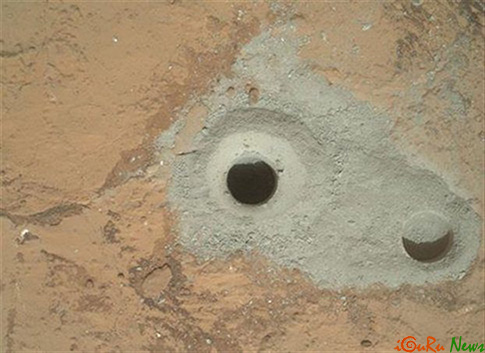
In the Gale Crater basin that it is exploring, Curiosity has already identified rounded stones believed to be pebbles from an ancient river. Chemical analyses are now expected to provide new clues about Mars' wet past, and perhaps lead to the discovery of organic substances associated with life.

Curiosity landed in Gale Crater in August 2012 (NASA/JPL-Caltech)
The first drill
The robot's drill—the first drill on any space mission to date—is designed so that the dust it creates passes through grooves in the nose and ends up in small chambers. From there, it can be transferred to ChemCam, a camera that determines the chemical composition, as well as SAM, a series of spectrometers that provide more information about the chemistry of the samples.
In the first phase, however, the dust collected from the first hole will rotate inside the drill, in order to scrape and remove any particles of earth dust, which could affect the results of the analyses.
The process is also delayed by the slightly longer Martian day than Earth's. Each Martian day, known as a sol, lasts 24 hours and 40 minutes, a difference that gradually decouples communication with researchers. This means that each robot movement must be planned two sol in advance.
