

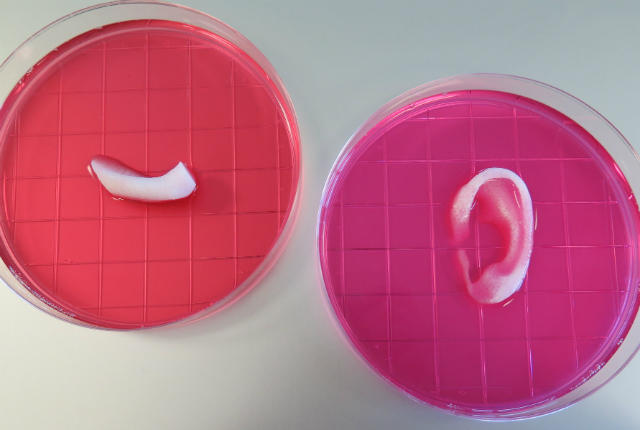
3D printing has helped us make plastic ornaments, phone cases, figurines, and splints for broken arms. And now it can help us by making new ears!
Researchers from the Wake Forest Institute for Regenerative Medicine published a study in the scientific journal Nature Biotechnology, detailing a new 3D printer that can build biocompatible tissues for use in transplants, including muscle, cartilage, bone and an entire human ear.
The 3D printer, called the Integrated Tissue-Organ Printer (iTop), has overcome some of the hurdles in 3D printing that have prevented researchers from creating stable, human-scale tissue constructs. A member of the research team, Anthony Atala, said the team prints the structures with cell-laden hydrogels, which act as a kind of “bio-ink.” But using hydrogels is only the first step in making the tissue successful and stable.
“One of the major limitations of nature is that tissues or cells will not survive in a volume larger than 100-200 μm, which is about 0.1 to 0.2 mm. The cells need to be close enough to the capillaries that carry blood to get the necessary ‘nutrition’ and survive through diffusion. “What we did with the printing technology is create microchannels in the structure, which allowed nutrition to pass through and allowed us to essentially overcome nature’s limit,” Atala said.
To test the effects of this new 3D printing technology, the Wake Forest team implanted the 3D-printed tissues into rats in the lab. They then analyzed them after 5 months, finding newly vascularized tissue in the implants and no necrosis.
Tissue modeling is done by taking a digital model of the body part or tissue section and translating it into a software program that controls the Itop. This means the printer is capable of creating any size or shape given to it, and is completely customizable.
