

All that the Internet throws at you…
Sometimes they are natural cynics, liars who enjoy deceiving, narcissists who want to occupy, and other times angry critics of what they consider badly written works. In online trolling everyone, good and bad, fits. Some undermine common sense, others mock the world's absurdities. However, what is the limit of satire and banter, and at what point do the jokes and insults begin?
What worries me on social networks is that the ethics of communication collapses under the weight of an ever‑inflating narcissism. In New Media, trolling takes on uncontrolled dimensions not only quantitatively but also qualitatively – Elsa Deligianni, associate professor in the Department of Journalism & Media of the Aristotle University of Thessaloniki
The right of reply and correction does not apply in the case of trolling, as opposed to the press and broadcasting. The legislator does not provide protection of the right regarding electronic crimes and the Information Law is still limited – Anastasia Doulkiri, Communications professor at Aristotle University of Thessaloniki
***
Years ago, in the era when magazines defended with hysteria a flamboyant lifestyle, I had sat in the defendant's dock for an article titled «Viva Miracolosamente», in which together with my journalist colleague we satirized the top miracles of domestic Christianity, elevating them to images of everyday life and madness. «Write whatever you want», the legal counsel of the publishing house we worked for had told us after the acquittal, «but leave religion out of it». At that time the word trolling didn't exist in our vocabulary and Facebook was an unknown place. Fifteen plus years later, everything is different, yet fundamentally the same.
Trolling has now become the permanent accompaniment of every «serious»» news item. Its confusingly clear and blatantly ambiguous nature confuses and misleads. At times it tells painful truths and humorously attacks badly written pieces, and at other times it caresses the hairy chest of the monster. It is not uncommon for extremist and violent social groups to hide behind it, groups that do not stay within simple news reproduction, opinions and comments focused on satire or coarse jokes. It is not uncommon for trolling to have crossed the boundaries of profanity. It is not uncommon for the reader to not know whether the one who trolls—always anonymously— reacts to the badly written pieces, fights the absurdity of the current authority, or supports it like a broken wagon. The enigmatic nature of the extremes is justified once again.
«In Internet language, the word troll (troll) describes an Internet user with mischievously provocative, deliberately foolish or deliberately off‑topic positions and opinions in an online open community, such as a discussion forum, mailing list, chat room or blog, with the primary intention to provoke and irritate other users or in any way cause disruption to an online discussion on any topic and to achieve a chain of reactions from other users. This behavior is often accompanied by a controversial dispute among the others about its purpose», continues Wikipedia, interpreting the new cyber‑space “cobweb”.».
The trolls, the ugly creatures of Norwegian mythology, something like our own goblins, constituted - according to some conjectures - the inspiration for naming this digital communication, giving it something of their otherworldly ugliness, but also of their lively personality. At this point the comic-tragic element of the story smiles with the same sardonic grin that the crude depiction of the troll has. Is it possible that there are people who believe in the «truth» of the troll? Is it possible that there are people who are unable to distinguish mockery from the actual fact? Is it possible that there are people who believe that they are spraying us? That the Earth is flat? That the woman with three breasts is real?

Satire, parody or insult?
And while ubiquitous lawyers try to incorporate new chapters into the criminal code, in an effort to delimit trolling from cybercrime, isolated cases of trolls have already been sentenced. Among the best-known trolling cases in Greece is the case of «Gerontas Pastitsiou», a satirical website, which in 2012 invented and published an alleged posthumous miracle of a Mount Athos monk, Gerontas Païsiou. The creator of the humorous page on Facebook, Filippos Loïzos, was found guilty last January for «offending religion» and was sentenced to 10 months imprisonment suspended, after a parliamentary question to the Parliament (September 2012) by the Golden Dawn MP Christos Papa, in which he claimed that «the user insults, mocks and tries to demean the sacred form of Greek Orthodoxy, Gerontas Païsiou». However, the court decision was criticized negatively by social media, legal circles, and the press.
«Dogmatism is included in the concept of trolling, as is extreme humor or spreading misleading news just for fun. Certainly, however, in the case of Elder Pastitsios it is not an insult to religion. And I consider the reaction of religious organizations excessive and extreme, without, of course, being surprised by’ it. Nevertheless, in general, what worries me on social networks is how the ethics of communication collapses under the weight of an ever‑inflating narcissism. In New Media, trolling takes on uncontrolled dimensions not only quantitatively but also qualitologically», says Elsa Deligianni, associate professor at Aristotle University of Thessaloniki in the Department of Journalism and Media.
 And while in Britain legal actions are being pursued in relation to cyberbullying (cyber bulling) and in Arizona, USA a law is being voted on according to which the «evil» troll will be imprisoned for up to 25 years, in neighboring Turkey Kıhat Akbel, known for his provocative posts, was sentenced to 5 months in prison after launching a campaign with hashtags against singer Alim Aslim. Specifically he said «we must go to her concert and throw a hammer at her head». Apparently because the 35‑year‑old Aslim, born in Germany, an alternative rock singer, has repeatedly criticized the Erdogan government. And on the ’ other hand, in September 2013, a Turkish court sentenced the famous pianist Fazil Sai to 10 months in prison for Twitter posts that were deemed religious insults. The two sides of the same coin and the troll in the middle, playing the role of a balancer.
As far as our country is concerned, “if it is classified as satire or parody, trolling may fall within the regulatory field of freedoms of expression and art and enjoy their protection»,” explains Elsa Deligianni. But if it is not classified as “satire or parody»?” then it may end up in a condemnatory judgment by the courts, since, as the professor points out, “freedom of expression and of the Press gives rise to ‘duties and responsibilities’ and can be subject to restrictions; under article 10 of the European Convention on Human Rights, satire is also subject to restrictions.” According to the case law of the Greek courts, the ECtHR and the European Court of Human Rights, the limit of satire is defined as human dignity and personality in all its manifestations» and concludes: “Especially under the ECtHR (see Lazopoulos/Dennis case) the limits of satire are determined by the constitutional criterion of program quality, which, according to the Constitution, must in turn have the qualitative level imposed by human dignity».
The anti‑trolling strategy
Meanwhile, while trolling tightens its ropes to make its first big jumps, an anti‑trolling movement is devising defensive strategies against trolling. On the antitroller.blogspot.gr website, the instructions are clear: “How should we all deal with a troll? The people who post such messages do it to attract attention and cause a stir. The most basic rule is: The best answer is not to answer. If you give it attention and continue the logic (or lack of logic) of the troll's post, you contribute, unintentionally, to the noise and annoyance the troll wanted to cause. It is advisable, before giving any answer, to think about the following:”
 * Have answers already been given by others?
* Is my answer going to add some information that others possibly don't already know?
* Will the issue be resolved, or does the discussion seem like it will end up in an exchange of accusations, or even insults?
* Should I send a PM to answer, instead of posting my answer for everyone to see?
* I will regret later the content of those I post?
Guidelines/questions that touch the boundaries of existent existence. As if the exquisite anxiety of «being» automatically turned into trolling. Or perhaps we are simply talking about a trend?
«Aside from the fact that using the Internet is a “trend”, it is an easy way of communication and relatively inexpensive, suitable for people who are not familiar with using books. The audience is therefore broadened. Especially regarding trolling, it is facilitated through the use of the Internet. Despite the fact that the Internet encourages dialogue, this dialogue is not substantive, as it excludes immediate response, personal contact and interaction», says Anastasia Doulkere, Professor of Communication in the Department of Journalism and Media at Aristotle University of Thessaloniki, and continues: «Anonymity is especially important, especially for individuals who lack the courage or ability to express themselves freely (usually they are timid or introverted characters). The science of Communication supports that people express themselves freely when they do not disclose their identity and especially when addressing an unknown audience. Trolling is called the “pulling” (from the English troll) of a discussion with the main purpose of causing confusion, unrest, disruption, intense disputes among members of an online discussion group. Specifically, the sender, in this case the creator of the “pulling” of the discussion, regains his “power” within the framework of his communication with the receiver, in this case the users and members of open online communities, who become powerless. The right of reply and correction does not apply in the present case, unlike what happens in the Press and Television. The legislator does not provide protection of the right regarding electronic crimes and the Information Law is still limited», explains Anastasia Doulkere.».

«Troller is anyone who claims to perform miracles»
However, what could be the deeper psychological motives of a troll? For the topic we turned to the perspective of a psychiatrist, Konstantinos Kanellakis, asking him to shed some light on the labyrinth of the mind of a trolling fanatic. «I consider trolling either the deliberate and on purpose spread of false news, with the aim of real or psychological benefit, or the doctrinal and provocative projection of positions that aim at the fixation of ideas and the suppression of questioning, dialogue and communication. In no case do I consider trolling satire or the projection in an unorthodox, even provocative way of positions that promote questioning, communication and truly highlight political, social and other problems», says the psychiatrist, setting a limit within the chaos of cyberspace.
 «To give an example, using the case of Pastitsios. I do not consider Pastitsios a troll, in the sense I mentioned above. On the contrary, in my logic, a troll is anyone who claims to communicate with God, prophesies the future, or performs miracles. Because he shapes public opinion in a dogmatic and absolute way, not with arguments and ideas, but relying on fear, awe and superstition. And this is done for the purpose of personal gain, e.g., power, respect, prestige, the fueling of narcissism. Because if this does not hold, then we are talking about madness. Whoever stigmatizes and provokes this absurdity, as well as the foolishness of the credulous, is not a troll, in my opinion, with the malicious meaning. In this case, anonymity, although it continues to lend prestige to the writings, is also self‑protection».
And Konstantinos Kanellakis concludes: “We continue in the year 2014 to live in a country where the Church has not been separated from the state and where fanaticism continues to be a danger. Which, moreover, was demonstrated by the lifting of confidentiality and the condemnation of Pastitsios. In my personal opinion, the prosecutorial official who ordered the lifting of confidentiality, in any favorable and rational society should already be available and be prosecuted criminally».
Epilogue: The famous butterfly, from chaos theory, is beginning and looks more and more like a silkworm again.
«Greek society cannot tolerate self‑criticism»
In my opinion, trolling is done by smart people - I make it clear that I do not consider myself smart - and sensitive, who have something to say. People you want to meet. You will not meet apolitical trolls or those who belong to the far-right space 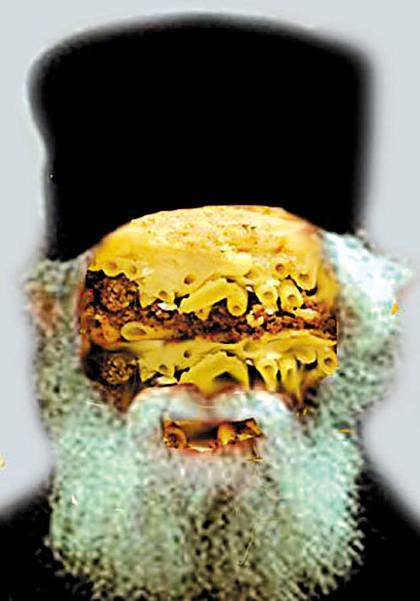 * Give me your own definition of trolling.– Trolling requires a victim and an aggressor, who, with the appropriate techniques, will force the former to deal with him in order to ridicule and expose him. The word comes from the English trolling, which means fishing with the process of dragging bait. On the Internet, trolling is also encountered in mass form with coordinated attacks by organized trolls with common goals, which goals can be individual persons (e.g. politicians, journalists, bloggers) but also social groups, e.g. political parties, organizations, a specific ideology or mentality, etc. My page was mainly satirical in nature, I used trolling in very specific cases, such as a fake miracle I had fabricated, which was subsequently seized upon by religious people as real.* What was the message you wanted to convey through this page?– It is common in Greece, in times of crisis or turning point, for reactionary voices to appear that preach fanaticism and messianism. In Greece, fundamentalists are usually the ones who have the greatest impact and are not necessarily figures from the Church. They can be parareligious organizations, televangelists and the far-right press. The figure of Paisios was systematically cultivated by far-right circles as a symbol of nationalist fundamentalism and unfortunately had a great impact. The ultra-conservative and far-right press built a large profitable industry around the salvation and intolerant rhetoric attributed to this particular monk. Rhetoric that I could not help but criticize. That is how the page came about. The message was clear. Do not believe in prophecies and miracles, because they are fabrications of con artists whose sole purpose is to manipulate, fanaticize and exploit the masses. Every week a new “miracle” emerged and almost every day a prophecy was “completed” that was validated by the “signs of the times”, after they had first been appropriately interpreted by the “expert” peddlers of hope and salvation.
  * What was the atmosphere like in court?– In court, I was treated very aggressively by the judges, who, since they were unable to identify anything insulting or blasphemous in the case file, since my satire was not religious but social, tried to discredit me as being in bad taste and obsessive. The charge I have been charged with is the repeated insult of religion, but I was ultimately sentenced to 10 months for intentional insult, because I did not impose censorship on visitors to the page who posted material that offended religion. The Internet is a form of virtual direct democracy that enables dominated groups to react against dominant groups. Internet censorship is a common phenomenon in Eastern countries, including Greece. My conviction was a warning to future generations.* Where does the lie end and the truth begin in trolling?– There is no lie in trolling, because it is not something that is done arbitrarily for the sake of fun alone (those who do this go unnoticed) nor does it carry the illusion of a keyboard revolution. Trolling acts in a targeted manner and I think it is not something easy. In my opinion, it is done by agile people - I clarify that I do not consider myself agile - and sensitive people who have something to say. People you want to get to know. You will not meet apolitical trolls or those who belong to the far-right space. It is difficult to say what is an insult and when the reputation of a person, the state, God, etc. is affected. Let's say that trolling also uses abusive methods, because it can have satirical moods - I avoided it, because I wanted to be heard - or aggressive towards a group, which as I said before you believe dominates you and with the help of anonymity you can avoid the consequences. Besides, to what extent could we now characterize the insult as not politically correct, with the neo-Nazi rhetoric that characterizes with all too much ease entire social groups as subhuman and trash even within the Parliament, or the sermons of hatred against homosexuals by ecclesiastical figures without anyone's ears sweating?* Do you think that Greek society lacks humor?– No society lacks humor. The issue is whether it lacks satire, as we Westerners know it. The groundbreaking satire of Aristophanes, for example, which criticizes and raises questions. Greek society cannot tolerate such satire, because it cannot tolerate self-criticism. There is humor, but not satire, and if there were, it would have no audience.
