

In an era where cyber threats and physical hazards overlap, the need for a unified defense has never been more urgent. Hospitals, universities and airports are faced with scenarios in which a digital incident – such as a network scan – can work in concert with a physical intrusion. Until now, most security tools have addressed these dimensions separately. The ARGUS, however, is changing that landscape: it promises protection against both physical and cyber threats.
Developed by researchers at Ştefan cel Mare University in Suceava, Romania, ARGUS is a next-generation mobile security system that combines artificial intelligence, computer vision, and cyber-event analysis. It aims to provide a unified view of security — from what’s happening on the network to what’s happening physically in space.
From patrol to network — and vice versa
ARGUS is not a simple patrol robot. It is a complex “cyber-physical system” that simultaneously perceives the environment around it and the internal network of the infrastructure in which it operates. With high-resolution cameras, LiDAR sensors, ultrasound, GPS and microphones, it can recognize people, vehicles or suspicious objects, while also “listening” for sounds such as gunshots or screams.
See also: Chinese company created incredibly realistic robotic head
On the digital front, ARGUS integrates intrusion detection tools such as Snort and Suricata, which allow it to detect network attacks, port scans or suspicious traffic. Its real advantage, however, is that it connects the two fields: if, for example, it detects an attempt to physically access an area at the same time as cyber activity from the same IP range, it can identify a coordinated incident.
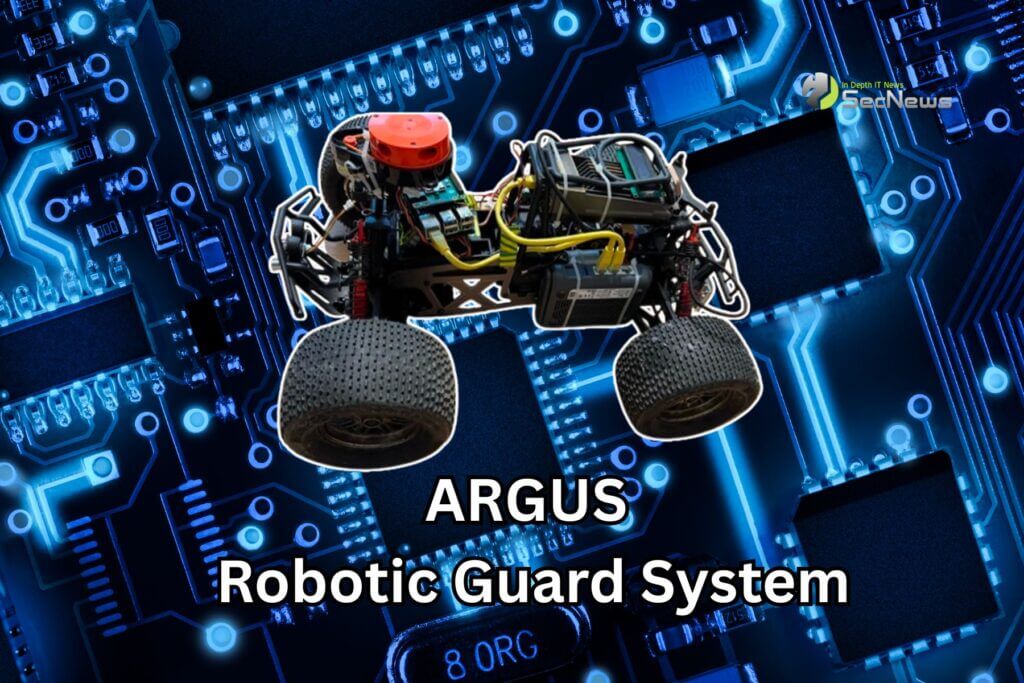
ARGUS’s logic is based on what’s called “edge architecture” — that is, it processes data locally, without sending it to the cloud. This approach improves speed and reduces the risks of data leakage, which is critical in environments like hospitals or university campuses where personal data is sensitive.
Smarter surveillance with artificial intelligence
ARGUS uses computer vision algorithms such as YOLOv8 (You Only Look Once) and MediaPipe to recognize faces, vehicles, and weapons. During its testing, it achieved 92.7% accuracy in face recognition and 89.3% in weapon detection — impressive figures for realistic conditions.
In practical terms, this means that the robot can control access points, identify authorized users and notify in real time of unauthorized attempts. All actions are recorded with a time stamp, allowing full traceability and aiding compliance with international security standards, such as ISO 27001 and GDPR.
See also: Robin: A robot that keeps children company in hospitals
How is “cyber-physical” defense organized?
The heart of the system consists of a cluster of computing units: Raspberry Pi for video and biometric processing, ZimaBoard for cybersecurity, and Arduino for environmental sensors. This separation allows for parallel execution of processes and continuous operation even if one subsystem is out of service.
The software, written primarily in Python, uses technologies such as OpenCV and RabbitMQ for real-time data and alerting. With a detection latency of less than one second, ARGUS is considered one of the most efficient systems surveillance presented to date at the academic level.

The next generation of security for "smart" infrastructures
The usefulness of such a system is obvious in infrastructures where cyberattacks can be combined with physical intrusions — such as airports, hospitals, universities, and even industrial facilities. A security breach may not necessarily be initiated by a hacker, but by a person with physical access acting in coordination with a digital attack.
ARGUS aims to fill this gap by offering an early warning system that integrates signals from physical and digital sensors. In addition, its researchers are planning future extensions, such as blockchain integration for tamper-proof event recording, 5G support for faster synchronization, and defense mechanisms against deepfake or spoofing attacks.
See also: Ant Group R1: The humanoid robot that will compete with Tesla Optimus
🔒 Protect your privacy with Proton VPN
Swiss VPN from the creators of Proton Mail — strict no-logs policy, strong encryption, and built-in NetShield that blocks ads, trackers, & malware.
- ✔ No-logs, based in Switzerland (except 14-Eyes)
- ✔ NetShield: blocks ads, trackers & malicious domains
- ✔ Covers all devices — free version available
The link is an affiliate link — SecNews may receive a commission at no additional cost to you. It does not affect the independence of our article writing.
Challenges and prospects
Despite its excellent performance, ARGUS faces limitations. Its accuracy decreases in low-light conditions or in crowded environments with obstacles. It was also trained on relatively small datasets, something its creators acknowledge and plan to expand in the future.
However, the fact that an autonomous robot can perceive, combine and react to both physical and digital threats in real time opens up new avenues for the future of security. ARGUS points the way towards a model of “unified situational awareness”, where information flows seamlessly between the two worlds.

The development of ARGUS signals a clear shift in the philosophy of security: the digital and the physical are no longer separate domains. The infrastructures of the future will need “smart guards” that understand both, analyze patterns, and predict risks before they become disasters.
With the increasing sophistication of attacks and the rapid spread of artificial intelligence, ARGUS is not just a security robot — it is a prelude to the next era of cyber-physical defense.
