

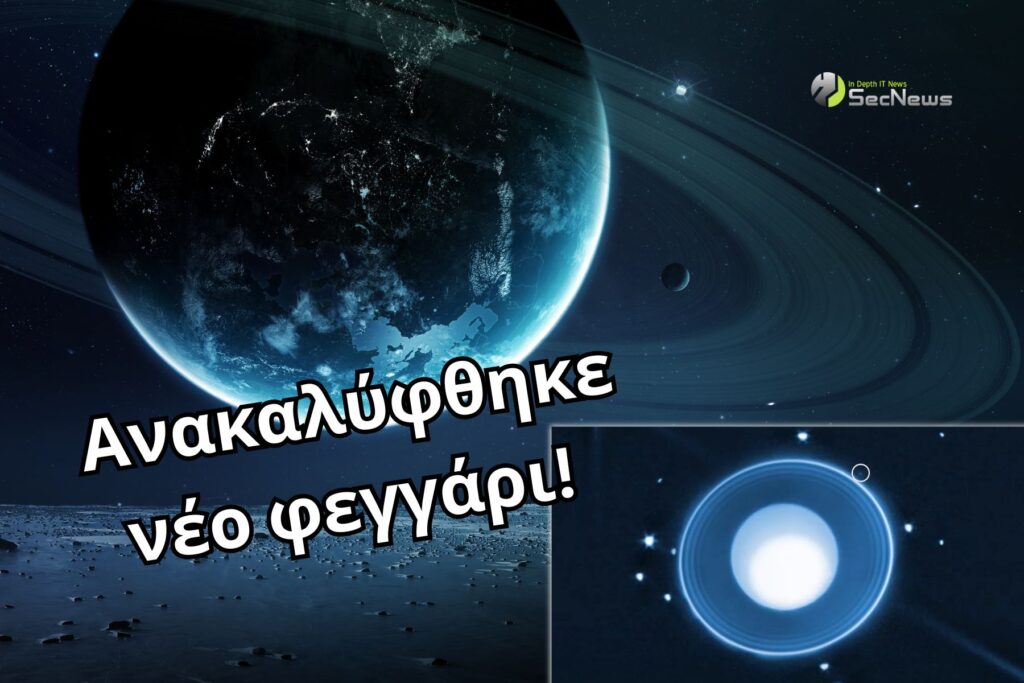
A major discovery has shaken up planetary astronomy. Using the groundbreaking capabilities of the James Webb Space Telescope (JWST), astronomers have spotted a new, tiny moon orbiting icy Uranus, the seventh planet from the Sun.The moon, tentatively designated S/2025 U1, is just 10 kilometers across, making it invisible to older telescopes and detectors.
The discovery was made by a team of scientists at the Southwest Research Institute (SwRI) in Colorado, who used the James Webb NIRCam camera. The result of this observation was the detection of the small satellite, bringing the total number of known moons of Uranus to 29.
See also: Saturn: 128 new moons discovered in orbit around it
A satellite in a "hidden" orbit
S/2025 U1 is located about 56,000 kilometers from the center of Uranus – a small distance compared to Earth's Moon, which orbits at 384,000 km. The satellite moves in a nearly circular orbit, which suggests that it likely formed in the position where we find it today, rather than being captured from elsewhere.
Its location puts it among a "neighborhood" of small inner satellites, which are located within the orbit of Uranus' larger moons: Miranda, Ariel, Umbriel, Oberon and Titania. It is worth noting that most of Uranus' moons have derived their names from Shakespeare's works, a tradition that will continue with the new S/2025 U1, when the International Astronomical Union (IAU) gives it an official name.
Uranus: A planet with a chaotic history
Uranus is not only known for its extreme tilt on its axis, but also for the complex system of rings and moons that surround it. The planet has 13 rings, which are quite dark and difficult to observe compared to the impressive rings of Saturn. Its inner moons appear to interact dynamically with these rings, helping to maintain their shape.
"No other planet has as many small inner moons as Uranus," said Matthew Tiscareno of the SETI Institute in California. "The interactions of these bodies with the rings create a chaotic scene that blurs the lines between a classical ring system and a moon system." The fact that S/2025 U1 is smaller and fainter than the known inner moons supports the idea that there may be other, unseen bodies that we haven't yet detected.
See also: Resilience: Japan is “going” to the moon again
From Voyager 2 to James Webb
The last time Uranus was the focus of a major space mission was in 1986, when Voyager 2 flew by, providing the first close-up images of the ice giant. At the time, scientists only knew of five of its moons. Four decades later, technology has advanced, and the James Webb spacecraft is here to continue that exploration in stunning detail.
Maryame El Moutamid, lead researcher at SwRI, said: “The discovery of S/2025 U1 demonstrates how modern astronomy continues to build on the legacy of missions like Voyager 2. Now, nearly forty years later, we can look deeper and clearer than ever before.”

What does this discovery mean?
Finding such a small moon isn't just another "box" on a list. In fact, it reinforces the theory that the Uranus system is much more complex than we thought. The interactions between moons and rings suggest a history full of collisions, rearrangements, and possibly lost moons that broke apart or merged with other bodies.
At the same time, the discovery highlights the crucial role of James Webb. If the telescope can detect a satellite just 10 km in diameter at such a great distance, then it paves the way for even more detailed studies of the outer planets and their satellites. In addition, it offers crucial clues about the process of moon formation and the long-term evolution of our solar system.
See also: NASA: Nuclear reactor on the Moon by 2030
The future of exploration
The scientific community has already begun pushing for a new mission dedicated solely to Uranus and Neptune—the two “forgotten” ice giants of our solar system. Such a mission could reveal even more details about the composition of their atmospheres, their magnetic fields, and their complex moon and ring systems.
Until then, James Webb continues to act as a window into the unknown, proving that even in the most studied planets, there is always room for new discoveries. Little S/2025 U1 is just the beginning.
