

In late 2019, the galaxy SDSS1335+0728 suddenly began to shine brighter than ever. To understand why, astronomers used data from a variety of space and ground-based observatories, including the European Southern Observatory's Very Large Telescope (ESO's VLT), to track how the galaxy's brightness was changing. In a recent study, they conclude that they are witnessing changes never seen before in a galaxy —likely the result of a supermassive black hole at its core waking up in real time.
See also: New massive black hole detected in our galaxy
“Imagine that you have been observing a distant galaxy for years, which has always seemed calm and inactive,” says Paula Sánchez Sáez, an astronomer at ESO in Germany and lead author of the study accepted for publication in Astronomy & Astrophysics. “Suddenly, its [core] starts to show dramatic changes in brightness, unlike any typical events we have seen before.”

This is what happened with SDSS1335+0728, which now has an active galactic nucleus (AGN)—a bright compact region powered by a supermassive black hole—after brightening dramatically in December 2019.
See also: Scientists discovered water in a black hole light years away
Certain phenomena, such as supernova explosions or tidal disruption events – when a star gets too close to a black hole and breaks apart – can cause galaxies to suddenly brighten. But these brightness variations typically last only a few dozen or, at most, a few hundred days. The galaxy SDSS1335+0728 is still getting brighter, more than four years after it was first seen to “ activate ,” leading scientists to believe that a black hole is waking up. What’s more, the variations detected in the galaxy, which lies 300 million light-years away in the constellation Virgo, are unlike any other, pointing astronomers to a different explanation.
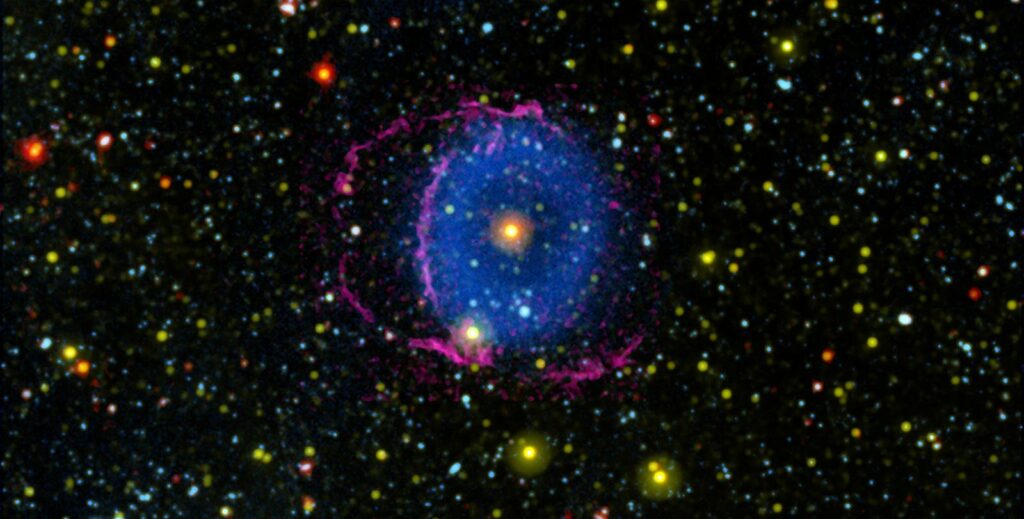
The team sought to understand these brightness variations using a combination of data and new observations from various facilities, including the X-shooter on ESO’s VLT in the Atacama Desert in Chile. Comparing data taken before and after December 2019, they found that SDSS1335+0728 now radiates significantly more light in ultraviolet, optical and infrared wavelengths. The galaxy also began emitting X-rays in February 2024.
See also: Black holes may be buried inside galaxies
Supermassive black holes—with a mass over a hundred thousand times that of sun —exist at the center of most galaxies, including our own Milky Way.
Further observations are still needed to confirm that this is a waking black hole and to rule out alternative explanations. Another possibility is that we are seeing an unusually slow tidal disruption event or even a new phenomenon. If this is in fact a tidal disruption event, this would be the largest and faintest such event ever observed.
Source: phys
